Recent listening, current

Saturday, August 31, 2013

129. Hank Jones and Frank Wess / Hank and Frank (2006)

Requiring no introduction, Hank Jones and Frank Wess have one of the best jazz albums of the past 20 years. Aside from Jones and Wess, bassist John Webber (try "You Made a Good Move") guitarist Ilya Lushtak, and drummer Mickey Roker make an appreciable impact, too. This is uber classic jazz with universal appeal. The joy in listening, for me, comes from how together the group is. Playing this music is beyond natural to the co-leaders and on the record, the product of their skills sounds as easy as breathing. Wess doubles on tenor and flute. To make a play on that line about "breathing," try listening to his beautiful lines on ""The Very Thought of You." There is a wide variety of material from blues to bossa nova, and don't miss the four originals by Wess or the tune by Mr. Parker like "Barbados." Best of all, if you can't get enough of Hank and Frank then you can always buy the second volume. Yes, there is a second volume.

Friday, August 30, 2013

128. Rabih Abou-Khalil / Blue Camel (1992)

Like Bukra, 1992's Blue Camel is a stimulating set of jazz fusion with roots in traditional Turkish and Middle Eastern music. Rabih Abou-Khalil's catalog is like a treasure box filled with gems but I think this collection ranks among his best efforts. Instrumentation (alto sax, oud, frame drums, percussion, trumpets, and bass) is similar to the aforementioned Bukra and has similar personnel in Ramesh Shotham. Certainly Charlie Mariano is capable of fusing these disparate musical worlds, and his improvisations with the alto are notable. The album begins with Mariano's tacit, contemplative solo introduction to "Sahara." It sounds like a gently intoned prayer, wafting melodiously through the speakers until Abou-Khalil and the group's other voices join him one by one. Kenny Wheeler on trumpet and flugelhorn is a good choice and his sound adds additional depth to the band. His technique treats the music nicely, like the nimble fingered flair in "Tsarka" and elsewhere. The arrangements develop the compositions with patience, and there is much interplay with the percussionists, which is integral.

Tuesday, August 27, 2013

127. The Dave Brubeck Octet (1950)


I find this, the Octet's only studio album, a roaring good listen. I enjoy it alongside the Birth of the Cool by the Miles Davis Nonet. Both are similar in size and in their means of repurposing, so to speak, some of our more venerable standards like "What is this Thing Called Love" or "September in the Rain." The group's personnel is notable too, considering their different trajectories after the Octet: Tjader became known for the vibes, Van Kriedt for education, and Collins for Woody Herman. The pieces have tight arrangements that sound cool and loose, reeling with the energy and excitement of dixieland. But there's an ever present discipline behind them, too, and the innovation of infusing jazz with classical forms of writing and arranging. The soloists are concise, wrapping their choruses in 8 or 12 bars, staying close to the melody with strong voice leading. Many stayed in the repertoire of the Dave Brubeck Quartet so it's fun to compare the bobbing and weaving counterpoint with later performances of the same tunes, like our opener "The Way You Look Tonight," which I associate with Desmond's snarky quotes from Stravinsky and that nasty blues lick from Jazz at Oberlin. In fact, come to think of it, it's been a while since giving that one a spin....

Tuesday, August 20, 2013

126. Babs Gonzales / The Chronological Classics: 1947-1949 (2000)

Babs Gonzales was a fringe character in jazz, although he garnered a devoted fan base. I have a difficult time finding him a slot in my head, which I guess a lot of people must. So I'll file him with King Pleasure on one side and Screamin' Jay Hawkins on the other, not too far from Slim Gaillard and Betty Roche. The chief characteristic of his music is a bebop inflected vocal style somewhere between scat and vocalese, with occasional forays into conventional lyric singing. He had lots of friends on his records: Tadd Dameron, Art Pepper, Sonny Rollins, Bennie Green, and James Moody to name a few. This disc contains just what its title describes. Included are his legendary sides for Blue Note with Dameron on piano, as well as his work for the smaller Apollo and Manor labels (enjoy Green and Moody on Manor). Also here are eight sides recorded by Capitol, three of which were rejected. These groups contain a young Sonny Rollins, Art Pepper, J.J. Johnson, Roy Haynes, as well as Wynton Kelly, and Pee Wee Tinney on guitar. It's a motley bunch of tunes and dudes that are charming ("Running Around"), humorous ("A Lesson in Bopology"), or spooky ("Weird Lullaby"), but always good fun. Appreciate them for containing the work of other notables, or on their own merit. You won't find much like Babs anywhere else.

Monday, August 19, 2013

125. Dave Brubeck Quartet / Dave Digs Disney (1957)

For all its thunder and snark, the Brubeck quartet improvised with a childlike curiosity, and Brubeck and Desmond both employed a genuinely sentimental touch with ballads. Maybe it's the music's built-in humor and romance, but I sense something very natural about this group covering Disney songs. Of course, the band was no stranger to the material, so there's the easy explanation, but they're clearly enjoying it. "Alice in Wonderland" is a breezy treat, with Desmond blowing blues into his explorations of the theme before trading jabs with Brubeck. "Heigh-Ho" is rendered at an uptempo clip and with a tough tone by Desmond before a romp by Morello. But it's shortest piece on the album and for all its perkiness, it's almost a footnote. A few pieces retrospectively transcend the Disney brand such as "When You Wish Upon a Star," or "Some Day My Prince will Come." The latter would eventually be made famous by Miles Davis, and is a further example of Brubeck's prescience. I overlooked this set for a long time because I thought it was a novelty act, but I was dead wrong. For further examples of Disney jazz, try Disney Songs the Satchmo Way, Everybody Wants to be a Cat, or Sun Ra's reverently maniacal settings of "Heigh Ho" and "Zip-A-Dee-Doo-Dah," among others.

Sunday, August 18, 2013

124. Chuck Mangione / Love Notes (1982)
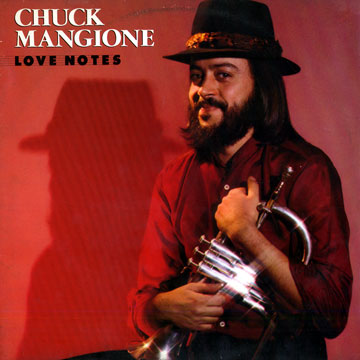
Love Notes has a cool and subdued feel, even for Mangione. But its charm is a sublimely clear tension roiling just beneath the surface that erupts in moments like the bright and sudden resurgences of mysterioso theme in "No Problem." I love the big and squibbly tone of Mangione's flugelhorn, and slippery technique that puts a human stamp on a style of jazz that too often gains marketability at the expense of character. During "No Problem," Mangione's minimal statements and restatements come and go over a funky vamp that recalls Miles Davis, weaving in and out of the choruses by Chris Vadala, a presence lurking in the eaves. The solos by Vidala and Peter Harris are excellent, mixing a clear appreciation of bop that stays close to the tune and deep in the groove. "Memories of Scirocco" is an evocative, songlike standout, combining bluesy inclinations with a subtly Latin flavor. Vadala breaks out the soprano midway and gets in some short, fiery licks that make the album worth having. "To the 80's" comes under fire of finger pops but retains an appeal for the classics with a melody that wouldn't be out of place on a Sonny Clark or Cliff Jordan date. Lastly, the title track is a wistful, smoldering ballad that closes the proceedings thoughtfully, dressed delicately by Vadala and Mangione.

Saturday, August 17, 2013

123. Wilton Felder / Forever, Always (1993)

Felder is a hard working session man on the bass and tenor who is deeply reverent of his roots in straight ahead jazz, soul, blues, and R&B. I'm down with that. But on the other hand, this funky, (thanks, Dwight Sills on bass) soul-influenced smooth jazz session is a snoozer. I'm not going to pan it because it's a very slick product with some uncanny melodies and remarkable consistency. Don't take me the wrong way because I like smooth jazz, soul jazz, and fusion. But when I turn on Forever, Always, from the very first note, I find myself looking toward the television for the weather forecast. You feel me? It's one of those records, and a very good one, at that. I find it to be good for the background, good music to listen to if I just want to relax because there aren't many surprises and rhythmically it's all at one depth. Felder's tone is very solid and downright enjoyable, but the music is thin on ideas and while it isn't uninspired, it comes off as routine. Sonically speaking, the mix is creamy and sounds equally at home on speakers or headphones. Did I mention I've retained this album in my iPod? There's a time and a place for everything. So if you're into smooth jazz, 80s soul jazz, or fusion groups without horns, this is the record for you. 

Saturday, August 10, 2013

122. Charlie Haden / Night and the City (1996)

Night and the City has an extra attraction for me, because I love the film by Jules Dassin. Anyway, they're not related, but it's a great record. It was recorded for Verve at the Iridium in NYC, home to many a great night of live music (see HughGotIt's excellent uploads of the Ed Palermo Big Band for a glimpse of when the tiny room really gets rocking, and also some of Hugh's other great live video work). This time Haden teams up with Kenny Barron on the keys. Their music is elegant and sparse, but not at all vacant. It's reverent of jazz from an earlier era, and even its title recalls a romantic notion of the city as theater of life. Barron's opening "Twilight Song" sets the pace. The tunes are mostly standards, with one original by Haden ("Waltz for Ruth") and Barron's aforementioned "Twilight" being exceptions. "Body and Soul," as if anyone can get away from it, is thoughtful and majestic and makes a perfectly timed appearance midway through the disc. I think the collection is a treat, and each player exercises a remarkable restraint to let the other sing and breathe as needed. It's thick on mood, but not overly heavy, and I highly recommend it.  

Monday, August 5, 2013

121. Johnny Griffin, John Coltrane, Hank Mobley / A Blowin' Session (1957)

Blue Note's A Blowin' Session featuring Little Giant, Trane, Hank Mobley, Lee Morgan, Wynton Kelly, Paul Chambers, and Art Blakey sounds exactly as you'd think it would. It's technically a Griffin date, who is leader, composer, and one third of the groups's tenor sax nucleus. But Morgan gets plenty of time, and so do Kelly and Blakey, for that matter as if Blakey's hard to miss. The meeting was a pickup after the Chicago-based Griffin found himself in New York at the same time as the others. With so many good players, it's a jazz buffet. The septet shows its talent in tracks like "The Way You Look Tonight," or the swinging ensemble groove of "Ball Bearing." As two horns who played with Miles Davis so close together, listening to Trane in opposition to Mobley is interesting (see Prestige's Two Tenors or Tenor Conclave for more of Trane and Mobley together). Morgan's licks on "Smoke Stack" set the pace for the rest of the group, though Coltrane feels overburdened, it's still my favorite cut on the album. Thankfully, there is an alternate take on the Blue Note CD that offers him a second chance as well as a wild good performance from Griffin. Why they issued the original take instead of this one remains a mystery to me, unless for the outstanding work by Morgan. As a note, this album also marks th eonly ecorded meeting between Griffin and Coltrane.

Sunday, August 4, 2013

120. Ahmad Jamal / At the Pershing, But Not For Me (1958)
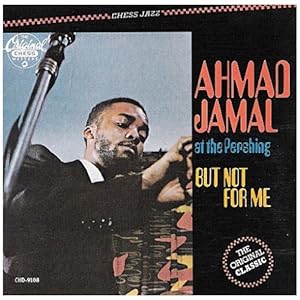
Out of Jamal's handful of live albums, each one a gem, At the Pershing stands out to me as essential listening. It was originally released on Chess Records' Argo label and became a smash hit, a coup for the label that had recorded a goodly variety of music but not broken into the jazz markets held by Blue Note, Verve, Columbia, or smaller labels like Prestige. Widely influential, it's become a classic. Jamal's emergent style is the principal attraction but the trio consisting Israel Crosby and Vernell Fournier isn't to be fooled with. Their brand of jazz is superbly crafted and seamlessly executed. Cooperation and interplay between bass, drums and piano is supernatural. Listen to the sparse but beautiful "Poinciana," demonstrating Jamal's wise but playful use of space and silence while the rhythm section carries a percussive groove. Some of the selections clearly presage the work of Miles Davis' first great quintet. My only complaint? On the original liner, Jamal writes that he himself selected eight tracks of the 43 they recorded 16 January 1958. Gambit's Complete Live at the Pershing Lounge 1958 offers only 20 tracks. I did the math, and while Jamal is still playing dates, it'd be darned nice to have those missing tapes....

Saturday, August 3, 2013

119. The Great Jazz Trio / Standard Collection (1987)

This great CD by Denon is sadly out of print. The trio is agile and smart, working through 16 standards, just as the title implies. Hank Jones is eloquent and a joy to listen to. On the drums is Jimmy Cobb adding just enough muscle to spread it out but playing with impeccable taste ("Caravan"). The bass chair this time is Eddie Gomez, who stands out in slippery but very melodic solos like "S'wonderful," "Embreceable You," or the excellent rendering of "Sophisticated Lady." The trio is augmented at times by the violin of Lewis Eley ("Autumn in New York," "Isn't it Romantic") adding a touch of style similar to the effect Ray Nance had on the Duke Ellington band. The album's selections fall mostly to the Ellington-Strayhorn team, Thelonious Monk, and George Gershwin. The pacing is good and the band is professional. They work closely and make a solid unit, Cobb and Jones especially. As I mentioned, Standard Collection is out of print but worth it, I think, for a band that plays straight from the heart. If you're interested in the other work by this fine and ever changing group, please see the Great Jazz Trio Discography page by 441 Records. The last four tracks composed by Monk are played by Jones with a special fondness, it seems.

Sunday, July 28, 2013

118. Art Blakey and the Jazz Messengers / Soul Finger (1965)

In 1965, the Jazz Messengers were navigating strange seas. The decade was only half finished but had already seen players like Dolphy, Coltrane, and a host of others. On the other hand, it's like the climate inside the Messengers was oblivious to this. Their music continued ahead, business as usual, driven by Blakey's hailstorm of press rolls and weaponized hi-hat pulse. I feel inclined, or almost obligated, to say what been said a thousand times. I suppose when someone mentions the Messengers, that's the image I conjure: the world's best hard bop band, Blakey at the helm. Yet this lineup feels different than other incarnations of the Messengers, even if it's obvious that no two were the same. The soloists take some unexpected corners, and it's an aggressive front line from the word "go" with Freddie Hubbard and Lee Morgan blowing alongside Gary Bartz and, on one track, Lucky Thompson. They're explosive but the charm, for me, comes between John Hicks in the left channel and Victor Sproles in the right. I hear a lot going on there. Unforgettable is the debut of Gary Bartz on alto. This disc might not be a definitive Messengers date, but there are some critically overlooked moments packed between these grooves, and a little jazz history, as well.

Saturday, July 27, 2013

117. Ben Webster and Associates (1959)

Similar to the Rollins/Coltrane session Tenor Madness, much of Webster's Ben Webster and Associates feels like friends trying out ideas with relatively no pressure. In other words, a damned good jam session. Of course, with this lineup, the music has a completely different feel than Sonny Rollins and Coltrane. Webster and Co. start off with "In a Mellow Tone," and keep at it for over 20 minutes. It's so enjoyable, it's a shame the tune has to end. There's room for everyone: Webster, Budd Johnson, Hawk, Roy Eldridge, even Ray Brown gets two choruses. The excitement building for the final push to the end isn't to be missed. They next turn up the heat for "De-Dar," a bluesy tune with with a boisterous arrangement that swings hard. As far as the tenors go, I like listening to all the different styles on the same record -- Johnson's streamlined and laconic phrases in double time, Hawk's strident tone emerging like a dark horse, and Webster alternately growling or whispering but always playing straight. "Time After Time" strips Johnson, Hawkins, and Eldridge for a more intimate setting and allows further explorations in the diverse sound that Webster was famous for. So what are you waiting or? Get on the stick! This should be on every shelf.

Saturday, July 20, 2013

116. Duke Ellington / Such Sweet Thunder (1957)
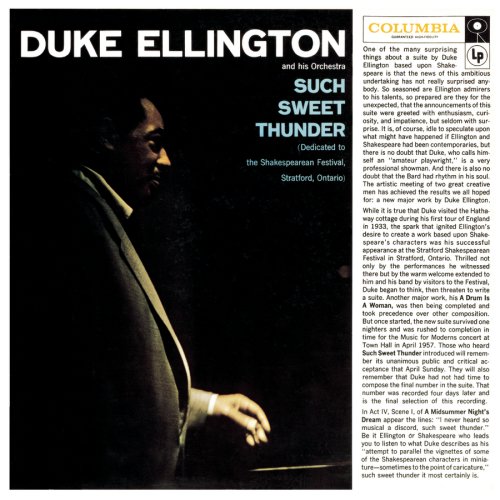
In 1999, Such Sweet Thunder was released on CD, expanded and including outtakes. It's a fantastic stereo reconstruction of the originally intended program, complete with inter-track studio ambience akin to a concert hall, formerly available only in mono due to a flawed production. The album's original 12 selections are Duke's musical interpretations of various Shakespearean characters. It's another of his concept pieces, a tone parallel like Black, Brown, and Beige. The music is filled with quirky grinners, as in "Lady Mac," where Duke writes new personality into Lady Macbeth. It shows an indulgently swinging streak to the infamous noblewoman, hitherto unseen on stage. And who's to say that's incorrect? It's refreshing. Most notably, the Ellington-Strayhorn team uses soloists in the band to great effect in pieces like "Sonnet for Caesar," the first of four such sonnets on the album that emulate the 14 line poetic form. The soloists actually play the characters with their instruments, so I wonder, wryly, if the union rep had anything to say about that. "Caesar" features Sam Woodyard imparting an appropriately martial atmosphere while Jimmy Hamilton takes the lead (literally) to portray history's great general in a stately and beauteous, but ultimately tragic, melody. The arrangements for other songs continue the trend of band-as-cast in brilliant works like "Up and Down." Here, Puck (played by Clark Terry) quotes mischievously while working the play's couples into increasingly awkward situations. Just three examples, there are nine more to enjoy. It's ambitious, and the CD release is a treasure. It's sound is brilliantly spacious and clear, and we have all the session's complete takes in one place..  

Tuesday, July 16, 2013

115. Joe Lovano / Celebrating Sinatra (1997)
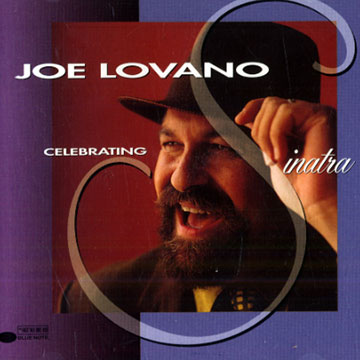
Joe Lovano here performs his version of the Great American Songbook by interpreting one of his more powerful muses, Frank Sinatra. I read Lovano's single page in the accompanying booklet and I can't disagree with him. Sinatra was consistently great for the duration of his career, and exerted a powerful influence on succeeding generations of musicians. The effect continues and this 1997 album is a prime example. As Lovano and crew cut through classics like "I've Got the World on a String," "In Other Words," or "Someone to Watch Over Me," they meld modern sensibilities and at least five decades of stylistic development in jazz with Sinatra's timeless swing. It's a natural setting for Lovano, like balm for the soul. He grew up with Frankie playing all around him, and it immediately conjures memories of his home and family, notably his Aunt Rose Verzi. A Sinatra devotee who saw him in person hundreds of times, she sounds pretty cool! Lovano was certainly taken by his auntie. His ballad work bubbles with ideas and earnest sentiment. The arrangements and orchestration aren't just tasteful, they're clever, too, as in the aforementioned "String" where Lovano weaves in and out with the cello to make a play on the lyrics in the song. Or the wild and nasty group sections culminating at the end of "One for My Baby." During "South of the Border," Lovano lets George Mraz have the first chorus, giving a new context for Lovano's solo to emerge in, instead of jumping right off the melody. The result is really fresh. Every track is as good as the next, so hats off to Joe Lovano for indulging his passion and recording this set of Sinatra staples. As with other Lovano records, it stands up heartily to repeat listening.

Thursday, July 11, 2013

114. Angelo Badalamenti / Music from Twin Peaks (1990)

David Lynch's highly individualistic and genre defying films have a niche all their own. A great part of the magic in films like Blue Velvet, Mulholland Drive, or the series Twin Peaks, can be credited to the composer Angelo Badalamenti whom Lynch has hired time and time again. Lynch is an auteur and when he finds something that works, he sticks with it. Other directors have famously created an arc of conceptual continuity by hiring the same actors and composers for multiple films (reluctantly, Tim Burton springs to mind) but Lynch has avoided typecasting, banality, and the curse of repeating himself. Lynch manages to work new and frightening ideas into each film while creating a mood that is distinctly a product of his own making. This soundtrack by Badalamenti is a prime example of how the composer contributes to essential mood magic. The tracks run the gamut from low key, enigmatic synthesizer statements ("Theme from Twin Peaks," "Laura Palmer's Theme") to steamy blues (like the spidery threads of "Bookhouse Boys"), and moments of rare beauty ("Love Theme from Twin Peaks").  There are some vocal spots, too, by Julee Cruise singing lyrics by Lynch and dreamy music in the vein of "Sleepwalker." And that is the operative word, here: dreamy. Remember, it's a Lynchian dream where nothing is as it seems.

Tuesday, July 9, 2013

113. Duke Ellington / Far East Suite (1967)
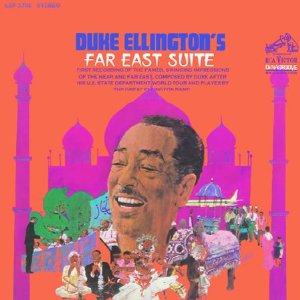
Last month, I rolled down the windows of my car after working a 12-hour day, twisted the cap off an ice cold Virgil's Orange Cream soda, and enjoyed the drive home while listening to this record. The Far East Suite is one of Duke's last recorded works, and one whose material might sport the familiar names and faces of orchestras past but its compositions have a unique flavor among others in the Duke canon. It's been on regular rotation at my house since that evening with the soda pop. Between the grooves are  yards of punchy counterpoint between reeds and brass, and some of Johnny Hodges' sweetest work on wax ("Isfahan"). And of course we are treated to equally fine work by the likes of Cootie Williams, Cat Anderson, Russell Procope, Harry Carney, et al. The recording is memorable throughout thanks to Duke's direction of the sublimely cohesive band. It is nice to hear Duke melding his percussive piano blues with sophisticated orchestral textures and touches of middle eastern music or orientalism in tracks like "Mount Harissa," "Ad Lib on Nippon" or the opening "Tourist Point of View." I was swept up by the tidal wave of sound, which is what usually happens when I listen to Mr. Ellington.

Saturday, July 6, 2013

112. Paul Desmond / Take Ten (1963)

If you can't get enough of "Take Five," then Take Ten is the album for you. It's one of several excellent slabs made during Desmond's many quartet sessions for RCA Victor. The band is Jim Hall on guitar, a moonlighting Connie Kay on drums and Gene Cherico on bass. Fellow Brubeckian Eugene Wright subs for Cherico on "Take Ten," adding an extra dimension of conceptual continuity to this 10/8 reworking of its famous counterpart. It starts with a familiar vamp that is reminiscent of a studio orchestra trying to avoid paying royalties for the genuine article. But then Desmond starts in on a deep and bluesy riff, finding new territory inside of an old melody. He blows these long and contemplative notes that explore the tonal color of the mode and remind me, in a very limited sense, of later work by Jackie McLean or John Gilmore. It's a treat, especially when he decides to hold on for just a bit longer and sustains the phrase with some vibrato. Proceedings quickly change the course toward Desmond's passion for bossa nova. In spite of an American burnout on the form, Desmond was one of its stalwart practitioners, and originals like "El Prince," "Embarcadero," or "Samba de Orfeu" are fine examples. Kay and Hall give the sessions that extra something it needs. Kay has a nice technique that intertwines his ever present cymbals with a driving attention to the skins. This band gives him elbow room that was impossible in the immaculately executed pieces by MJQ. A normally taciturn Hall takes some interesting breaks mixing chords with short flurries of single notes and a lot of fun riffing, and he is one of my favorite musicians. Together they make a melodically focused disc with good performances and an excited but cool, relaxed vibe that I wholeheartedly recommend. It ends as sweetly as it began, with an uptempo "Out of Nowhere" featuring George Duvivier on bass. The section at the end where Desmond has the floor to himself with punctuation marks by Kay is just magic.    

Thursday, June 27, 2013

111. Duke Ellington, Charles Mingus & Max Roach / Money Jungle (1963)

Money Jungle is all about contrasts and individuality. The music is famously, and often physically, tense. The grit is established on the first track "Money Jungle" where Mingus spends much of his time aggressively bending a static harmonic element while Duke assertively pounds big blocks across the registers. Each musician has a distinct playing style, and no one gives an inch for the notion of a group product. Remarkably, a unique group product is exactly what we get. The mood often swings to moments of quiet beauty, but rocks quickly back to outbursts of boulder dropping and more assaults on bass and drums. At times it sounds as if Duke is pointing to sections of his orchestra which are not actually in the studio, playing electrifying chords in his characteristic staccato style before drawing back in contemplation and moving his hands to other registers. With the keyboard laid out in front of him, he's arranging while improvising. A listener with experience with titles in the Duke Ellington catalog will hear the bones of the brass and reeds as sections rise and fall in the imaginary arrangement. I'm happy Duke had the foresight to request making this album with one of his greatest adherents, Charles Mingus, possibly the only talent in jazz that may have been equivocal in terms of composition, orchestration or arrangement.

Saturday, June 22, 2013

110. Mingus Mingus Mingus Mingus Mingus (1963)
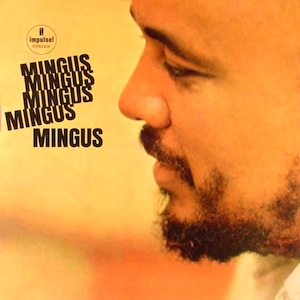
Mingus, the master orchestrator. Mingus the composer. Mingus the performer. He's got so many credits on this album that I marvel at how it doesn't sound one bit overrun by his presence, yet it's distinctly his product. The music swings with a loose and careening vibrancy that is electrified with spontaneity and invention. With just 10 pieces, his arrangements sound as quiet as a quartet or as powerful as a big band. Its performers lend the air of familiarity, dashing in and out of ensemble jams like "Better Get Hit in Yo' Soul" or blending sublimely as in the steamy rendition of "Mood Indigo." Mingus listeners will immediately sense the presence of old friends, because many of the tracks are new treatments of preexisting Mingus tunes. I'll let you figure what is what. As for soloists, I really enjoy Charlie Mariano (bias alert, I just got Blue Camel so I'm on a bit of a bender) or the shambling Walter Perkins on drums.

Tuesday, May 28, 2013

109. Julie London / Julie is Her Name (1955)

Julie London's range and the timbre of her voice is one that sits very well with me. Ensconced within her silky mezzo soprano is a space filled with sumptuous partials and overtones that make a single note sound like a chord. Her voice and my wife's are quite similar so when I listen, I sense something familiar. In the classic debut Julie is Her Name, London's young voice is the main attraction and backed often by only a guitar. Her phrasing and timing leave you on the edge of your seat, wondering where the next phrase will fall ("It Never Entered My Mind"). She's always playing this way with the lyrics and her timing, while Barney Kessel anxiously holds back comping. Later in her career, she fronted a big band whose eloquence and power gave her smoldering vocals and lovelorn ballads some extra emotional impact. But here it's all Julie. The album opens with the quintessential "Cry Me a River," and moves through 12 other standards and ballads including aforementioned, quirky "It Never Entered My Mind," and the beautiful "Laura." There's also a second volume, which is just as bit as this first volume, two records that should be on every jazz lovers shelf.

Monday, May 27, 2013

108. Duke Ellington / On the Road with Duke Ellington (1967)

On the Road is a documentary film from 1967 by Robert Drew. For an artist so prolific, Duke left behind precious few film documentaries. There is music performed in the film that'll give you goosebumps but the subject isn't the music itself, it's Duke and how he lives and works. The picture is grainy and saturated like an old Super 8, the audio is muddy, and you'll instantly disregard that because from the outset, you're aware that this is the best film on Duke Ellington that there is. It's delicious, for a Duke fan like me. The camera follows him in his daily routine as he opens his mail, lingers too long backstage on the piano, composes a new tune, or has his breakfast -- hot water, steak and potato, the same breakfast he's had for 40 years. Duke is a funny, funny guy. He's an autocratic employer, an eloquent speaker, and madly devoted to his craft. You see him flirting with fans at the airport, or backstage having a natter with Louis Armstrong, just talking like two old friends, which is extremely interesting. The bottom line is that Duke Ellington runs the show whether it's on the road, at home, or accepting an honorary doctorate. He works all nighters while he's not performing and performs when he's not working. At one point, he tells the crew that he can't imagine what retirement means because stagnation will not look good on him. And it's true, he worked until his death six years later. I think I learned that if I truly want what I think I want, then I know I'm not working hard enough. Like a thunderstorm, the power, sophistication, and beauty of Duke's orchestras always excited and impressed me. Watching it happen in the making reinforced that notion.

Sunday, May 26, 2013

107. Desmond, Brubeck, Van Kriedt / Reunion (1957)

This meeting of the minds that have met before on many occasions is as relaxed as it is concise. David Van Kriedt was the tenor and collaborator in the Octet alongside Brubeck and Desmond. He continued into academia, also playing with Stan Kenton, while Brubeck and Desmond became performers. On Reunion, there are some tastes of the fugue style writing for which the Octet was famous (Bach's "Chorale," the only tune without a Van K. credit), although in the mood is, as I mentioned, quite a bit more relaxed than it was in the Octet. Back then, as the record shows, everyone seemed scrambling to out-do his last chorus. This time, while it sometimes sounds as if there's no clear leader, each man gets a fair share of time during improvisations and the music has the feel of care and balance. The group idea of musicality is very strong. Brubeck often picks up where Van Kriedt leaves off, or Desmond does, with occasional episodes that quote slyly from whatever is near at hand. It's soft, sophisticated music with occasional fireworks ("Shouts," listen for the Brubeck boulder that spins Desmond into a tizzy) and superb arrangements by Van Kriedt, like the sumptuous "Prelude." Van Kriedt's tone is smooth and full like Lester Young, and the timbre is the ideal mixer for Desmond's alto.

Saturday, May 25, 2013

106. Frank Zappa / Hot Rats (1969)

Fusion, like the avant-garde, is a thing that everyone approaches from a different angle. Hot Rats is way off the typical fusion track, if you follow the example set by those who left Miles Davis' electric groups. But Frank wasn't moving in those circles. When he made Hot Rats, as ever, he was following his own muse. On the surface, Hot Rats takes the path of a hard rock band, emphasizing the "rock" half of the jazz-rock equation. It is filled out with intricate arrangements played on various reeds, electric guitar, electric violin, percussion, and keyboards. Most of the solos are blues-based guitar workouts or feedback-laden electric violin riffing by Sugarcane Harris (see "Willie the Pimp," "Gumbo Variations"). On the other hand, it also features quirky, composed pieces whose tight arrangements are closer to a synthesis of jazz and classical elements than they are to any mainstream American rock and roll from 1970. Listeners of European experimental music from the same time period, or Rock in Opposition groups like Henry Cow should have no trouble appreciating such pieces. "It Must Be a Camel" and "Peaches En Regalia" are notable in this regard, likewise the horn charts for "Son of Mr. Green Genes," which remained a live staple for years to come. Zappa was also a DIY innovator in the studio. If he didn't have the equipment he wanted, then he invented it, and he was endlessly creative at the mixing desk. So the aurally warm texture of Hot Rats was created with a forest of meticulous overdubs and tape manipulation techniques that Zappa pioneered on his own. Are you new to Frank Zappa? Hot Rats is a good entry point due to its presentation of several characteristics common to many pieces in the FZ oeuvre. It's also very good for rock audiences and toe dippers because it is listenable, contains none of Zappa's lyrics (which range from funny, to off-putting, to complete bullshit, depending on how they strike you), and is also widely available on CD format.

Friday, May 24, 2013

105. Benny Golson / Groovin' with Golson (1959)

Golson only has a single composing credit on this album ("My Blues House"), which is too bad considering how much I enjoy his style of jazz. But that tune, a slow blues, is the very first one on Groovin'. It is adequately seasoned with Curtis Fuller's flashy statements on trombone, perhaps more than Golson himself. Things move to a mid tempo piece "Drum Boogie" that swings hard with Art Blakey at the helm, before cooling down with the Rodgers and Hart standard "I Didn't Know what Time it was." Golson's sax blends sweetly with Fuller's trombone, and both are accomplished soloists. It's nice to hear their tones in opposition, too, as in "The Stroller" where a caustic Golson veritably peels the paint off the walls before we hear Fuller's punchy but softer sounding approach with short, staccato phrases. There's some brilliant piano work by Ray Bryant, possibly overshadowed by Golson or Fuller but easily underrated. Chambers and Blakey get a turn before everyone does fours and the thing wraps up. The quiet "Yesterdays" finishes the album with a whisper. Groovin' was recorded immediately before the formation of the Jazztet, but it's easy to see where things were going. I think here, Blakey gives a hard edge that was missing from even the Jazztet's most brilliant moments.

Thursday, May 23, 2013

104. Clifford Brown & Max Roach / Study in Brown (1955)

Study in Brown is a really enjoyable record. What's memorable, to me, in this Brown-Roach date from 1955, isn't just Brown's exceptional talent on the trumpet, but his talent as composer ("Sandu" is here) and contributions of tenor Harold Land on the front line. Between their instrumental abilities and composed works, the band is a really good combination. A bit like the Cookbook series by Eddie Davis, Brown and Roach went in the studio a few times and each time, the chemistry cooked something special. This set runs from blues to bop to standards, and through a variety of tempos. In the opening "Cherokee," Land can match Brown phrase for phrase at breakneck speed, and the wailing fragility of his reed provides additional texture and urgency. In each tune, Roach gets a lot of room, naturally, carving out his niche in jazz percussion with driving, melodically inspired solos on snares and toms. "Take the 'A' Train" has a really cool introduction and arrangement, and the jaunty "Gerkin for Perkin" keeps it interesting with a cool stop/start rhythm that causes Roach to kick up some dust. Such freshness, vibrancy and joy flows from this recording. It's almost hard to listen and not be overwhelmed by the sad feeling of knowing that Brown would be gone in less than a year.

Wednesday, May 22, 2013

103. Art Farmer / Meet the Jazztet (1960)

I love this album. Art Farmer's Jazztet was a lot like the Jazz Messengers. Their music had a different flavor than the Messengers but each group was stacked with the fine and innovative musicians and each played the picture of hard bop. Benny Golson does the arrangements and the band plays two of his tunes: "I Remember Clifford," the beautiful tribute for which words are woefully inadequate, and "Blues March," an attention-grabbing blues with a startling cadence and spunky arrangement. There are some obligatory standards ("It's Alright with Me," and swanky "It Ain't Necessarily So") during which the band displays its chops like fine silver. Golson and Farmer make ideal foils by themselves, Golson with superheated explosions of verbosity and Farmer with his carefully crafted and natural lyricism. But you can't forget or ignore the contributions of Curtis Fuller, either. He has some really hip parts, with big, brassy punctuation marks or deftly fingered runs that will make you think he's got a cornet. There's mucho variety, the arrangements keep it fresh, and Lex Humphries swings it hard. If you're getting into this type of music, Meet the Jazztet is essential listening.

Tuesday, May 21, 2013

102. Anthology of Big Band Swing, 1930-1955 (1993)

The scope of this Decca Records compilation encompasses the whole swing era from the stomping greats of 1930 to the final holdouts of the mid '50s. The restored sound quality is excellent but the strength, or allure, of this two-disc set is the variety of material that was chosen. The editors did a great job selecting the tracks, a sure success. Their work provides a detailed and meaningful cross section of the many diverse bands playing swing music in the United States. They could have flubbed it. Decca's roster was about as deep as the Yankees bullpen, but it also had some of the biggest guys in it. So in other words, while Basie, Duke, and Benny are represented here, they're not disproportionately represented to the exclusion of the label's other, smaller acts. Instead, the spotlight spreads a little wider. The resulting collection is presented chronologically and allows listeners to follow swing as it matured and developed over a cool quarter-century. Across 40 tracks, there are 37 different bands that will jump, jive and wail you into a frenzy. There are so many great bands here in one collection, not to mention their soloists -- Fletcher Henderson, Don Redman, Chick Webb, Jimmy Lunceford, Mills Blue Rhythm Band, Tiny Bradshaw, Jack Teagarden, Noble Sissle, Glenn Miller. And the list goes on, and on, and on! I listen to the whole thing and I get excited thinking about the era, the big dance halls and the excitement this type of music provided to people like my grandparents in such a trying time of depression, war, and uncertainty. It's difficult and expensive for a listener to take in all the swing groups one-by-one and try to put them in context. These 40 songs make it much easier to understand foundational jazz music of the '30s, '40s, and '50s. This should be on every jazz collector's shelf.