Recent listening, current

Showing posts with label trio. Show all posts

Monday, May 25, 2015

200. Giger Lenz Marron / Where the Hammer Hangs (1976) & 201. Giger Lenz Marron / Beyond (1977)

Peter Giger's career is full of wild one-way streets. It's like he can do it all, equally at home playing it straight, or rattling through an assortment of percussion instruments in jams of thorny, implacable experimentalism. Where the Hammer Hangs and its sister slab Beyond are just a short stop in his considerable career. Both albums are presently out of print, and are obscure considering his other accomplishments in major jazz circles. If you're familiar with Giger's work in more mainstream engagements, it's probably best to come at these from the Dzyan angle (which was actually my introduction to Giger some time back). Hammer and Beyond were released on his own Någarå label, and stylistically speaking, pick up right where the Dzyan vehicle left off. There are differences. Just like Dzyan, you will hear searching group improvisations, hints of Eastern rhythm and instrumentation, druggy, reverb-laden guitar forays, and plenty of crossover from the above. But Giger Lenz Marron has fewer pedestrian handholds, less that is familiar, and seemingly no rules except for limitations imposed by the instruments themselves. It's like the ingredients of a Dzyan album, but set in a different project removed from whatever restriction was imposed by the group moniker. Although not a major pit stop on the timeline of such prolific musicians as these, the GLM trio interests me for its freedom of form as well as its connections to several trends that first emerged ten years prior. It proves that jazz is a many faceted thing that will continue to be wrought anew by the creative hands and minds that shape it.

Thursday, April 24, 2014

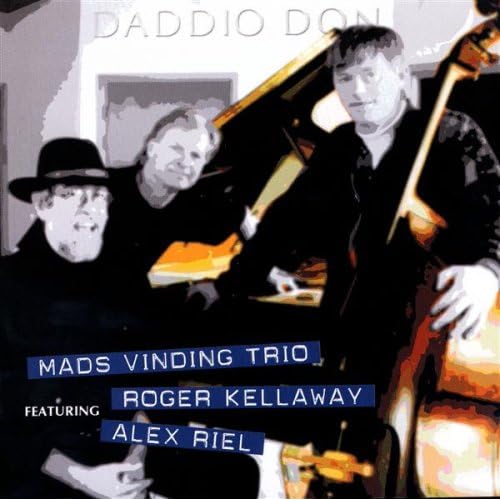
193. Mads Vinding Trio / Daddio Don (1998)

A while back, I recommended an album with Mads Vinding to a friend who loves the upright bass. It's his favorite instrument. We chatted about the Danish bassist and both agreed he's a hard one to not like. A few weeks later he gave me some CDs that, for whatever reason, didn't pan out for him the way he expected. It happens. But I was thrilled because among them was Daddio Don. I listened to it for the rest of the afternoon before promoting it to a coveted spot in the rotation of my daily commute. Vinding is impossible to keep up with, the tireless recording and performing artist for whom the word "prolific" seems inadequate. He's all over the map, discographically speaking, but always right where you need him with the soulful interplay, keen rhythmical knack, and melodic inventions that surpass keeping time for the time's sake. He has a sixth sense for interplay, or a humble ear for the group dynamic, always listening to what the other musicians are doing. I appreciate his earnest touch with the blues and immediate facility for navigating uptempo and bebop that remind me of Ray Brown (another favorite musician). His choruses are not boring, they're more like short songs. To paraphrase C. Michael Bailey's piece for AllAboutJazz.com, Vinding is like the Nordic George Mraz, expressing himself with a confident stride and robust tone that tricks the ear into hearing a full rhythm section where none is present. The trio is comprised of Vinding, drummer Alex Riel, and pianist Roger Kellaway. Kellaway has a sensitive understanding of the piano's dynamics, and moves with irresistible swing.
Image courtesy of soundcloud
More importantly, Kellaway has a penchant for odd time signatures (the album is titled for Don Ellis), and all three musicians are comfortable breezing through meters like Kellaway's "Seven," or Thad Jones' "A Child is Born" in 11/8. Riel's timekeeping is sumptuously alert. His dreamy brush work is punctuated by pertinent, percussive accents and taut interjections on the snare that make the emotive and pensive, often introspective set as lush and flush as a well arranged quintet. "How Deep is the Ocean" is intriguing, demonstrating the shared chemistry of the trio. It's a touch faster than is typical, and the order of its open sections are negotiated as you hear them. It typifies the musical cooperation which is the album's hallmark. If you're the type of listener that enjoys quiet spaces with tricky corners, a shared creation of three musicians that reveals the sheer clumsiness of language when describing a mere "piano" trio, then Daddio Don needs to be on your list. And if you try it but you don't enjoy it, perhaps you can pass it on to a friend.

Saturday, March 15, 2014

190. Erroll Garner / Jazz 'Round Midnight (1991)

Compilations from Jazz 'Round Midnight are usually good, and while this one is no exception, it tends to be monopolized by downtempo ballads. Across 16 tracks, listeners hear Garner's solo and trio recordings from the mid '40s and '50s. You get the basic idea -- contrasts of soft with loud, twinkling arpeggios from the right hand, chord tracing from the left. But the towering crescendos and dizzying excitement that so frequently come up when people talk about Garner seem missing. Things heat up a little in "I've Got The World On A String" and especially "Part Time Blues". Garner's punchy rhythmic accents and huge, bluesy blocks remind me of why I love the piano of Duke Ellington and Oscar Peterson. While I appreciate them for the variety, I want more. None of this, however, should detract from the stately beauty of "I Can't Get Started" or "Misty." As Garner is one of those pianists who has been anthologized and repackaged a thousand times, this installment could be worth passing over. But in a lot of other ways it's a good one for the car, for after a hard day, or for audiences that are unlikely to gripe about the track sequence as I have. I almost forgot to mention the last track, a 10:42 solo take of "Over the Rainbow." It leaves me spellbound and feeling guilty for taking issue with any of the above.

Monday, January 6, 2014

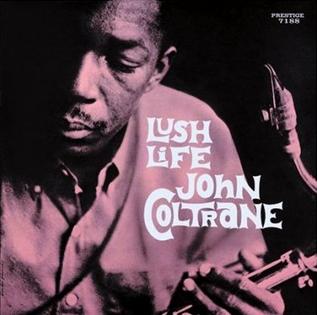
167. John Coltrane / Lush Life (1961)

While Prestige's Lush Life was not released until 1961, it was recorded by Van Gelder during three sessions in '57 and '58. As he was no longer recording for the label, Coltrane had no say in it but ironically, the record contains a few of his choicest recordings playing in the small group, hard bop setting. This was an incredibly fertile period for Coltrane. He had yet to compose the seminal works that later appeared on Blue Note and Atlantic but was already working on the technique and musical ideas that would define his legacy. The first three tracks present Coltrane as leader of a pianoless trio, fleshing out a lot of chords in lieu of the keyboard. The most memorable moment on Lush Life is probably the title track, a luscious ballad owned by the leader until around nine minutes in when Donald Byrd steps out of the woodwork for some equally inspiring lines on the trumpet. Two years ago I was at a stoplight listening to this on the radio and was so transfixed by Byrd's meandering melancholy that it took a horn blast from the car behind me to break the reverie. While I'll never recreate that moment, I can still listen again and again. "Trane's Slo Blues" is also notable for Coltrane's moves inside the changes. These tracks appear on the boxset Fearless Leader although they are not presented in the same sequence as they are here, which is actually quite good. 

Thursday, November 21, 2013

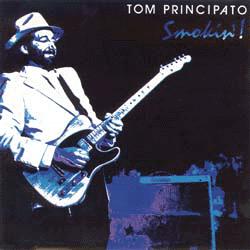
152. Tom Principato / Smokin' (1985)

Principato is well known on the East Coast circuit. In the 70s, he made a pair of legendary albums with fellow Tele-wizard Danny Gatton (Blazing Telecasters and More Blazing Telecasters). But outside of the South, his name is more obscure. Principato's nimble, string bending, Fender-driven brand of electric blues combines a stripped down Chcago style with Texas and Southern flavors. Like the discs he did with Gatton (and much of Gatton's work, Tom or no), it draws from all over the blues tradition, a swirling cocktail of jump, boogie, rock, country, and swing. There's a tinge of honky tonk and each lick is rendered with gratuitous twang. Principato's sustain on sweeping string bends gives each note its own zip code. Smokin' is the perfect title. The album cooks on high from the first note until the last. For verse sections, Principato plays riffs close to the nut in a deep, growly sound. He soon flies up the neck in a combination of slick, fluid phrases that are interspersed with chunky bends and exciting slides. "Lipstick, Powder & Paint" continues the twangy blues vibe, likewise "Fish Fry." Harder rocking tracks include Principato's "Talkin' Trash" and the closing "Hard Livin'." Fans of Stevie Ray or any of the usual suspects will find this to be an infectious delight. Be warned: buying one album may lead to buying three or four more...

Saturday, September 21, 2013

141. Monty Alexander, Ray Brown, Herb Ellis / Triple Treat (1982)

For various reasons, the cover of this recording seems oddly appropriate. A photograph of a three-scoop ice cream sundae makes a cheeky pun for the piano trio's sweet and sometimes quirky set of tunes like Blue Mitchell's "Fungi Mama" (with fun quotes by Ellis, and some jangly syncopation by Alexander) or the hot side-opening "(Meet The) Flintstones." Monty Alexander fills the piano chair and I don't think he sounds one bit like Oscar Peterson, in spite of Brown and Ellis being longtime members of that musician's group. The other music on the album is equally sweet and creamy, as with the sumptuous "Body and Soul" and "Sweet Lady," or swinging "When Lights are Low." Also notable is the title track, the "Triple Treat Blues." Chemistry, relaxed atmosphere and slick, baton passing choruses of these three musicians make a buoyant and memorable session that is out of print but worth seeking out. If you enjoy this lineup, be sure to check out their other albums, as well.

Thursday, September 19, 2013

140. Tal Farlow / The Swinging Guitar of Tal Farlow (1956)

This blues and bop trio date with Farlow, Eddie Costa and Vinnie Burke is easy to listen to, and closer listening reveals a lot going on. The styles of Costa on piano and Farlow's guitar dovetail nicely. Farlow's eloquently phrased and heavy swinging choruses are followed by those of Costa, who plays in a hard-hitting, single-note style and is very rhythmic. Farlow uses the occasional slide, as in "Yardbird Suite," but instead of relying on an arsenal of tricks and stock licks, he is adept in inventing on the fly. The improvisations literally flow from the speakers like they're on tap. With so many ideas being tossed around, there's a lot of interplay between the piano and guitar. Burke plays the bass more or less steadily throughout, occasionally getting a chorus his own. The outtakes of "Taking a Chance on Love," Yardbird," and two (!) extra takes of "Gone with the Wind" are all so good that it's difficult to say how they determined a master. At any rate, the bonuses are much appreciated by this listener! Admirers of Ahmad Jamal's drumless trio with Ray Crawford, the Aladdin dates of Art Pepper, or the Modern Jazz Quartet should take immediately to the music herein.

Thursday, September 5, 2013

132. John Coltrane / Fearless Leader (2006)

Coltrane's Prestige albums have been available in various formats since the 1950s. Another chapter in the flood of repackaged Coltrane on CD, Fearless Leader places his earliest recordings as leader in chronological order. This allows serious listeners to study his development as composer, arranger, and stylist without having to track down the individual records. Moreover, by removing these recordings from their in-album sequences, they exist in a proper or at least more authentic musical context. They transcend the supposition that is imposed by arbitrary sequencing and stand their ground against one another, in the order they were created. Listening to the whole box, or at least a good chunk of it in one sitting, is a rewarding experience. From the outset, Coltrane's groups are well rehearsed and the arrangements are tight. Throughout the progression, it's exciting to hear Coltrane's tone become more sonorous, his technique sharper, more assured. In addition to the leader, there's Paul Chambers, Art Taylor, Red Garland, Mal Waldron, Freddie Hubbard, and others. We hear them take some excellent shots at the blues, as well as Coltrane's peerless balladry in classic chestnuts like "Lush Life" (Donald Byrd around the 9-minute mark, wow), and some early sheets of sound ("Black Pearls," "Russian Lullaby"). Across six discs, there's too much to discuss here. Somebody could, and several people have, written books on this music. The concept of the six-disc set, plus accompanying booklet with copious photos and notes, make it a really attractive package. Unless you want the individual albums, I'd say this is a core collection item.

Sunday, August 4, 2013

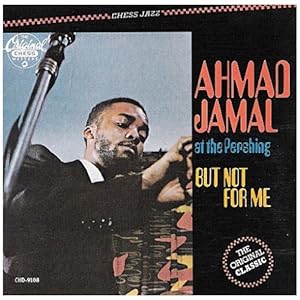
120. Ahmad Jamal / At the Pershing, But Not For Me (1958)

Out of Jamal's handful of live albums, each one a gem, At the Pershing stands out to me as essential listening. It was originally released on Chess Records' Argo label and became a smash hit, a coup for the label that had recorded a goodly variety of music but not broken into the jazz markets held by Blue Note, Verve, Columbia, or smaller labels like Prestige. Widely influential, it's become a classic. Jamal's emergent style is the principal attraction but the trio consisting Israel Crosby and Vernell Fournier isn't to be fooled with. Their brand of jazz is superbly crafted and seamlessly executed. Cooperation and interplay between bass, drums and piano is supernatural. Listen to the sparse but beautiful "Poinciana," demonstrating Jamal's wise but playful use of space and silence while the rhythm section carries a percussive groove. Some of the selections clearly presage the work of Miles Davis' first great quintet. My only complaint? On the original liner, Jamal writes that he himself selected eight tracks of the 43 they recorded 16 January 1958. Gambit's Complete Live at the Pershing Lounge 1958 offers only 20 tracks. I did the math, and while Jamal is still playing dates, it'd be darned nice to have those missing tapes....

Saturday, August 3, 2013

119. The Great Jazz Trio / Standard Collection (1987)

This great CD by Denon is sadly out of print. The trio is agile and smart, working through 16 standards, just as the title implies. Hank Jones is eloquent and a joy to listen to. On the drums is Jimmy Cobb adding just enough muscle to spread it out but playing with impeccable taste ("Caravan"). The bass chair this time is Eddie Gomez, who stands out in slippery but very melodic solos like "S'wonderful," "Embreceable You," or the excellent rendering of "Sophisticated Lady." The trio is augmented at times by the violin of Lewis Eley ("Autumn in New York," "Isn't it Romantic") adding a touch of style similar to the effect Ray Nance had on the Duke Ellington band. The album's selections fall mostly to the Ellington-Strayhorn team, Thelonious Monk, and George Gershwin. The pacing is good and the band is professional. They work closely and make a solid unit, Cobb and Jones especially. As I mentioned, Standard Collection is out of print but worth it, I think, for a band that plays straight from the heart. If you're interested in the other work by this fine and ever changing group, please see the Great Jazz Trio Discography page by 441 Records. The last four tracks composed by Monk are played by Jones with a special fondness, it seems.

Thursday, June 27, 2013

111. Duke Ellington, Charles Mingus & Max Roach / Money Jungle (1963)

Money Jungle is all about contrasts and individuality. The music is famously, and often physically, tense. The grit is established on the first track "Money Jungle" where Mingus spends much of his time aggressively bending a static harmonic element while Duke assertively pounds big blocks across the registers. Each musician has a distinct playing style, and no one gives an inch for the notion of a group product. Remarkably, a unique group product is exactly what we get. The mood often swings to moments of quiet beauty, but rocks quickly back to outbursts of boulder dropping and more assaults on bass and drums. At times it sounds as if Duke is pointing to sections of his orchestra which are not actually in the studio, playing electrifying chords in his characteristic staccato style before drawing back in contemplation and moving his hands to other registers. With the keyboard laid out in front of him, he's arranging while improvising. A listener with experience with titles in the Duke Ellington catalog will hear the bones of the brass and reeds as sections rise and fall in the imaginary arrangement. I'm happy Duke had the foresight to request making this album with one of his greatest adherents, Charles Mingus, possibly the only talent in jazz that may have been equivocal in terms of composition, orchestration or arrangement.

Tuesday, May 28, 2013

109. Julie London / Julie is Her Name (1955)

Julie London's range and the timbre of her voice is one that sits very well with me. Ensconced within her silky mezzo soprano is a space filled with sumptuous partials and overtones that make a single note sound like a chord. Her voice and my wife's are quite similar so when I listen, I sense something familiar. In the classic debut Julie is Her Name, London's young voice is the main attraction and backed often by only a guitar. Her phrasing and timing leave you on the edge of your seat, wondering where the next phrase will fall ("It Never Entered My Mind"). She's always playing this way with the lyrics and her timing, while Barney Kessel anxiously holds back comping. Later in her career, she fronted a big band whose eloquence and power gave her smoldering vocals and lovelorn ballads some extra emotional impact. But here it's all Julie. The album opens with the quintessential "Cry Me a River," and moves through 12 other standards and ballads including aforementioned, quirky "It Never Entered My Mind," and the beautiful "Laura." There's also a second volume, which is just as bit as this first volume, two records that should be on every jazz lovers shelf.

Friday, April 19, 2013

86. The Oscar Peterson Trio / Night Train (1962)

Probably the most well known of all Oscar Peterson dates, thanks to the archetypal deep swing of the title track. I read that Peterson's father was a railroad porter, and the composition and album are a tribute to him. The leader invests a lot of emotion in these quiet but swinging selections. There's a lot of good material on this record -- "C-Jam Blues," "Georgia on my Mind," "Moten Swing," "Honey Dripper," and "Night Train" are all bona fide classics. Peterson is comparatively quiet behind the keys, humming less and seemingly content while employing bouts of delicious slides and twinkling arpeggios to get his point across. He uses the dynamics of the keyboard very effectively to underscore the emotional impact of each piece. And remember those other two -- Ray Brown and Ed Thigpen -- ain't no slouches, either. I think Ray's about as bluesy as Oscar. Four stars, and a good album for a date.

Wednesday, April 10, 2013

77. Nat Adderley / Work Song (1960)

Some corners of hard bop were already getting funky by 1960 but Nat's classic album still sounds ahead of the curve. Selections are like a hard bop stew, highly inspired music expressed in various forms of funkified rhythm and blues, bop, gospel, and truly aching ballad work. Sam Jones makes an impression on me. He slides all over the place and plays his choruses as if he has a guitar sitting on his lap. His doubling on cello and movement to the front line boldly pays big dividends. Wes Montgomery was in on the session, and between these two there's enough bluesy gumption to hold down that part of the fort. This doesn't stop everyone else from contributing, though. The early "Work Song" and Cannonball's "Sack of Woe" are a fine one-two punch, except they're separated by three equally impacting tracks. At times, Adderley breaks the sextet down to a trio or quartet so there's evidence that this group could be effective hitting on all six or with just half its compliment. It's an album with levels that has staying power for a reason, fine music thoroughly worth its salt.

Monday, April 8, 2013

75. The Bad Plus / Prog (2007)

I admit the title caught my eye: Prog. I like Bad Plus well enough, even if their brand of jazz-rock fusion tends to wear thin (or thick) on my ears after so long. In jazz we describe them as a piano trio. I say they're a power trio, lying closer to Cream than Oscar Peterson. Sure, that's a minor conundrum of classification, but this is an interesting album, and what we call "jazz" has become an interesting field, to say the least. There are some terrific originals (I like Iverson's "Mint" and Anderson's epic "Giant"), but this record's trick is in the interpretation of progressive rock like Rush ("Tom Sawyer"), David Bowie ("Life on Mars"), and Tears for Fears ("Everybody Wants to Rule the World"). These invoke the roots of both the prog rock and jazz-rock fusion, a crossing of wires in a genre of crossed wires. I love it. Remember Mahavishnu Orchestra, Miles Davis, and Return to Forever? How they smashed exploratory jazz head-on with the fury of electricified rock and roll? All those extravagant displays of musicianship that pushed the envelope so far into left field that the genre designation didn't just stop mattering, it ceased to be? My language skirts hyperbole, but that's how I feel when I listen to Prog. I think they've really hit the nail squarely with this record -- it is innovative, attentive, intelligent, and really exciting. It cuts straight to the root of why these compositions have come to be what they are to us, and why we appreciate either style of music, running with that idea until the band is out of string and must make its own. And that thrill is why I listen to jazz.

Wednesday, March 27, 2013

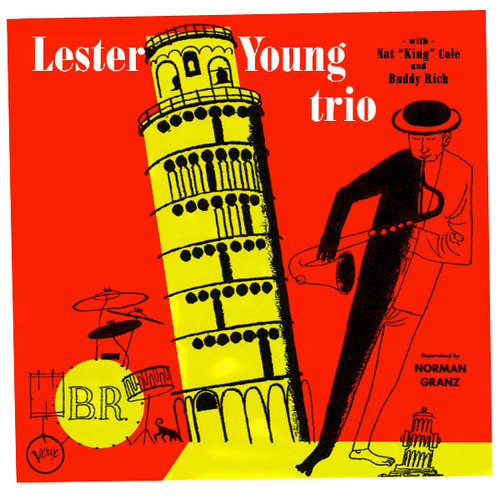
63. Lester Young Trio with Nat King Cole and Buddy Rich (1946)

This is Lester Young right after the war, 1946, and leading a piano trio with Nat King Cole and Buddy Rich. It's the comfort food of jazz, and very satisfying. Young's lines are the epitome of their form, sweetly imagined, and sound as much like lines in a conversation as they do lines of melody on a saxophone. It's a good example of Young's casual, easy swinging style, and with just two other guys in the group, it's everywhere on the record. Nat's left hand does somersaults in playful runs, inventive patterns and good rhythmic chording, making the idea of a bass player obviously redundant. Cole interacts with Lester a lot. The pair is constantly trading ideas and listening to one another intently. Rich mostly uses the brushes but makes a relaxed vibe, keeping tempos taut and encouraging the soloists. There's a lot to choose from. The CD issue has two versions of "I Cover the Waterfront" and a handful of outtakes at the end of the disc which are nice. 

Monday, March 25, 2013

61. Grant Green / Grant's First Stand (1961)

Green's debut for Blue Note, his first disc as leader, frames him in a swinging organ trio with Baby Face Wilette and Ben Dixon. It's a good crew to support Green, two players who are very much in the same frame of mind. It's not a crowded sound, although everyone is busy, but when one member takes a chorus, the inherently sparse nature of the trio puts the soloist front and center for your enjoyment. Wilette's organ gives bluesy grooves like "Miss Anne's Tempo" or "Blues for Willarene" a heartier texture and emotional urgency that Green balances with velvety smooth and bop influenced melodic runs on the guitar. He's not a chord freak, so his music has a different feel than some other jazz guitarists. Dixon is very active, fleshing out the trio's overall sound and making his presence loud and clear. He's a great drummer who is no stranger to the format, and does an admirable job here, his affinity for the work of Art Blakey rumbling loud and clear. While it isn't really fair to call a guy's first record his best, especially when he made so many others after it, this album may be just that good.

Tuesday, February 12, 2013

32. The Jimmy Giuffre 3 / The Easy Way (1959)

The Easy Way is darned sneaky, the way it passes so quietly upon first listening. The music is so sparse that it stops your breath like a stillborn moment, a feeling almost too sparse, but the second time around, that same quality forces a closer inspection and reveal ongoing relationships of very dynamic interplay at the heart of the chemistry. I keep going back to it. In this 1959 session, Giuffre swaps bassist Ralph Pena for Ray Brown, trading the busy sound of Pena for Brown's commanding and bluesy style. They work with it. On "Ray's Time" we get an extra dose of the Ray dimension while Jim Hall comps and Giuffre lays out. When Giuffre is playing he is taking a lot of ideas from Brown and Hall, who turn them right back around. The album is divided into two distinct halves: the first comprised of blues like the Ray tune and standards like "Mack the Knife," and a more exploratory or section, marked by "Time Enough," "Montage," and "Off Center."

Monday, February 11, 2013

31. Wes Montgomery / Boss Guitar (1963)

This is a really slick album by the Wes Montgomery trio, one of four recorded with organist Melvin Rhyne. Montgomery takes most of the leads, although Rhyne does get a few. When he does, he doesn't use the draw bars much, although he plays a great bass accompaniment on the pedals and occasionally uses the bars while interplaying with Jimmy Cobb or comping. So it's pretty much Wes Montgomery, right up front, all the time. Most of the tunes are standards except for two. It's accessible music of the funky and soulful variety that Wes purveyed across his career. The music is so smooth that it's almost easy to ignore if Montgomery wasn't so good, and Jimmy Cobb certainly keeps listeners awake on the drum kit. He does the octave picking a little bit, but does more blues-based riffing and plays some very spontaneous figures in the upper register that remind me of alto saxophone technique. "Besame Mucho" is the standout mark of a seasoned professional and Montgomery's own "The Trick Bag" really heats up. From the looks of things, I think Rhyne and Cobb like "Trick Bag," too. 

Saturday, February 9, 2013

29. Ahmad Jamal / Chamber Music of the New Jazz (1955)

I find myself listening to the 'original unconventional' piano trio again and again, and I enjoy it more each time I hear it. It's light and refreshing, cracking with good ideas and smooth sailing without even a hint of drums. Why bother? Jamal has Israel Crosby doing great interplay on bass while also hitting the pulse, and Ray Crawford strikes and plucks the guitar for a similar effect. Crawford has some good solo space, too, while Jamal comps or plays with Crosby. The three musicians have effervescent chemistry and often finish each other's sentences, musically speaking. Jamal has enough room to use the piano trio for what it was meant intended. He does all kinds of inventive stuff and blocks or plays alone with his right hand, occasionally dropping boulders to make the point. You can hear he's trying stuff out, and uses the full range of the keyboard, too. The influential player and album were like a drop of water for the arrangers' seed, inspiring Gil Evans and Miles Davis to the heights of cool in the 1950s. Best part is when it comes to Jamal, this album was only the beginning.