Recent listening, current
Archived listening, 2013-2016
Showing posts with label ballads. Show all posts
Monday, June 22, 2015
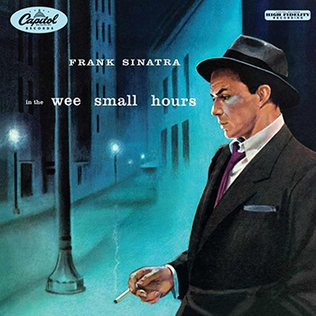
206. Frank Sinatra / In the Wee Small Hours (1955)
Though not as languished as 1959's No One Cares, this album of ballads sets the bar for melancholy, as well as being the first of the themed (and innovative) full-length LP's that Sinatra recorded for Capitol. Gordon Jenkins arranged and conducted on No One, but originally it was Nelson Riddle at the stand. The collaboration is magical. Riddle's restrained treatments underscore the mood of each lyric and magnify their impact. Sinatra expertly uses breath control and different vocal textures to interpret the material while Riddle's charts employ orchestral color at all the right incidental moments. Sinatra sings the passages carefully, sounding deeper and more mature than ever before. The frankness of songs like "Last Night When We Were Young," "I See Your Face Before Me," and "When Your Lover Has Gone" have secured In the Wee Small Hours a permanent place in the hearts of many fans. It remains one of his most satisfying and moving performances on wax. More than a routine set of ballads, it only takes a few notes to know that Sinatra is making these songs his own. At the same time, they're yours too.
Saturday, April 19, 2014
192. John Scofield - A Moment's Peace (2011)
Like any other artist, John Scofield is no stranger to the ballad, which is amply represented in his back catalog and live repertoire. But A Moment's Peace is the guitarists first album consisting entirely of ballads (Scofield's albums are big on themes, anyway). It's a really enjoyable set of standards with Brian Blade, Larry Goldings, and Scott Colley on hand to help out. They deserve congratulations because while anybody will recognize these tunes, when the band locks in with Sco in the lead for emotive rushes like "I Want to Talk About You," or the slippery bends and bluesy explorations of "Gee Baby Ain't I Good to You," it's still pure magic, despite the age of the music. Scofield's guitar is heard in a judiciously reverberant, tone saturated signal that is occasionally augmented by simple effects like tremolo, or Scofield rolling the volume knob for shading and dynamics. I love that technique, especially when Blade is playing sympathetically, and Goldings starts to use the draw bars in the same track... the cumulative effect of both instruments pulsing together creates a blissfully disorienting sonic texture that shimmers like light reflecting on a water surface. A Moment's Peace was good when I heard it three years ago, and it is getting better. Highly recommended.
Friday, February 14, 2014
177-185. Music for St. Valentine's Day?
173. John Coltrane / Coltrane For Lovers (2001)
As long as you don't accidentally mix this up with Stellar Regions, it's ready-made for a date. A posthumous release on the Impulse! label, Coltrane For Lovers showcases Trane's work with the ballad. Included are tracks with Johnny Hartman (like "My One and Only Love") and Duke Ellington ("In a Sentimental Mood"), as well as the superb "After the Rain." This set would be even better if it included things from the Prestige catalog like "I Want to Talk About You" or "Lush Life" -- a homebrew playlist solves that, or just purchase The Gentle Side of John Coltrane, also on Impulse! The album serves with distinction as the one I see for sale most often at the mall.
174. Derek & the Dominoes / Layla and Other Assorted Love Songs (1970)
The tortured "Layla" has become iconic of blues rock and a radio staple, but its arresting power, continued through the rest of the epic set recorded in Miami, Florida, reaches every high and low possible in a romantic relationship -- loving, leaving, missing, cooing, trash talkin'... whether "I Am Yours" or you've got the "Keys to the Highway," it's all in there. Duane Allman is on hand (and on bottleneck) to press the point.
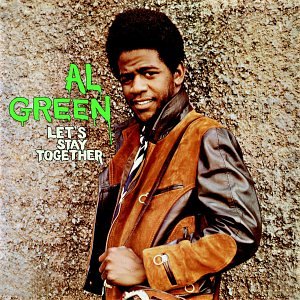
175. Al Green / Let's Stay Together (1972)
The ultimate R&B record. The songs are concise and earnest. Green's velvety delivery and rich emotional timbres drip from these soulful grooves, easily the best record that Green made with producer Willie Mitchell. It's sexy, it's strong, it's beautiful. It's Al Green.
176. Otis Redding / The Ultimate Otis Redding (1986)
Classic tracks, sufficiently casual but with intimacy compelled by Redding's yearning vocal. This easy to find compilation contains some of my favorites like the wrenching "That's How Strong My Love Is," "Pain in My Heart," as well as "Try a Little Tenderness." If you can't warm up to Otis, you must have no heart at all.
177. Frank Zappa / Cruising with Ruben & the Jets (1968)
Hunh? Love comes in many forms. Zappa's Ruben allows you to get your "Cheap Thrills" on the backseat, or maybe opine how wronged you were when snookums threw your best shark skin suit out on the lawn. Humor aside, you have the unmistakable nice-guy touch of "Sweet Baby Ray" Collins. And one starts to get the impression that this is really Zappa's love letter to the malt shop pop music that he loved.
178. Marvin Gaye / Let's Get It On (1973)
No introduction required..
179. Duke Ellington / Indigos (1958)
1958, the Ellington band runs through some popular blues like "Solitude," "Where or When" and "Autumn Leaves." Surprisingly, there are more covers than originals. Low and slow is the tempo, leading some overeager critics to condemn it as a snoozer. My take? Such listeners obviously missed the point. Indigos is probably as close as Duke and Company ever got to a record of slow jams. But they steer wide of the saccharine, the commercial, the banal, or outright schmaltz. Something about these stately renderings continues to captivate me.
180. John Scofield / A Moment's Peace (2011)
No space jazz here. Scofield is a remarkably fluent guitarist, capable of reaching the outer fringes of musicality in jams that recall the Grateful Dead in 1970 more than the jazz clubs of New York. Here he attempts, and succeeds in crafting a sleek and modern ballads-only set that are specifically not easy listening. The band really plays, as Sco describes, which makes all the difference. There are five fine originals, but check out the blissful cover of Carla Bley's "Lawns," or the Lennon-McCartney favorite "I Will."
181. Terence Blanchard / Wandering Moon (2000)
I've already described Wandering Moon in this blog, so I won't add too much to it here, except that it strikes me as one of the most effectively melancholy jazz dates I have ever listened to. Talk about deep and blue. Grooves by Dave Holland, a tribute written for Sweets Edison, and more than enough minor key lamenting for a whole bus of heartsick musicians, the music herein also retains a confidence brought by superior musicianship.
As long as you don't accidentally mix this up with Stellar Regions, it's ready-made for a date. A posthumous release on the Impulse! label, Coltrane For Lovers showcases Trane's work with the ballad. Included are tracks with Johnny Hartman (like "My One and Only Love") and Duke Ellington ("In a Sentimental Mood"), as well as the superb "After the Rain." This set would be even better if it included things from the Prestige catalog like "I Want to Talk About You" or "Lush Life" -- a homebrew playlist solves that, or just purchase The Gentle Side of John Coltrane, also on Impulse! The album serves with distinction as the one I see for sale most often at the mall.
174. Derek & the Dominoes / Layla and Other Assorted Love Songs (1970)
The tortured "Layla" has become iconic of blues rock and a radio staple, but its arresting power, continued through the rest of the epic set recorded in Miami, Florida, reaches every high and low possible in a romantic relationship -- loving, leaving, missing, cooing, trash talkin'... whether "I Am Yours" or you've got the "Keys to the Highway," it's all in there. Duane Allman is on hand (and on bottleneck) to press the point.
175. Al Green / Let's Stay Together (1972)
The ultimate R&B record. The songs are concise and earnest. Green's velvety delivery and rich emotional timbres drip from these soulful grooves, easily the best record that Green made with producer Willie Mitchell. It's sexy, it's strong, it's beautiful. It's Al Green.
176. Otis Redding / The Ultimate Otis Redding (1986)
Classic tracks, sufficiently casual but with intimacy compelled by Redding's yearning vocal. This easy to find compilation contains some of my favorites like the wrenching "That's How Strong My Love Is," "Pain in My Heart," as well as "Try a Little Tenderness." If you can't warm up to Otis, you must have no heart at all.
177. Frank Zappa / Cruising with Ruben & the Jets (1968)
Hunh? Love comes in many forms. Zappa's Ruben allows you to get your "Cheap Thrills" on the backseat, or maybe opine how wronged you were when snookums threw your best shark skin suit out on the lawn. Humor aside, you have the unmistakable nice-guy touch of "Sweet Baby Ray" Collins. And one starts to get the impression that this is really Zappa's love letter to the malt shop pop music that he loved.
178. Marvin Gaye / Let's Get It On (1973)
No introduction required..
179. Duke Ellington / Indigos (1958)
1958, the Ellington band runs through some popular blues like "Solitude," "Where or When" and "Autumn Leaves." Surprisingly, there are more covers than originals. Low and slow is the tempo, leading some overeager critics to condemn it as a snoozer. My take? Such listeners obviously missed the point. Indigos is probably as close as Duke and Company ever got to a record of slow jams. But they steer wide of the saccharine, the commercial, the banal, or outright schmaltz. Something about these stately renderings continues to captivate me.
180. John Scofield / A Moment's Peace (2011)
No space jazz here. Scofield is a remarkably fluent guitarist, capable of reaching the outer fringes of musicality in jams that recall the Grateful Dead in 1970 more than the jazz clubs of New York. Here he attempts, and succeeds in crafting a sleek and modern ballads-only set that are specifically not easy listening. The band really plays, as Sco describes, which makes all the difference. There are five fine originals, but check out the blissful cover of Carla Bley's "Lawns," or the Lennon-McCartney favorite "I Will."
181. Terence Blanchard / Wandering Moon (2000)
I've already described Wandering Moon in this blog, so I won't add too much to it here, except that it strikes me as one of the most effectively melancholy jazz dates I have ever listened to. Talk about deep and blue. Grooves by Dave Holland, a tribute written for Sweets Edison, and more than enough minor key lamenting for a whole bus of heartsick musicians, the music herein also retains a confidence brought by superior musicianship.
Tuesday, May 28, 2013
109. Julie London / Julie is Her Name (1955)
Julie London's range and the timbre of her voice is one that sits very well with me. Ensconced within her silky mezzo soprano is a space filled with sumptuous partials and overtones that make a single note sound like a chord. Her voice and my wife's are quite similar so when I listen, I sense something familiar. In the classic debut Julie is Her Name, London's young voice is the main attraction and backed often by only a guitar. Her phrasing and timing leave you on the edge of your seat, wondering where the next phrase will fall ("It Never Entered My Mind"). She's always playing this way with the lyrics and her timing, while Barney Kessel anxiously holds back comping. Later in her career, she fronted a big band whose eloquence and power gave her smoldering vocals and lovelorn ballads some extra emotional impact. But here it's all Julie. The album opens with the quintessential "Cry Me a River," and moves through 12 other standards and ballads including aforementioned, quirky "It Never Entered My Mind," and the beautiful "Laura." There's also a second volume, which is just as bit as this first volume, two records that should be on every jazz lovers shelf.
Saturday, May 11, 2013
100. Various Artists / Jazz Ballads for Late Nights (2000)
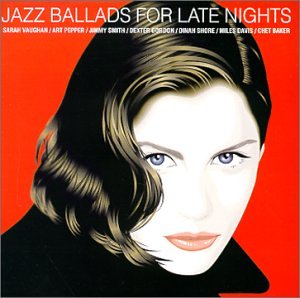
In spite of similar thematic content, ballad comps are not often interchangeable. Each one has a different character depending on who's on it and what tunes they do. You could almost divide them into subcategories of microthemes. Take Sinatra's No One Cares or Chet Baker's Chet, and it's easy to see. Would you play the Sinatra record for a date? Never. Yet Chet could be perfect for a romantic occasion, and in another way, its stormy introspection also suits a party of one. Jazz Ballads for Late Nights has a mood that's suitable for two and seems made that way. It begins with the profound and majestic occasion of Sarah Vaughan singing her blues in "Round Midnight," but the rest of the disc has a warm atmosphere that leans the way of love shared, rather than love lost or unrequited. There is a sly, almost playful "Willow Weep for Me" by the Three Sounds, and also a swank "Lover Man" by Jimmy Smith, with beautiful and rhythmically provocative alto work by Lou Donaldson. Several vocals even the pace, reminding you and that special someone why you're listening (Baker's quaint and pining "My Ideal," or Dinah Shore's "My Melancholy Baby"). I think the mood on the Baker tune should have closed it out, preceded by Ike Quebec, and not the other way around. Baker veritably whispers the closing statements and makes it the perfect song to end on, and it doesn't leave you keyed up the way Ike's impassioned soloing does. But these are mere quibbles. What more do you need? Short answer: a babysitter.
Friday, April 5, 2013
72. Frank Sinatra / No One Cares (1959)
This collection of lovelorn standards is about as dark as Sinatra gets. The selections, with orchestra, were arranged and conducted by Gordon Jenkins. They collaborated on several other albums for Capitol, and oddly enough this is my favorite. Sinatra supposedly referred to this as a set of suicide songs, although I haven't verified that. One might listen and think some levity is in order, but is it really? While the material and arrangements are stormy (the photo on the jacket ain't no joke), the mood is a nice change of pace and Sinatra's mature performance is rich and captivating. He sings confidently and in good voice, working through the likes of "I Don't Stand a Ghost of a Chance," "I Can't Get Started," and the superb "Stormy Weather," and a handful of others big and small. I think some of these performances might be worthy of their own benchmarks, even as high as the bar was set by other performers in earlier times. Enjoy the CD which contains several previously unreleased bonus tracks.
Thursday, February 28, 2013
46. Donald Byrd / Byrd's Word (1955)
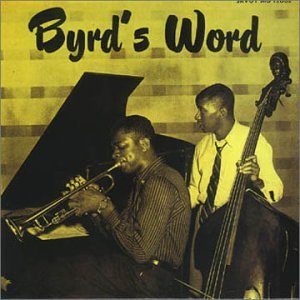
It was announced that Mr. Byrd passed away early this month. Before his role in jazz education and outreach, Byrd was a noted session leader and prolific collaborator. Byrd's Word (not to be confused with Charlie Byrd's Byrd's Word! from 1958) is an early disc of his that was recorded for Savoy in 1955 and shows his original, pre-funk style on the open trumpet. When a guy has a good tone, I love to hear him use it. That's the case here, although his licks are understated compared to his pyrotechnics on other people's dates, like Coltrane's exemplary "Lush Life." Chambers plays bass, Basie alum Frank Foster and the versatile Hank Jones do tenor and piano, with Kenny Clarke on drums. Byrd's "Gotcha Goin' n' Comin'" is a bluesy exercise in mood and rhythm that seems to be as much about Clarke and Chambers, as it is about Byrd. There's a lot of space in the middle and it's heavy on the atmosphere. But once it whispers goodbye, the followup is the jolting "Long Green" that sounds straight off one of the Charlie Parker Savoys. Foster is a versatile player who can play bop as well as he can do hard swing or ballads. There's room for everyone, before the album closes with "Star Eyes" and the beautiful "Someone to Watch Over Me." The latter is my favorite cut on the album, but it works only if I listen to the whole album first. It's a fitting closer to the preceding program, featuring a sentimental intro from Byrd, a moving legato chorus from Foster and one from Chambers, then the go-lightly contributions of Jones and all, who carry it out and are careful not to break the magic. Overall it's a very loose hard bop session that's probably easy to forget and may be similar to other groups, but is superbly rendered.
Thursday, February 21, 2013
40. Joe Harriott / Cool Jazz with Joe (1954)
Harriott is a shady figure in American jazz circles, unknown except to the most academically inclined fans of post-bop, or attentive listeners of the avant-garde and free jazz a bit later. Harriott, a British alto by way of Kingston, Jamaica, could do both. In straight ahead mode, he played with dazzling fluidity and a laid back, bluesy sensibility, combining Birdlike flights into the upper register with dancing snatches of melody that walked down again in idiosyncratic syncopations immediately recalling those of a mento band. When I listen to this early EP, I hear licks that I've never heard anyone else do. Here he plays four standards with his working group, including the equally talented but no less obscure pianist, Dill Jones. While a cursory glance at the liner seems to fulfill the lie that British jazz musicians would forever emulate their American counterparts, Harriott forges ahead with a deftly original set that begs you to reconsider. Fractions of a second behind the beat a bit like Hank Mobley would later do, Harriott is a stylist whose impact one can only speculate upon, had he been based in New York, and not London. The opener "April in Paris" has bold melodic statements from Harriott who occasionally emphasizes another, more danceable rhythm he sees lurking just below the surface, accentuating the relationship with figures of repeated notes, catching the attention of drummer Phil Seamen in the process. "Out of Nowhere" sees Harriott treating us again with Caribbean inclinations. The evocative "Summertime" features some moody work by Dill Jones, and the ubiquitous "Cherokee" frames Harriott's chops in the quintessential bebop composition. This EP is out of print, but is available (along with a herd of others) from the good people of the BritJazz blog. Please pay them a visit for the download link, and drop them a line to say thanks while you're at it.
Monday, February 18, 2013
38. Miles Davis / Ballads (1990)
Talk about the quintessential nonessential Miles Davis CD, this is it. Columbia compiled a scanty eight tracks recorded between 1961 and '63, and released them here with a ballads-only theme. Very little about Miles Davis in the sixties sounds dated or anachronistic to my ears, but in today's climate of iPods and customized playlists, such a compilation album doesn't have the same role it did in 1990. And this product, as a whole, hasn't aged well even if the opposite is true for the selections themselves. I say it didn't age well but I'm not sure it would have made sense 20 years ago, either. First, it's an odd choice of material if you're trying to showcase what Davis could do with a ballad. Five tracks by the Gil Evans orchestra, two by the quintet with George Coleman and a live cut by the Mobley quintet is a rather baffling sequence. Are we doing Evans, or a club date? Because the two are so unlike each other that the program seems interrupted when the group changes. The very context of the Gil Evans orchestra was so different than that of a street group, any street group, that a ballad within its fold is a thing transmuted, a wholly different musical animal. Good work from everyone involved musically, but shame on Columbia for ever selling this.
Labels:
1961,
1962,
1963,
1990,
ballad,
ballads,
columbia,
compilation,
cornet,
george coleman,
gil evans,
hank mobley,
jazz,
miles davis,
orchestra,
quintet,
trumpet
Subscribe to:
Posts (Atom)


