Recent listening, current
Archived listening, 2013-2016
Showing posts with label film. Show all posts
Saturday, September 7, 2013
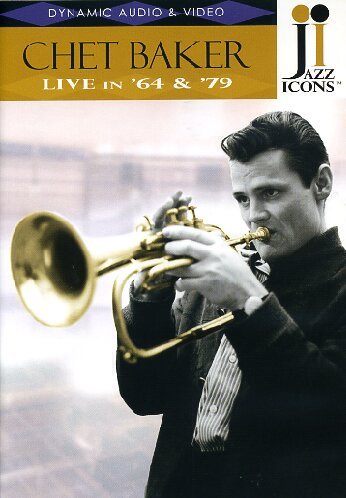
134. Chet Baker / Live in '64 and '79 (2006)
Baker's music definitely matured, although his development is sometimes difficult to appreciate given how his drug habit impacted his life and performances. This DVD from Jazz Icons shows him playing with two European groups, 15 years apart. In the '64 quintet I sense tension between the underplayed Baker and overactive pianist Rene Utreger, who is constantly throwing heavy handed chords at the end of Chet's phrases, sometimes before they appear to be completed. It's like a leadership dispute, and the band or producers clearly have their own ideas about who falls where. In spite, Baker manages a lovely "Time After Time," though the quintet's take on "So What" seems like a missed opportunity. Baker has trouble finding space to express himself and fights with the group, and also has difficulty with the intonation. The second performance is from '79 and begins with an interview that segues into "Blue Train," in progress. Baker says his lyrical approach to improvising has become more subtle with experience and the performance reflects this. The drummerless quartet is much more together than the '64 group, thankfully, and Baker's rich sumptuous tone pervades the set. Although "Blue Train" is truncated (which stinks, because what we do hear is beautiful), we get a heavy swinging and creative take on "Softly As In a Morning Sunrise" with Baker's smoothly flowing melodic improvisation, the occasionally interesting turn of a chord, and overriding melancholic appeal. Also notable are pianist and vibraphonist Michele Graillie and Wolfgang Lackerschmid. I like this installment of Jazz Icons for the contrast it provides between a younger Baker and an older, perhaps wiser player with a more respectful band.
Thursday, July 11, 2013
114. Angelo Badalamenti / Music from Twin Peaks (1990)
David Lynch's highly individualistic and genre defying films have a niche all their own. A great part of the magic in films like Blue Velvet, Mulholland Drive, or the series Twin Peaks, can be credited to the composer Angelo Badalamenti whom Lynch has hired time and time again. Lynch is an auteur and when he finds something that works, he sticks with it. Other directors have famously created an arc of conceptual continuity by hiring the same actors and composers for multiple films (reluctantly, Tim Burton springs to mind) but Lynch has avoided typecasting, banality, and the curse of repeating himself. Lynch manages to work new and frightening ideas into each film while creating a mood that is distinctly a product of his own making. This soundtrack by Badalamenti is a prime example of how the composer contributes to essential mood magic. The tracks run the gamut from low key, enigmatic synthesizer statements ("Theme from Twin Peaks," "Laura Palmer's Theme") to steamy blues (like the spidery threads of "Bookhouse Boys"), and moments of rare beauty ("Love Theme from Twin Peaks"). There are some vocal spots, too, by Julee Cruise singing lyrics by Lynch and dreamy music in the vein of "Sleepwalker." And that is the operative word, here: dreamy. Remember, it's a Lynchian dream where nothing is as it seems.
Monday, May 27, 2013
108. Duke Ellington / On the Road with Duke Ellington (1967)
On the Road is a documentary film from 1967 by Robert Drew. For an artist so prolific, Duke left behind precious few film documentaries. There is music performed in the film that'll give you goosebumps but the subject isn't the music itself, it's Duke and how he lives and works. The picture is grainy and saturated like an old Super 8, the audio is muddy, and you'll instantly disregard that because from the outset, you're aware that this is the best film on Duke Ellington that there is. It's delicious, for a Duke fan like me. The camera follows him in his daily routine as he opens his mail, lingers too long backstage on the piano, composes a new tune, or has his breakfast -- hot water, steak and potato, the same breakfast he's had for 40 years. Duke is a funny, funny guy. He's an autocratic employer, an eloquent speaker, and madly devoted to his craft. You see him flirting with fans at the airport, or backstage having a natter with Louis Armstrong, just talking like two old friends, which is extremely interesting. The bottom line is that Duke Ellington runs the show whether it's on the road, at home, or accepting an honorary doctorate. He works all nighters while he's not performing and performs when he's not working. At one point, he tells the crew that he can't imagine what retirement means because stagnation will not look good on him. And it's true, he worked until his death six years later. I think I learned that if I truly want what I think I want, then I know I'm not working hard enough. Like a thunderstorm, the power, sophistication, and beauty of Duke's orchestras always excited and impressed me. Watching it happen in the making reinforced that notion.
Subscribe to:
Posts (Atom)