Recent listening, current
Archived listening, 2013-2016
Showing posts with label big band. Show all posts
Saturday, December 12, 2015
208. Lionel Hampton / Hamp: The Legendary Decca Recordings (1996)
This two-disc set by Decca Jazz was produced by Orrin Keepnews and released in 1996. Its 36 tracks present two decades of music from a motley handful of bands, strong selections that amply demonstrate the bands' power and talent. Its main attraction for me is the inclusion of several scorching live cuts. But the track sequence isn't plagued by the problems inherent to retrospective collections like an excess of vocal numbers, songs in the same key, or long runs of tracks by the same group. The disc starts live in 1945 with a wild, careening orchestra whose high energy and charm inspires jealous visions of what a swing concert was like during the heyday. Throughout, the soloists are wide and varied (Jacquet, Gillespie, Shavers, Grey, et al) and, like many of the era's best known bands, Hamp's rosters are a veritable skeleton key to the door of jazz greatness. While Hamp is not an authoritative guide nor a complete collection by any means, it is an immensely enjoyable and astutely compiled survey of one of the 20th century's most influential bandleaders and his equally influential players. Recommended.
Sunday, August 17, 2014
196. Buddy Collette / Live from the Nation's Capital (2000)
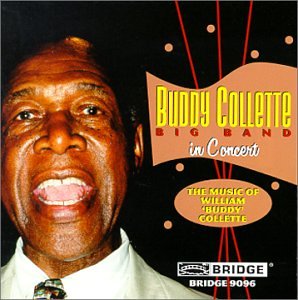
Buddy Collette was an originator on the West Coast jazz scene. He cofounded the Chico Hamilton Quintet and devoted his time to education, as well as composing and performing. This live disc from 2000 captures a Collette program for the ages, and its disparate contents cover the arc of his career. Performance and audio production are slick, typical of groups billed on the national stage. There is a lot to enjoy. Professionalism aptly describes the soloists, who play snappy, expressive lines that don't disrupt the cascading harmonies. Arrangements are by several including Collette. No matter the arranger, though, the playlist is unified by breaking the group into combos, building tension, and using the whole ensemble for bursts of energized dramatics. Nothing new under sun as far as big band goes (Gerald Wilson or Sam Rivers orchs are more my style) but the infectious bounce on tracks like "Mr. and Mrs. Goodbye" hold a warm sentimentality for a bygone era while others, like the Afro-Cuban rhythm of "Andre" or improvs on "Blues #4" keep the pace and make good use of variety. Live from the Nation's Capital isn't the most essential big band record in my collection, but it offers a lot of good stuff and demonstrates (in a very straight way) the wide array of styles that Collette worked in throughout his career.
Thursday, February 20, 2014
186. Duke Ellington / Sophisticated Lady (1996)
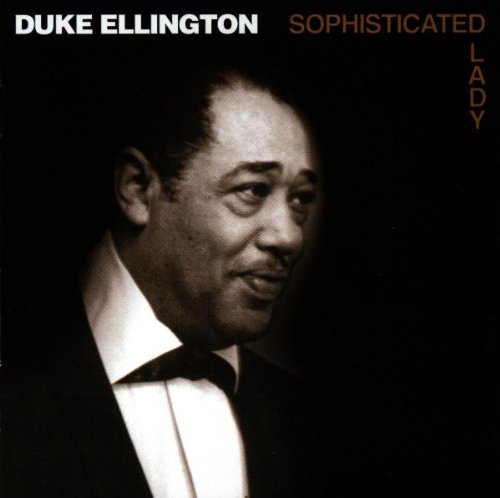
Sophisticated Lady is another cull from the legendary RCA sessions. It's a good one. Selections from the period also appear on the three-disc set, Never No Lament. But that, or Bluebird's Blanton-Webster box that spawned them all, are going to make one hell of a dent in your bankroll. On the other hand, you can buy Sophisticated Lady over at Amazon for the princely sum of one penny. I know, you have enough Ellington at home and will forgo this stage in the endless saga of repackaged jazz music. Still, a penny? I'll wait here while you go and get one. Back already? When it arrives in the mail, you'll appreciate the diversity of material and engaging sequence. Duke's best pieces are present, and there is a fair mixture of instrumental and vocal music. With Blanton at the wheel, it swings like a hammock. There is magic from start to finish. Like Kay Davis' electrifying vocal that makes "Mood Indigo," followed by Webster's whispering tenor. Tricky Sam Nanton's trombone should get you "In a Sentimental Mood," but beware the three sirens telling you "It Don't Mean a Thing if it ain't Got that Swing" (Joya Sherrill, Kay Davis, Marie Ellingon). The affair heats up to a frenzy courtesy of Jimmy B. Then Ray Nance sings "Just Squeeze Me," Al Hibbler chimes in on "Solitude"... Nothing to shake a stick at here, this is real music. This is what it all means. This is "it."
Labels:
1940,
1941,
1942,
1945,
1946,
1996,
al hibbler,
ben webster,
big band,
compilation,
duke ellington,
jimmy blanton,
joya sherrill,
kay davis,
ray nance,
rca,
swing,
victor,
vocal,
vocalist
Monday, December 30, 2013
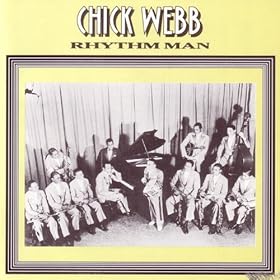
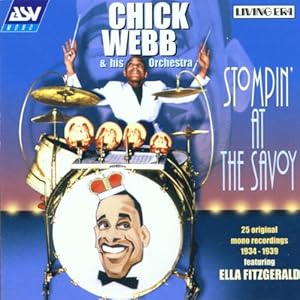
163-165. Chick Webb / Rhythm Man (HEP CD 1023) Stompin' at the Savoy (CD AJA 5416) & Stompin' at the Savoy (FABCD 119)
I've recently come across three similar compilations of the swing drummer and bandleader Chick Webb, who was affectionately known to his friends and admirers as "Little Man." Webb was a prominent leader on the '30s swing circuit, perhaps best known for introducing the world to Ella Fitzgerald who led the band following his death. Although short lived, Webb's orchestra was respectable and performed on par with the Ellington, Basie, Lunceford, Redman, and Henderson bands. Tragically, Webb died in 1939 so we don't know what kind of magical music he would have continued to make as the swing craze really took off.
All three records feature common selections in the playlists, all are released as public domain music by UK labels, but that's about where the similarities stop. If I could pick only one, I'd go with Rhythm Man. It has superior audio (transfers by John R.T. Davies), detailed liner notes including arranger credits and order of soloists, and two versions each of "Blue Minor" and "On the Sunny Side of the Street." If I could pick two of the three, then the ASV disc is the next clear winner. It has bright audio with excellent definition up top, but somewhat stingy in the low end. Like the Stompin' disc by Fab, it includes some later material not heard on the Hep release (hear "A-Tisket, A-Tasket"). Fab's Stompin' suffers from dismal and murky audio that sounds like gratuitous noise reduction, as well as some artificial reverb and overly loud levels. For all of its clarity and definition, the ASV's Stompin' sounds like it could be running a bit fast. Given, the difference in speed is only really apparent by listening to the two discs in contrast. Presently supplies are limited and ASV/Living Era imprint is defunct so better get on the stick if you'd like to own one today.
The following is a summary breakdown of each album, and should it interest you, I prepared a .PDF to download here which graphically compares the playlists of each album.
All three records feature common selections in the playlists, all are released as public domain music by UK labels, but that's about where the similarities stop. If I could pick only one, I'd go with Rhythm Man. It has superior audio (transfers by John R.T. Davies), detailed liner notes including arranger credits and order of soloists, and two versions each of "Blue Minor" and "On the Sunny Side of the Street." If I could pick two of the three, then the ASV disc is the next clear winner. It has bright audio with excellent definition up top, but somewhat stingy in the low end. Like the Stompin' disc by Fab, it includes some later material not heard on the Hep release (hear "A-Tisket, A-Tasket"). Fab's Stompin' suffers from dismal and murky audio that sounds like gratuitous noise reduction, as well as some artificial reverb and overly loud levels. For all of its clarity and definition, the ASV's Stompin' sounds like it could be running a bit fast. Given, the difference in speed is only really apparent by listening to the two discs in contrast. Presently supplies are limited and ASV/Living Era imprint is defunct so better get on the stick if you'd like to own one today.
The following is a summary breakdown of each album, and should it interest you, I prepared a .PDF to download here which graphically compares the playlists of each album.
Rhythm Man
Hep Records
HEP CD 1023
Has a lot of earlier material, not included on either of the others. Excellent audio definition, transfers done by John R.T. Davies. Best liner notes and discographical information. Lacks later material, and there are no vocals by Fitzgerald. Two versions each of "Blue Minor" and "On the Sunny Side of the Street."
Stompin' at the Savoy
ASV/Living Era (imprint)
CD AJA 5416
Contains everything on FABCD 119 except five songs. Lacks earlier material found on HEP CD 1023. Good definition and clarity, however, sounds like maybe running fast. Lower end tends to lack body. Later recording of "Sunny Side" and "Blue Minor." Fitzgerald on "A-Tisket, A-Tasket." Out of print and limited availability. Pretty good liner notes.
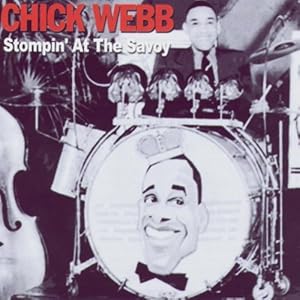
Stompin' at the Savoy
Fabulous
FABCD 119
Similar playlist as CD AJA 5416. Muddy sound lacks definition and high range possibly due to noise reduction. Is that artificial "concert hall" reverb that I hear? Boo! Speeds seem inconsistent - some too fast, others too slow. Levels are hotter than ASV, and a little less than Hep. Earlier recording of "Blue Minor." Limited liner notes and discographical information.Friday, December 6, 2013
155. Earl Bostic / Flamingo (2002)
Flamingo is a double disc compilation by the UK's Proper Records label, covering 1944 to 1951. The audio quality is very good. These groups are like many of the transitional orchestras of the 40s and early 50s. They feature veterans alongside torchbearers from swing to bop and beyond. In the early sides, we hear Bostic with Rex Harris, Cozy Cole, Don Byas, Tiny Grimes, and Lionel Hampton. Later, in his stripped down R&B orchestra, we hear a sampling of Jimmy Cobb, Wilbur Campbell, and Jaki Byard. Listen for the transition from gut busting alto to what became Bostic's trademark technique. In the 1949 sextet, tracks like "Filibuster" show repeated riffing with huge tone, but also a nimble fingered aptitude for clean, double-time runs through the scales, colored here and there with reed buzz. The lovely "Serenade" (Gene Redd on vibes) has a similar feel. Like Ben Webster, Bostic could play with arresting power, or sublime gentleness. "Flamingo," probably his best known track, has become the archetypal rendition, although it isn't much different in structure or appeal than other sides recorded by the group. I like the later sides best, but the early ones are priceless, too.
Labels:
1944,
1945,
1946,
1947,
1949,
1950,
1951,
2002,
alto,
alto saxophone,
big band,
earl bostic,
flamingo,
proper,
rhythm and blues,
septet,
sextet,
swing
Thursday, October 3, 2013
142. Miles Davis / Miles Ahead (1957)
This album is the natural progression out of the Miles Davis Nonet style that was documented on The Complete Birth of the Cool. Davis and Evans deliver on the promise with a new band almost double in size. Davis is the only soloist, playing flugelhorn instead of trumpet. Evans is composer and arranger. The sound of the orchestra is lush and slick, clear evidence of the project's bigger budget. Evans' arrangements elegantly capitalize on the power of the massed pieces, and with Davis on the flugelhorn, there's a stately majesty at play. The playlist is arranged like one continuous performance (see Such Sweet Thunder by Duke Ellington). I love the way all the moods melt into one another, contrasting against a greater arc of musical story. The Spanish tinge of "Maids of Cadiz," for example, or the hard swinging "New Rhumba" (Ahmad Jamal) that explodes from "Blues for Pablo." It's magic, and essential listening for all jazz fans. No excuses!
Monday, September 16, 2013
139. Jimmie Lunceford / Strictly Lunceford (2007)
Today, Lunceford is lesser known than his peers. This four-disc set from Proper provides a good introduction to Lunceford's work across numerous record labels. Audio and notes in the accompanying 28-page booklet are commendable. Considering how good this band was, any neglect by record companies or listeners seems a real shame: Lunceford's band replaced Cab's at the Cotton Club, an appointment that was no mean feat. Then and now, they have a lot to offer. The famously diverse repertoire uses vocals, novelty songs, and barn burning dance music on par with other great orchestras. Lunceford's driving two-beat pulse appears in tracks like "Lunceford Special." I find it instructive to compare arrangements by Sy Oliver to those done by his successor, Billy Moore, as well as the other arrangers in the group. All crackle with originality. I love Oliver's muted brass ensemble in "Chillun, Get Up!" but Wille Smith's radical take on "Mood Indigo," replete with staccato phrases and soaring three-octave accompaniment on reeds and brass, isn't to be tangled with, either. On every track, the soloists are poignantly melodic and very sweet, like Eddie Tompkins on trumpet or the aforementioned Willie Smith on alto. The eagle-eyed (or eared?) listener will also spot the likes of Snooky Young and Gerald Wilson. Don't overlook this set!
Saturday, July 20, 2013
116. Duke Ellington / Such Sweet Thunder (1957)
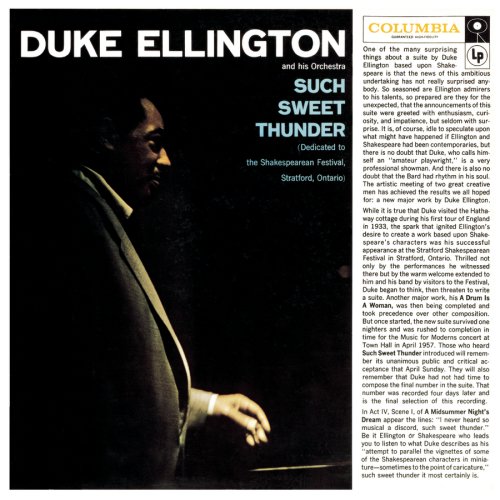
In 1999, Such Sweet Thunder was released on CD, expanded and including outtakes. It's a fantastic stereo reconstruction of the originally intended program, complete with inter-track studio ambience akin to a concert hall, formerly available only in mono due to a flawed production. The album's original 12 selections are Duke's musical interpretations of various Shakespearean characters. It's another of his concept pieces, a tone parallel like Black, Brown, and Beige. The music is filled with quirky grinners, as in "Lady Mac," where Duke writes new personality into Lady Macbeth. It shows an indulgently swinging streak to the infamous noblewoman, hitherto unseen on stage. And who's to say that's incorrect? It's refreshing. Most notably, the Ellington-Strayhorn team uses soloists in the band to great effect in pieces like "Sonnet for Caesar," the first of four such sonnets on the album that emulate the 14 line poetic form. The soloists actually play the characters with their instruments, so I wonder, wryly, if the union rep had anything to say about that. "Caesar" features Sam Woodyard imparting an appropriately martial atmosphere while Jimmy Hamilton takes the lead (literally) to portray history's great general in a stately and beauteous, but ultimately tragic, melody. The arrangements for other songs continue the trend of band-as-cast in brilliant works like "Up and Down." Here, Puck (played by Clark Terry) quotes mischievously while working the play's couples into increasingly awkward situations. Just three examples, there are nine more to enjoy. It's ambitious, and the CD release is a treasure. It's sound is brilliantly spacious and clear, and we have all the session's complete takes in one place..
Tuesday, July 16, 2013
115. Joe Lovano / Celebrating Sinatra (1997)
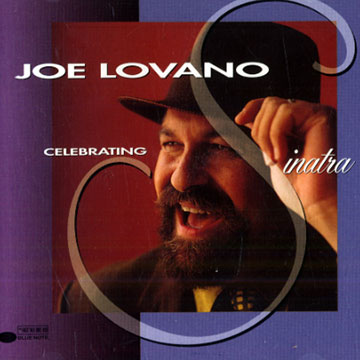
Joe Lovano here performs his version of the Great American Songbook by interpreting one of his more powerful muses, Frank Sinatra. I read Lovano's single page in the accompanying booklet and I can't disagree with him. Sinatra was consistently great for the duration of his career, and exerted a powerful influence on succeeding generations of musicians. The effect continues and this 1997 album is a prime example. As Lovano and crew cut through classics like "I've Got the World on a String," "In Other Words," or "Someone to Watch Over Me," they meld modern sensibilities and at least five decades of stylistic development in jazz with Sinatra's timeless swing. It's a natural setting for Lovano, like balm for the soul. He grew up with Frankie playing all around him, and it immediately conjures memories of his home and family, notably his Aunt Rose Verzi. A Sinatra devotee who saw him in person hundreds of times, she sounds pretty cool! Lovano was certainly taken by his auntie. His ballad work bubbles with ideas and earnest sentiment. The arrangements and orchestration aren't just tasteful, they're clever, too, as in the aforementioned "String" where Lovano weaves in and out with the cello to make a play on the lyrics in the song. Or the wild and nasty group sections culminating at the end of "One for My Baby." During "South of the Border," Lovano lets George Mraz have the first chorus, giving a new context for Lovano's solo to emerge in, instead of jumping right off the melody. The result is really fresh. Every track is as good as the next, so hats off to Joe Lovano for indulging his passion and recording this set of Sinatra staples. As with other Lovano records, it stands up heartily to repeat listening.
Tuesday, July 9, 2013
113. Duke Ellington / Far East Suite (1967)
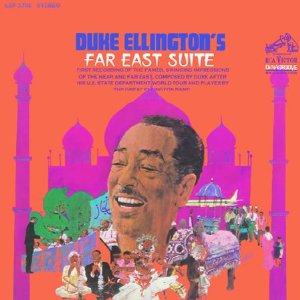
Last month, I rolled down the windows of my car after working a 12-hour day, twisted the cap off an ice cold Virgil's Orange Cream soda, and enjoyed the drive
home while listening to this record. The Far East Suite is one of Duke's last recorded works, and one whose material might sport the familiar names and faces of orchestras past but its compositions have a unique flavor among others in the Duke canon. It's been on regular rotation at my house since that evening with the soda pop. Between the grooves are yards of punchy counterpoint between reeds and brass, and some of Johnny Hodges' sweetest work on wax ("Isfahan"). And of course we are treated to equally fine work by the likes of Cootie Williams, Cat Anderson, Russell Procope, Harry Carney, et al. The recording is memorable throughout thanks to Duke's direction of the sublimely cohesive band. It is nice to hear Duke melding his percussive piano blues with sophisticated orchestral textures and touches of middle eastern music or orientalism in tracks like "Mount Harissa," "Ad Lib on Nippon" or the opening "Tourist Point of View." I was swept up by the tidal wave of sound, which is what usually happens when I listen to Mr. Ellington.
Labels:
1967,
big band,
bluebird,
cootie williams,
duke ellington,
far east suite,
harry carney,
isfahan,
jazz,
johnny hodges,
orientalism,
paul gonsalves,
piano,
rca,
review,
russell procope
Saturday, June 22, 2013
110. Mingus Mingus Mingus Mingus Mingus (1963)
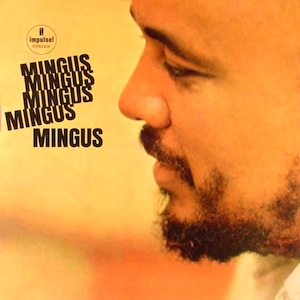
Mingus, the master orchestrator. Mingus the composer. Mingus the performer. He's got so many credits on this album that I marvel at how it doesn't sound one bit overrun by his presence, yet it's distinctly his product. The music swings with a loose and careening vibrancy that is electrified with spontaneity and invention. With just 10 pieces, his arrangements sound as quiet as a quartet or as powerful as a big band. Its performers lend the air of familiarity, dashing in and out of ensemble jams like "Better Get Hit in Yo' Soul" or blending sublimely as in the steamy rendition of "Mood Indigo." Mingus listeners will immediately sense the presence of old friends, because many of the tracks are new treatments of preexisting Mingus tunes. I'll let you figure what is what. As for soloists, I really enjoy Charlie Mariano (bias alert, I just got Blue Camel so I'm on a bit of a bender) or the shambling Walter Perkins on drums.
Monday, May 27, 2013
108. Duke Ellington / On the Road with Duke Ellington (1967)
On the Road is a documentary film from 1967 by Robert Drew. For an artist so prolific, Duke left behind precious few film documentaries. There is music performed in the film that'll give you goosebumps but the subject isn't the music itself, it's Duke and how he lives and works. The picture is grainy and saturated like an old Super 8, the audio is muddy, and you'll instantly disregard that because from the outset, you're aware that this is the best film on Duke Ellington that there is. It's delicious, for a Duke fan like me. The camera follows him in his daily routine as he opens his mail, lingers too long backstage on the piano, composes a new tune, or has his breakfast -- hot water, steak and potato, the same breakfast he's had for 40 years. Duke is a funny, funny guy. He's an autocratic employer, an eloquent speaker, and madly devoted to his craft. You see him flirting with fans at the airport, or backstage having a natter with Louis Armstrong, just talking like two old friends, which is extremely interesting. The bottom line is that Duke Ellington runs the show whether it's on the road, at home, or accepting an honorary doctorate. He works all nighters while he's not performing and performs when he's not working. At one point, he tells the crew that he can't imagine what retirement means because stagnation will not look good on him. And it's true, he worked until his death six years later. I think I learned that if I truly want what I think I want, then I know I'm not working hard enough. Like a thunderstorm, the power, sophistication, and beauty of Duke's orchestras always excited and impressed me. Watching it happen in the making reinforced that notion.
Tuesday, May 21, 2013
102. Anthology of Big Band Swing, 1930-1955 (1993)
The scope of this Decca Records compilation encompasses the whole swing era from the stomping greats of 1930 to the final holdouts of the mid '50s. The restored sound quality is excellent but the strength, or allure, of this two-disc set is the variety of material that was chosen. The editors did a great job selecting the tracks, a sure success. Their work provides a detailed and meaningful cross section of the many diverse bands playing swing music in the United States. They could have flubbed it. Decca's roster was about as deep as the Yankees bullpen, but it also had some of the biggest guys in it. So in other words, while Basie, Duke, and Benny are represented here, they're not disproportionately represented to the exclusion of the label's other, smaller acts. Instead, the spotlight spreads a little
wider. The resulting collection is presented chronologically and allows listeners to follow swing as it matured and developed over a cool quarter-century. Across 40 tracks, there are 37 different bands that will jump, jive and wail you into a frenzy. There are so many great bands here in one collection, not to mention their soloists -- Fletcher Henderson, Don Redman, Chick Webb, Jimmy Lunceford, Mills Blue Rhythm Band, Tiny Bradshaw, Jack Teagarden, Noble Sissle, Glenn Miller. And the list goes on, and on, and on! I listen to the whole thing and I get excited thinking about the era, the big dance halls and the excitement this type of music provided to people like my grandparents in such a trying time of depression, war, and uncertainty. It's difficult and expensive for a listener to take in all the swing groups one-by-one and try to put them in context. These 40 songs make it much easier to understand foundational jazz music of the '30s, '40s, and '50s. This should be on every jazz collector's shelf.
Wednesday, April 24, 2013
91. Duke Ellington & His Orchestra / Never No Lament: The Blanton-Webster Band (2003)
This superb 3-disc set from Bluebird compiles all the master takes from 1940-42, plus a handful of juicy alternate takes. These sides are for the Duke catalog what the Complete Decca Recordings are for Basie. The comparisons should generally end there, but I just want to convey how important they are not only to the group, but to the notion of jazz itself. And finally, justice was done to this historic music in terms of packaging and audio quality (I say finally, but we've had this set for 10 years now), a clear improvement over previous digital offerings. If you already own RCA's Complete Duke Ellington set and you're only a casual listener, then there isn't much to entice you into repurchasing. But if you lean the way of the completist, or you're more serious about your collection, then you really need to have this on your shelf. It's many people's favorite Duke orchestra, and in hindsight the stand looks like a murderer's row of jazz legends. Of course you get Ben Webster and Jimmy Blanton, but there's also Cootie and Cat Anderson, Sonny Greer, Juan Tizol, Ray Nance, Rex Stewart.... the list goes on and on, without even getting into the vocalists. I'm not going to bother talking about individual tracks because we all have our favorites, and there isn't a lemon in the bunch. Above all, this music proves that eloquence is truly timeless.
Saturday, April 13, 2013
80. Jimmy Smith & Wes Montgomery / The Dynamic Duo (1966)
The arrangements by Oliver Nelson are assertive but don't sound as if they're intruding on the small group which is at the core of this session. Nelson's robust charts quickly give way to the main attraction, a reactive meeting of the Smith and Montgomery schools. If you liked the big band on Smith's The Cat then you'll appreciate this album's similar vibe. There's intense, crispy drumming from Grady Tate, occasionally complemented by Ray Barretto. Montgomery on rhythm is as impressive as he is on lead, like the high-octane percussive comping in "Down by the Riverside." There's a huge contrast between the two leaders. Montgomery's smooth, melodic lines are the ideal foil for Smith's fiery, organ revival. They play off each other well. Things appear to cool off with "Night Train," but a relaxed tempo only stokes the flames! The second side is more standards, first the dark chart of "13," followed by a lighthearted "Baby it's Cold Outside." If I listen to this too soon after Bags Meets Wes, I invariably wish Smith and Montgomery could have called Bags to join them. What if...
Friday, April 12, 2013
79. Lester Young / The Complete Savoy Recordings (2002)
Labels:
1944,
1949,
1950,
2002,
big band,
bop,
complete savoy recordings,
jazz,
lester young,
pres,
president,
prez,
quintet,
savoy,
septet,
sextet,
tenor sax,
tenor saxophone
Thursday, April 11, 2013
78. Count Basie / Straight Ahead (1968)
Thursday, April 4, 2013
71. Sun Ra / Blue Delight (1989)
Blue Delight recorded alongside Purple Night and so the music retains the same character. Be advised, though, All Music Guide and anyone who quoted them got it wrong, because there is no Don Cherry heard here -- he's on Purple Night. The title track is jubilant and showcases Ra's style on the piano. He is double-fisted, percussive, highly rhythmic, and swinging. His chords are thick and the left hand interplays with the right, sometimes dividing phrases between the two, punctuating them with occasional boulders. There are stimulating interpretations of tunes like "Days of Wine and Roses" and "Gone with the Wind" but my favorite track is the Ra-riginal "They Dwell on Other Planes." Ra uses the synth sparingly, but numerous solos over the menacing vamp extend it beyond the 12-minute mark. Throughout the album, strains from Tommy Turrentine, John Gilmore, Bruce Edwards, and others usher the proceedings with excitement and color. I once heard this described as "hip music for squares or square music for hipsters" and that's it. If I find that reviewer, I''ll quote him here. I think it's damned good music, and an essential recording for listeners who enjoy their jazz left of center.
Tuesday, March 26, 2013
62. Orchestra Jazz Siciliana / Plays the Music of Carla Bley (1985)
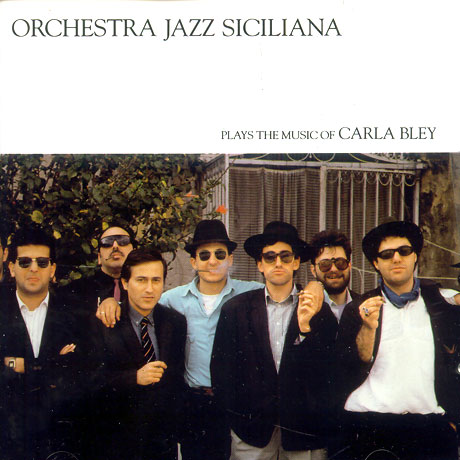
I scratch my head and wonder what type of band feels up to the task of taking on the Carla Bley catalog -- the feel, the humor, the attitude, the fun, the mayhem of it all -- and not just "doing" it, but actually doing it justice? It's a tall order not for the feint of heart, a matter complicated by the fact that you need a pretty big band to come even close. And then I find this CD, I take one look at the cover, and I know I've found the group. They might be nuts, you don't know, but you're surely not going to ask. Maybe you'll just listen and let the music do the talking. More to the point, I open up the disc and there's a photo... four photos! of Carla mugging with the band in some Mediterranean backstreet, plus a credit to her name for conducting and arranging the selections. As if that wasn't enough, Steve Swallow and Gary Valente are on hand as guests. Alto Orazio Maugeri blows my mind. In fact, they all do. I'm not a newcomer to the Carla Bley discography but somehow I missed this one completely. It's the closest anyone will ever get to doing Carla, and in a sense, it is Carla. In a word, it's perfect.
Tuesday, March 19, 2013
56. Count Basie / Count Basie at Newport (1957)
This set is a giant. Basie already has a power packed orchestra with Thad Jones, Frank Foster, Frank Wess, Sonny Payne, Freddie Greene, and a handful of others. But he invites superstars from his past bands to join them. Lester Young, Jimmy Rushing, Jo Jones, Joe Williams, and Illinois Jacquet all have a few moments to play with the current band. It's powerful music that is energetic, exciting, inspired, and obviously enjoyed by everyone on the stand and in the crowd. The tracks with Basie's reformed orchestra -- sleek and modern, young but steeped in swing and the blues -- are a nice contrast with older, swing-based musicians like Lester doing "Polka Dots and Moonbeams" followed by a frenetic "Lester Leaps In" and Jimmy Rushing singing the jaw dropping blues "Sent for You Yesterday and Here You Come Today." Rushing's gigantic voice demonstrates what it takes in terms of volume and stage presence to stand out in front of the most motley orchestra in the business. The old chemistry is still there, and this album, like Duke's record from Newport '56, demonstrates that big band wasn't dead yet.
Labels:
1957,
big band,
blues,
count basie,
count basie at newport,
frank foster,
frank wess,
jazz,
jimmy rushing,
jo jones,
joe williams,
kansas city,
lester young,
review,
swing,
thad jones,
verve
Subscribe to:
Posts (Atom)