Recent listening, current

Showing posts with label charles mingus. Show all posts

Thursday, June 27, 2013

111. Duke Ellington, Charles Mingus & Max Roach / Money Jungle (1963)

Money Jungle is all about contrasts and individuality. The music is famously, and often physically, tense. The grit is established on the first track "Money Jungle" where Mingus spends much of his time aggressively bending a static harmonic element while Duke assertively pounds big blocks across the registers. Each musician has a distinct playing style, and no one gives an inch for the notion of a group product. Remarkably, a unique group product is exactly what we get. The mood often swings to moments of quiet beauty, but rocks quickly back to outbursts of boulder dropping and more assaults on bass and drums. At times it sounds as if Duke is pointing to sections of his orchestra which are not actually in the studio, playing electrifying chords in his characteristic staccato style before drawing back in contemplation and moving his hands to other registers. With the keyboard laid out in front of him, he's arranging while improvising. A listener with experience with titles in the Duke Ellington catalog will hear the bones of the brass and reeds as sections rise and fall in the imaginary arrangement. I'm happy Duke had the foresight to request making this album with one of his greatest adherents, Charles Mingus, possibly the only talent in jazz that may have been equivocal in terms of composition, orchestration or arrangement.

Saturday, June 22, 2013

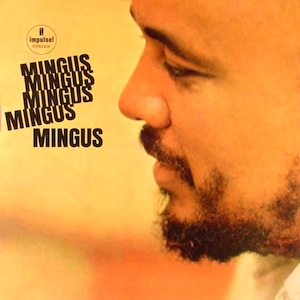
110. Mingus Mingus Mingus Mingus Mingus (1963)

Mingus, the master orchestrator. Mingus the composer. Mingus the performer. He's got so many credits on this album that I marvel at how it doesn't sound one bit overrun by his presence, yet it's distinctly his product. The music swings with a loose and careening vibrancy that is electrified with spontaneity and invention. With just 10 pieces, his arrangements sound as quiet as a quartet or as powerful as a big band. Its performers lend the air of familiarity, dashing in and out of ensemble jams like "Better Get Hit in Yo' Soul" or blending sublimely as in the steamy rendition of "Mood Indigo." Mingus listeners will immediately sense the presence of old friends, because many of the tracks are new treatments of preexisting Mingus tunes. I'll let you figure what is what. As for soloists, I really enjoy Charlie Mariano (bias alert, I just got Blue Camel so I'm on a bit of a bender) or the shambling Walter Perkins on drums.

Monday, April 22, 2013

89. Charles Mingus / East Coasting (1957)

Happy Birthday, Charles Mingus! He'd would have been 91 today. I like East Coasting a lot, and always have. Maybe it's the title, but the longer I remain in exile west of the Mississippi, the more I am drawn to this record. The lineup is one of my very favorite Mingus groups, probably because of Shafi Hadi on alto and tenor, but it's complemented by Bill Evans. Proceedings start with a beautifully longing take of "Memories of You," which crackles through some unexpected turns as the soloists lend their voices. That's a good rule for the whole record, which is always surprising me. No matter how many times I hear it, I hear something new. Tonight, for instance, I'm really into that bass solo in "West Coast Ghost," and the brief but alarming resurgence of the ensemble when Mingus finishes, before they take it out on a lamb. Mingus was always concerned with harnessing group chemistry and giving his musicians plenty of freedom to interpret changes, and this album is an outstanding exemplar of that magic. It might lack the gravitas of other dates, but who cares. I need to hear "Celia" one more time....

Sunday, February 24, 2013

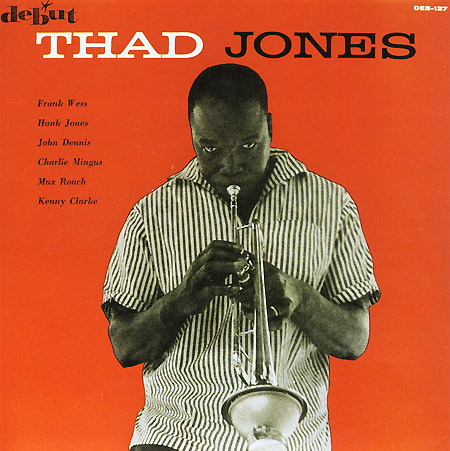
43. Thad Jones / The Fabulous Thad Jones (1958)

This LP is collated from two sessions recorded by Rudy Van Gelder in 1954 and 1955. Group 1 is Jones, Charles Mingus, John Dennis and Max Roach. Although Jones leads the session, it feels strongly like Mingus is at the helm. The group is rhythmcally direct, playing a mixture of standards and Thad Jones originals. The spotlight is on Jones for every track, although "I Can't Get Started" stretches out with some interesting interplay between Jones and Mingus, and has tempo changes that lean the way Miles Davis did with his "Basin Street Blues." Jones plays evocatively with and without a mute, and shows off a only a little bit. Group 2 is Jones, Mingus, Hank Jones, Kenny Clarke, and the tenor sax and flute of Frank Wess (a la Hank Jones with Frank Wess). It's a somewhat softer, lush and casual small-group swing that excels in the ballads. This band sounds gelled and confident due to the players' associations in the Basie band. Together, the two bands make a good album that doesn't sound disjointed or uneven, although their differences are plain.