Recent listening, current
Archived listening, 2013-2016
Showing posts with label septet. Show all posts
Saturday, September 17, 2016
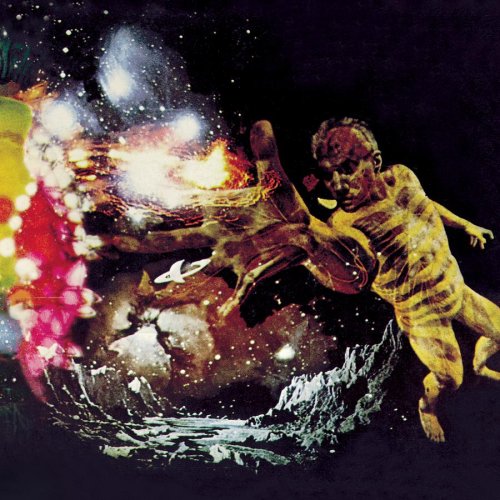
210. Santana / Santana III (1971)
In the dictionary next to the word "essential," you'll find a picture of this album. Sandwiched between the seminal Abraxas and the revolutionary Caravanserai, Santana's third LP finds the band now very comfortable inside their invention, that unique fusion of Afro-Cuban rhythm with pan-Latin import and the ferocious, unrelenting pound of a psychedelic rock and roll band in full flight. If you liked Abraxas, don't forget to go the extra step and get this one, too. Because none were doing it in 1971, and none have done it better since. I think it's amazing how fresh and how mature the group sounds for just the third album, and yet, with all the swirling Hammond organ, raucous percussion and abrasive guitar, the thought of Caravanserai's chill embarkation for parts unknown almost brings a tear -- and by the way, I love Caravanserai. Compared to its immediate predecessor in the discography, III is rougher around the edges, a little more relentless in its pursuit of the groove, and maybe even a little less accessible. The music is fully cooked and raging. It sounds a lot like a live album, and the segues between tracks are so tight that they beg you to look for the seams. The audio quality on all available CD editions is stellar, and the "Legacy" edition contains a full live set from July 04, 1971 at the Fillmore West, plus extra studio sessions. Play it loud!
Friday, December 20, 2013
160. Duke Ellington & Johnny Hodges / Side By Side (1959)
I put this album in the "essential" pile. From the first punchy, rather
Dukelike chords in "Stompy Jones," we're off to the races with two sessions
comprised of Ellington and Basie alumni. I love listening to Sweets
Edison in the context of a small group. His lines in "Stompy" are clean, concise,
and eloquent, ringing out above the swinging bass, Jo Jones' crashing cymbals and Duke's
rhythmical encouragement. Those two guys -- Duke Ellington and Jo Jones
-- make quite the pair midway through the tune when the front line lays
out and lets them have a round of aggressive chords and
crashing percussion. Hodges comes back just in time for a
joyous, New Orleans style melee at the end. The lineup with Ellington
and Sweets only does three of the album's nine tracks ("Stompy,"
"Squeeze Me" and "Going Up"). The second session is a septet recorded
six months earlier with Billy Strayhorn, Ben Webster, Roy Eldridge,
Wendell Marshall, and Lawrence Brown. The character is similar but the
different chemistry is easy to hear. Of course the soloists change, Eldridge's style is flashier than Sweets', but
there's also a different sentimental quality and certain reserve presiding over cuts like "Let's Fall in
Love" that is absent from the music with Ellington. Maybe it's Webster. Or maybe it's Strayhorn? Who knows. Regardless of which band you prefer, this disc is wonderful.
Labels:
1958,
1959,
al hall,
ben webster,
billy strayhorn,
duke ellington,
harry sweets edison,
jo jones,
johnny hodges,
lawrence brown,
les spann,
roy eldridge,
septet,
sextet,
side by side,
verve,
wendell marshall
Friday, December 6, 2013
155. Earl Bostic / Flamingo (2002)
Flamingo is a double disc compilation by the UK's Proper Records label, covering 1944 to 1951. The audio quality is very good. These groups are like many of the transitional orchestras of the 40s and early 50s. They feature veterans alongside torchbearers from swing to bop and beyond. In the early sides, we hear Bostic with Rex Harris, Cozy Cole, Don Byas, Tiny Grimes, and Lionel Hampton. Later, in his stripped down R&B orchestra, we hear a sampling of Jimmy Cobb, Wilbur Campbell, and Jaki Byard. Listen for the transition from gut busting alto to what became Bostic's trademark technique. In the 1949 sextet, tracks like "Filibuster" show repeated riffing with huge tone, but also a nimble fingered aptitude for clean, double-time runs through the scales, colored here and there with reed buzz. The lovely "Serenade" (Gene Redd on vibes) has a similar feel. Like Ben Webster, Bostic could play with arresting power, or sublime gentleness. "Flamingo," probably his best known track, has become the archetypal rendition, although it isn't much different in structure or appeal than other sides recorded by the group. I like the later sides best, but the early ones are priceless, too.
Labels:
1944,
1945,
1946,
1947,
1949,
1950,
1951,
2002,
alto,
alto saxophone,
big band,
earl bostic,
flamingo,
proper,
rhythm and blues,
septet,
sextet,
swing
Tuesday, August 20, 2013
126. Babs Gonzales / The Chronological Classics: 1947-1949 (2000)
Babs Gonzales was a fringe character in jazz, although he garnered a devoted fan base. I have a difficult time finding him a slot in my head, which I
guess a lot of people must. So I'll file him with King Pleasure on
one side and Screamin' Jay Hawkins on the other, not too far from Slim Gaillard and Betty
Roche. The chief characteristic of his music is a bebop inflected vocal style somewhere between scat and vocalese, with occasional forays into conventional lyric singing. He had lots of friends on his records: Tadd Dameron, Art Pepper, Sonny Rollins, Bennie Green, and James Moody to name a few. This disc contains just what its title describes. Included are his legendary sides for Blue Note with Dameron on piano, as well as his work for the smaller Apollo and Manor labels (enjoy Green and Moody on Manor). Also here are eight sides recorded by Capitol, three of which were rejected. These groups contain a young Sonny Rollins, Art Pepper, J.J. Johnson, Roy Haynes, as well as Wynton Kelly, and Pee Wee Tinney on guitar. It's a motley bunch of tunes and dudes that are charming ("Running Around"), humorous ("A Lesson in Bopology"), or spooky ("Weird Lullaby"), but always good fun. Appreciate them for containing the work of other notables, or on their own merit. You won't find much like Babs anywhere else.
Monday, August 5, 2013
121. Johnny Griffin, John Coltrane, Hank Mobley / A Blowin' Session (1957)
Blue Note's A Blowin' Session featuring Little Giant, Trane, Hank Mobley, Lee Morgan, Wynton Kelly, Paul Chambers, and Art Blakey sounds exactly as you'd think it would. It's technically a Griffin date, who is leader, composer, and one third of the groups's tenor sax nucleus. But Morgan gets plenty of time, and so do Kelly and Blakey, for that matter as if Blakey's hard to miss. The meeting was a pickup after the Chicago-based Griffin found himself in New York at the same time as the others. With so many good players, it's a jazz buffet. The septet shows its talent in tracks like "The Way You Look Tonight," or the swinging ensemble groove of "Ball Bearing." As two horns who played with Miles Davis so close together, listening to Trane in opposition to Mobley is interesting (see Prestige's Two Tenors or Tenor Conclave for more of Trane and Mobley together). Morgan's licks on "Smoke Stack" set the pace for the rest of the group, though Coltrane feels overburdened, it's still my favorite cut on the album. Thankfully, there is an alternate take on the Blue Note CD that offers him a second chance as well as a wild good performance from Griffin. Why they issued the original take instead of this one remains a mystery to me, unless for the outstanding work by Morgan. As a note, this album also marks th eonly ecorded meeting between Griffin and Coltrane.
Thursday, April 18, 2013
85. Lester Young / The Jazz Giants (1956)
The Green-Ramey-Jones factor is in effect here, as Lester blows for the first time alongside the exquisite Roy Eldridge and Vic Dickenson. Teddy Wilson provides piano, his first date with Prez in a decade, and the whole thing really swings. The chemistry is great and it's a good listen. Knowing who is on the session, I love hearing one chorus while waiting for the next guy. Lester does some fireworks (try "Gigantic Blues," also note Eldridge, Wilson and Jones) but he sounds profoundly blue throughout the others. I never bought the description of Prez as lean or
altoesque, or however that's said. He's got a big, sonorous tone
that portrays (and occasionally betrays) every nuance of the piece. These are mostly ballads so it suits this album especially well. In the arrangements, Lester usually goes first followed by Dickenson or Eldridge. When they get to the end, the whole band takes it out. It reminds me of a big band arrangement, and harnesses the septet's additional weight to good effect.
Friday, April 12, 2013
79. Lester Young / The Complete Savoy Recordings (2002)
Labels:
1944,
1949,
1950,
2002,
big band,
bop,
complete savoy recordings,
jazz,
lester young,
pres,
president,
prez,
quintet,
savoy,
septet,
sextet,
tenor sax,
tenor saxophone
Subscribe to:
Posts (Atom)
