Recent listening, current
Archived listening, 2013-2016
Showing posts with label debut. Show all posts
Sunday, May 31, 2015
202. Flying Island / Flying Island (1975)
The self-titled debut from the fruitful but short lived Connecticut group Flying Island has excellent music to offer and deserves wider recognition. Things begin with a sharply executed "Funky Duck," but the material takes interesting turns into weirder territory and more aggressive textures like on "Flying Island" and "I Love to Dance." The music proceeds across shifting time signatures in tradeoffs between Fred Fraioli's electric violin and keyboards by Jeff Bova. Fraioli speaks in squalling, anthemic strokes, sometimes smooth, sometimes menacing, bookended by his fiery runs and escalated, wailing solos. Also present are guitarist Ray Smith, bassist Thom Preli, and drummer Bill Bacon. Smith and Bacon emerge as superb players that make the album much heavier than your typical mid-70s fusion outing. After the violin-keyboard pyrotechnics are over, their work is often the force that distinguishes the band from dozens of similar acts. Flying Island and the follow-up Another Kind of Space should interest fans of higher profile names in '70s fusion like Jean-luc Ponty, Weather Report, or Mahavishnu Orchestra. The musicians are competent and talented, and the total package is professional and well rehearsed. Yet it is not without the spark needed to bring a studio take home for the listener. Highly recommended!
Labels:
1975,
bill bacon,
clavinet,
debut,
electric guitar,
electric piano,
flying island,
fred fraioli,
fusion,
jazz rock fusion,
jeff bova,
organ,
quintet,
ray smith,
review,
sextet,
thom preli,
vanguard,
violin
Thursday, December 12, 2013
159. Buck Hill Quartet / This is Buck Hill (1978)
This is Buck Hill is Hill's recording debut on SteepleChase. From Washington D.C., Hill worked for the post office by day and was a hard driving driving tenor sax leader by night. So by the time we meet him in 1978, he is 51 years old and already possesses a fully developed tone and unique stylistic approach to modal material. Because of this late exposure, he is easy to miss, but he was and continues to be a fantastic player in the tradition of other big tenors that jazz listeners are more familiar with. For the debut he teams up with Billy Hart, Kenny Barron, and Buster Williams. They have a good sound that approaches the Prestige or Blue Note gold standard from two decades earlier. This session lacks the production gloss of newer Hill releases like Relax (which is also excellent). Notably, four of the album's seven tracks are Hill's originals. These are modal explorations with contributions from all members of the group. The four musicians play so well together that it's a hard sell for me to believe they weren't working together a lot longer than they were! Finding the vinyl could be a challenge but the recent CD is a worthwhile purchase and comes with a bonus take of Hill's "S.M.Y."
Thursday, November 14, 2013
148. Fenton Robinson / Somebody Loan Me a Dime (1974)
I like this debut for Alligator a lot because Robinson's guitar and vocals combine much of what I love about Texas, Chicago, jazz, and soul all in one place. It has a pureness, a genuine flavor that is unmistakable, yet it is not adequately described by any one of those styles. It all starts with the vocals and guitar which are backed by a straight ahead band including Bill Heid and Mighty Joe Young. Robinson's voice is a deep baritone, capable of rich emotional detail while its timbre is smooth enough to imply a dimension of gentleness. This distinguishes him from the haughty, barkingly self-assured styles of singers like Muddy Waters and Howlin' Wolf (just saying). And it's a big voice, too. They needed a microphone for the sessions but it's easy to see him singing without one. For "mikeless" cred, he even covers Big Joe Williams' "You Say You're Leaving," and to devastating effect. His unique blues guitar style is evident from the first track, "Somebody Loan Me a Dime." Robinson plays smart licks in a call-and-response style, but draws jazzy patterns from a more colorful pallet than your typical player. The tone is dirty and overdriven, without reverb, and sounds pretty much right from the wire. This is essential for fans of Chicago or Texas blues because it's good for character, and an easy like for fans of Grant Green or anyone with a penchant for soul jazz.
Labels:
1974,
alligator,
bill heid,
bill mcfarland,
blues,
chicago,
cornelius boyson,
dave baldwin,
debut,
elmer brown,
fenton robinson,
guitar,
mighty joe young,
norval hodges,
somebody loan me a dime,
texas,
tony gooden
Tuesday, October 22, 2013
144. Yma Sumac / Voice of the Xtabay (1950)
Xtabay is the Peruvian soprano's famous American debut. Its release was in 1950 when she signed to Capitol and began thrilling audiences with an astonishing range of nearly five octaves. The songs were composed and arranged by Les Baxter along with husband Moises Vivanco, and John Rose. Exotica aficionados will appreciate the presence of Baxter but Vivanco actually gets most of the credits. Some of these tracks, or at least snippets of them, have appeared in advertising campaigns and movie soundtracks, so there could be many listeners who are familiar with the voice but unaware of who it is. Selections combine catchy snatches and "exotic" percussion with lush jazz instrumentation and strains of Peruvian folk music. Some songs are haunting and ethereal ("Virgin of the Sun God"), some are delightfully quirky ("Monos"), and all feature Sumac's captivating voice. She doesn't just sing, either, but breathes, chants, yelps, croons, and shouts. It's invigorating! If you're new to this vocalist, then you could get one of those greatest hits compilations, but you'd do just as well to start here, and it's a very nice item for the shelf.
Labels:
1950,
capitol,
debut,
exotica,
john rose,
latin,
les baxter,
lounge,
moises vivanco,
orchestra,
peru,
vocal,
vocalist,
xtabay,
yma sumac
Sunday, September 8, 2013
135. Ryan Kisor / Minor Mutiny (1992)
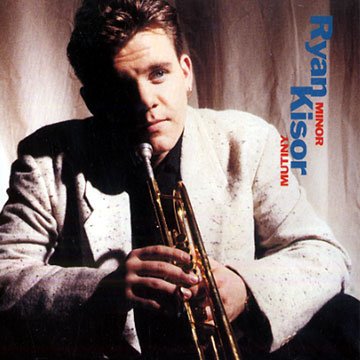
The cover, which apes Chet Baker, first grabbed me. I saw a young guy, similar features, sport coat, trumpet, and dramatic lighting. I thought, okay, let's try this out. The second thing, first hearing then reading, was the personnel including Ravi Coltrane, Lonnie Plaxico, Michael Cain, and either Jeff Siegel or producer Jack DeJohnette on drums. It's a sweet debut, a sort of double debut if you count Siegel. I was immediately swept up by the beautifully lonesome "One For Miles," which evokes Davis' "Basin Street Blues" from Seven Steps to Heaven. Kisor pays through the mute and it's a spot on, glowing tribute. My reaction was, "If this guy doesn't sound like Miles!" Yet in spite of Kisor's obvious reverence for the master, the performance isn't cliche and the style is all his own. Then there's the work by Ravi Coltrane on tenor and soprano. His tone and intonation on soprano are exemplary and the choruses take possibly the most unique voice in the group. Juxtaposition of drummers Siegel and DeJohnette do not ruin the continuity. Siegel is fantastic, playing responsively in intricate patterns all around the beat, and doesn't suffer for following an experienced musician like DeJohnette. You'll find that Siegel's playing even starts the melancholy album (there is some great mood on this disc), and he is only supplanted by DeJohnette on two tracks.
Labels:
1992,
columbia,
debut,
jack dejohnette,
jeff siegel,
lonnie plaxico,
michael cain,
minor mutiny,
quintet,
ravi coltrane,
ryan kisor,
soprano sax,
tenor sax,
tenor saxophone,
tribute,
trumpet
Tuesday, May 28, 2013
109. Julie London / Julie is Her Name (1955)
Julie London's range and the timbre of her voice is one that sits very well with me. Ensconced within her silky mezzo soprano is a space filled with sumptuous partials and overtones that make a single note sound like a chord. Her voice and my wife's are quite similar so when I listen, I sense something familiar. In the classic debut Julie is Her Name, London's young voice is the main attraction and backed often by only a guitar. Her phrasing and timing leave you on the edge of your seat, wondering where the next phrase will fall ("It Never Entered My Mind"). She's always playing this way with the lyrics and her timing, while Barney Kessel anxiously holds back comping. Later in her career, she fronted a big band whose eloquence and power gave her smoldering vocals and lovelorn ballads some extra emotional impact. But here it's all Julie. The album opens with the quintessential "Cry Me a River," and moves through 12 other standards and ballads including aforementioned, quirky "It Never Entered My Mind," and the beautiful "Laura." There's also a second volume, which is just as bit as this first volume, two records that should be on every jazz lovers shelf.
Monday, March 25, 2013
61. Grant Green / Grant's First Stand (1961)
Green's debut for Blue Note, his first disc as leader, frames him in a swinging organ trio with Baby Face Wilette and Ben Dixon. It's a good crew to support Green, two players who are very much in the same frame of mind. It's not a crowded sound, although everyone is busy, but when one member takes a chorus, the inherently sparse nature of the trio puts the soloist front and center for your enjoyment. Wilette's organ gives bluesy grooves like "Miss Anne's Tempo" or "Blues for Willarene" a heartier texture and emotional urgency that Green balances with velvety smooth and bop influenced melodic runs on the guitar. He's not a chord freak, so his music has a different feel than some other jazz guitarists. Dixon is very active, fleshing out the trio's overall sound and making his presence loud and clear. He's a great drummer who is no stranger to the format, and does an admirable job here, his affinity for the work of Art Blakey rumbling loud and clear. While it isn't really fair to call a guy's first record his best, especially when he made so many others after it, this album may be just that good.
Tuesday, March 5, 2013
51. Freddie Hubbard / Open Sesame (1960)
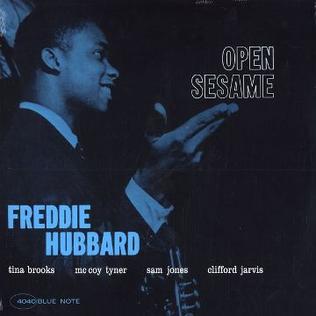
I think: Open Sesame. The title says, as if by magic, Freddie
Hubbard has arrived. It's is a very strong debut and an easy mark for
the core collection. We also get a great band. Tina Brooks on tenor really tears it up. On the title track, Brooks sinks his teeth into the riffs, blowing these long, stretchy phrases that step across the bars like hurdles and land back in time when he runs out of breath. He's a good man on ballads, too, like the droopy "But Beautiful." Behind the traps is Clifford Jarvis, two years shy of becoming a Saturnian. His energy, polyrhythmical claptrap and close work with Hubbard's improvisations add depth that is a few cuts above the standard hard bop set. Sam Jones plays big round notes in a sentimental and melodic style which at times reminds me of Ray Brown. He's aided everywhere by McCoy Tyner's drizzling fills and colorfully voiced chords. "Gypsy Blue" has a Latin tinge. The head has a cool arrangement where Hubbard and Brooks play in, and then slightly out of phase, hypnotically swinging it along. Hubbard's centerpiece is the rollicking "All or Nothing at All," where he shows off his chops in wild, flashy runs, rubber fingered flourishes, and big brassy blasts in the upper register. The guy's a natural who learned to improvise before he learned to read, and it shows.
Sunday, February 24, 2013
43. Thad Jones / The Fabulous Thad Jones (1958)
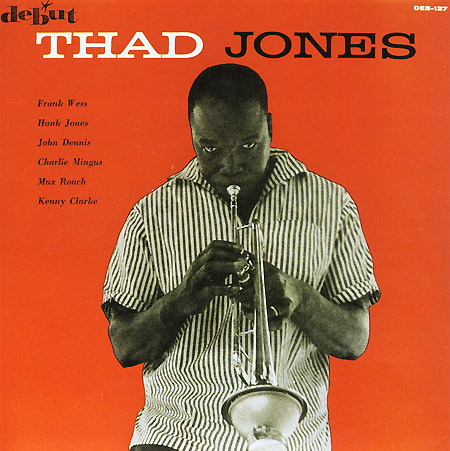
This LP is collated from two sessions recorded by Rudy Van Gelder in 1954 and 1955. Group 1 is Jones, Charles Mingus, John Dennis and Max Roach. Although Jones leads the session, it feels strongly like Mingus is at the helm. The group is rhythmcally direct, playing a mixture of standards and Thad Jones originals. The spotlight is on Jones for every track, although "I Can't Get Started" stretches out with some interesting interplay between Jones and Mingus, and has tempo changes that lean the way Miles Davis did with his "Basin Street Blues." Jones plays evocatively with and without a mute, and shows off a only a little bit. Group 2 is Jones, Mingus, Hank Jones, Kenny Clarke, and the tenor sax and flute of Frank Wess (a la Hank Jones with Frank Wess). It's a somewhat softer, lush and casual small-group swing that excels in the ballads. This band sounds gelled and confident due to the players' associations in the Basie band. Together, the two bands make a good album that doesn't sound disjointed or uneven, although their differences are plain.
Labels:
1954,
1958,
album,
charles mingus,
cornet,
debut,
fantasy,
frank wess,
hank jones,
jazz,
john dennis,
kenny clarke,
max roach,
review,
thad jones,
trumpet
Subscribe to:
Posts (Atom)

