Recent listening, current

Showing posts with label bass. Show all posts

Thursday, July 16, 2020

214. Sacred System / Chapter One: Book of Entrance (1996)

Dub alert. Book of "En-trance," get it? I got into Laswell after I saw his credit on albums by people like Henry Threadgill, then discovered his towering discography under many pseudonyms. Laswell works in NYC with everybody from Nona Hendryx to John Zorn. I get the impression that if you hung around the Bowery for long enough, and made a habit of staying up way past your bedtime, you'd eventually end up recording with him. 'Chapter One' is the first of four records (I think it's four) under his Sacred System moniker. The music is a unique flavor of ethereal trance-oriented dub. Tracks build from subtle, soulful bass grooves into all-out psychedelic dub glaciers where the keyboards speak in tongues, replete with weird echoes, prepared loops, backwards banshee wails, and self oscillating delays... but chill, really chill. You get the picture. 

If you're not all that into trance or dub, or you get turned off by the genre description, please understand that this is not your garden variety, up-all-night dance soundtrack. Laswell is a master producer and does not employ effects for their novel value, nor does he beat you over the head with them. (He doesn't beat you over the head with his beats, either.) He knows how to build a musical track into an eight-minute experience for the ears and mind; his aural soundscapes are constantly in flux, with new textures coming and going, perking the attention span. It's a process of regeneration -- new chittering spasms of sound are born as others decay, so out with the old and in with the new as the groove rolls onward. The bottom line is that you never know what's lurking around the next sonic corner. 'Book of Entrance' is a fantastic example, not just a clever title.

Friday, February 10, 2017

212. Weather Report / Legendary Live Tapes: 1978-1981 (2016)

On point! Four discs of hitherto unreleased live material from Weather Report's finest lineup. Pastorius recorded a healthy parade of studio LPs with the group and played dozens of gigs. His tenure is my touchstone for the Weather Report discography (I'm a native South Floridian, and admit heavy local partiality). I never saw them live, and I wore out the 8:30 album. That album's cushy overdubs and post-production soften the raw, affirmed talent in evidence on the live document. Given the Report's rep for slick and innovative studio work, I concur and take no issue there. But needless to say I am very happy that these tapes were assembled and released so we can hear them in the buff. Without hitting trading circles for soundboards and audience tapes, it's enough to pore over for a few years. Working through the first disc, my ears perk at Erskine's sparkling and aggressive work behind the drum kit, and his interactions with Jaco. Half the total sound is the rhythm section, hard to believe that only two people are carrying that. Nice notes are also included. While you wait for these to arrive in your mailbox, I heartily recommend the aptly titled Trio of Doom live disc with McLaughlin and Tony Williams.

Saturday, June 20, 2015

204. Don Cherry / Art Deco (1988)

Credited to Cherry, this session belongs to the same unit that worked together before Cherry, Haden, and Higgins historically joined ranks with Ornette Coleman. It's a beautiful straight set, comprised of cooly executed standards, originals, and several Coleman covers. The quartet is familiar and tight. I haven't listened to much of James Clay's past work, but now I wish I had more of it on hand to explore. His deep, supple lines in "Body and Soul" put a fresh coat on the old song, mixing wry bop phrasing with bursts of unexpected tonal color and bluesy swagger. Cherry takes a rest while Higgins and Haden nimbly sidestep one another before Haden builds a short solo. The ensemble picks up again behind Clay's last chorus and the plaintively emotive outro for solo tenor. Monk's "Bemsha Swing" comes next, where Cherry and Clay get most of the spots, but leave room for Higgins. Higgins, Cherry, and Haden each get time alone on "Passing," "Maffy," and "Folk Medley," quiet, introspective spaces that give listeners a chance to appreciate their individualism. Eight-bars-and-blow gets old, I agree, but these renderings sagely belie that trope with wit, spirit, and a genuine enjoyment for the music Do you love great jazz? Find it, buy it.

Thursday, April 24, 2014

193. Mads Vinding Trio / Daddio Don (1998)
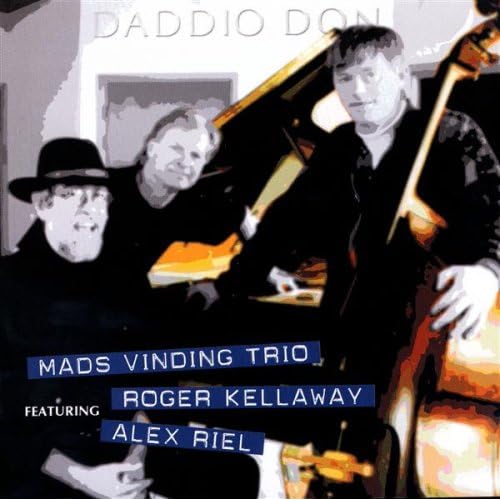
A while back, I recommended an album with Mads Vinding to a friend who loves the upright bass. It's his favorite instrument. We chatted about the Danish bassist and both agreed he's a hard one to not like. A few weeks later he gave me some CDs that, for whatever reason, didn't pan out for him the way he expected. It happens. But I was thrilled because among them was Daddio Don. I listened to it for the rest of the afternoon before promoting it to a coveted spot in the rotation of my daily commute. Vinding is impossible to keep up with, the tireless recording and performing artist for whom the word "prolific" seems inadequate. He's all over the map, discographically speaking, but always right where you need him with the soulful interplay, keen rhythmical knack, and melodic inventions that surpass keeping time for the time's sake. He has a sixth sense for interplay, or a humble ear for the group dynamic, always listening to what the other musicians are doing. I appreciate his earnest touch with the blues and immediate facility for navigating uptempo and bebop that remind me of Ray Brown (another favorite musician). His choruses are not boring, they're more like short songs. To paraphrase C. Michael Bailey's piece for AllAboutJazz.com, Vinding is like the Nordic George Mraz, expressing himself with a confident stride and robust tone that tricks the ear into hearing a full rhythm section where none is present. The trio is comprised of Vinding, drummer Alex Riel, and pianist Roger Kellaway. Kellaway has a sensitive understanding of the piano's dynamics, and moves with irresistible swing.
Image courtesy of soundcloud
More importantly, Kellaway has a penchant for odd time signatures (the album is titled for Don Ellis), and all three musicians are comfortable breezing through meters like Kellaway's "Seven," or Thad Jones' "A Child is Born" in 11/8. Riel's timekeeping is sumptuously alert. His dreamy brush work is punctuated by pertinent, percussive accents and taut interjections on the snare that make the emotive and pensive, often introspective set as lush and flush as a well arranged quintet. "How Deep is the Ocean" is intriguing, demonstrating the shared chemistry of the trio. It's a touch faster than is typical, and the order of its open sections are negotiated as you hear them. It typifies the musical cooperation which is the album's hallmark. If you're the type of listener that enjoys quiet spaces with tricky corners, a shared creation of three musicians that reveals the sheer clumsiness of language when describing a mere "piano" trio, then Daddio Don needs to be on your list. And if you try it but you don't enjoy it, perhaps you can pass it on to a friend.

Saturday, September 21, 2013

141. Monty Alexander, Ray Brown, Herb Ellis / Triple Treat (1982)

For various reasons, the cover of this recording seems oddly appropriate. A photograph of a three-scoop ice cream sundae makes a cheeky pun for the piano trio's sweet and sometimes quirky set of tunes like Blue Mitchell's "Fungi Mama" (with fun quotes by Ellis, and some jangly syncopation by Alexander) or the hot side-opening "(Meet The) Flintstones." Monty Alexander fills the piano chair and I don't think he sounds one bit like Oscar Peterson, in spite of Brown and Ellis being longtime members of that musician's group. The other music on the album is equally sweet and creamy, as with the sumptuous "Body and Soul" and "Sweet Lady," or swinging "When Lights are Low." Also notable is the title track, the "Triple Treat Blues." Chemistry, relaxed atmosphere and slick, baton passing choruses of these three musicians make a buoyant and memorable session that is out of print but worth seeking out. If you enjoy this lineup, be sure to check out their other albums, as well.

Saturday, August 10, 2013

122. Charlie Haden / Night and the City (1996)

Night and the City has an extra attraction for me, because I love the film by Jules Dassin. Anyway, they're not related, but it's a great record. It was recorded for Verve at the Iridium in NYC, home to many a great night of live music (see HughGotIt's excellent uploads of the Ed Palermo Big Band for a glimpse of when the tiny room really gets rocking, and also some of Hugh's other great live video work). This time Haden teams up with Kenny Barron on the keys. Their music is elegant and sparse, but not at all vacant. It's reverent of jazz from an earlier era, and even its title recalls a romantic notion of the city as theater of life. Barron's opening "Twilight Song" sets the pace. The tunes are mostly standards, with one original by Haden ("Waltz for Ruth") and Barron's aforementioned "Twilight" being exceptions. "Body and Soul," as if anyone can get away from it, is thoughtful and majestic and makes a perfectly timed appearance midway through the disc. I think the collection is a treat, and each player exercises a remarkable restraint to let the other sing and breathe as needed. It's thick on mood, but not overly heavy, and I highly recommend it.  

Thursday, June 27, 2013

111. Duke Ellington, Charles Mingus & Max Roach / Money Jungle (1963)

Money Jungle is all about contrasts and individuality. The music is famously, and often physically, tense. The grit is established on the first track "Money Jungle" where Mingus spends much of his time aggressively bending a static harmonic element while Duke assertively pounds big blocks across the registers. Each musician has a distinct playing style, and no one gives an inch for the notion of a group product. Remarkably, a unique group product is exactly what we get. The mood often swings to moments of quiet beauty, but rocks quickly back to outbursts of boulder dropping and more assaults on bass and drums. At times it sounds as if Duke is pointing to sections of his orchestra which are not actually in the studio, playing electrifying chords in his characteristic staccato style before drawing back in contemplation and moving his hands to other registers. With the keyboard laid out in front of him, he's arranging while improvising. A listener with experience with titles in the Duke Ellington catalog will hear the bones of the brass and reeds as sections rise and fall in the imaginary arrangement. I'm happy Duke had the foresight to request making this album with one of his greatest adherents, Charles Mingus, possibly the only talent in jazz that may have been equivocal in terms of composition, orchestration or arrangement.

Saturday, June 22, 2013

110. Mingus Mingus Mingus Mingus Mingus (1963)
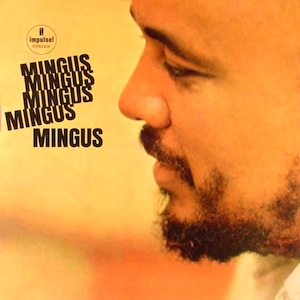
Mingus, the master orchestrator. Mingus the composer. Mingus the performer. He's got so many credits on this album that I marvel at how it doesn't sound one bit overrun by his presence, yet it's distinctly his product. The music swings with a loose and careening vibrancy that is electrified with spontaneity and invention. With just 10 pieces, his arrangements sound as quiet as a quartet or as powerful as a big band. Its performers lend the air of familiarity, dashing in and out of ensemble jams like "Better Get Hit in Yo' Soul" or blending sublimely as in the steamy rendition of "Mood Indigo." Mingus listeners will immediately sense the presence of old friends, because many of the tracks are new treatments of preexisting Mingus tunes. I'll let you figure what is what. As for soloists, I really enjoy Charlie Mariano (bias alert, I just got Blue Camel so I'm on a bit of a bender) or the shambling Walter Perkins on drums.

Monday, April 22, 2013

89. Charles Mingus / East Coasting (1957)

Happy Birthday, Charles Mingus! He'd would have been 91 today. I like East Coasting a lot, and always have. Maybe it's the title, but the longer I remain in exile west of the Mississippi, the more I am drawn to this record. The lineup is one of my very favorite Mingus groups, probably because of Shafi Hadi on alto and tenor, but it's complemented by Bill Evans. Proceedings start with a beautifully longing take of "Memories of You," which crackles through some unexpected turns as the soloists lend their voices. That's a good rule for the whole record, which is always surprising me. No matter how many times I hear it, I hear something new. Tonight, for instance, I'm really into that bass solo in "West Coast Ghost," and the brief but alarming resurgence of the ensemble when Mingus finishes, before they take it out on a lamb. Mingus was always concerned with harnessing group chemistry and giving his musicians plenty of freedom to interpret changes, and this album is an outstanding exemplar of that magic. It might lack the gravitas of other dates, but who cares. I need to hear "Celia" one more time....

Wednesday, April 17, 2013

84. Modern Jazz Quartet / Concorde (1955)

I vividly remember the day I bought this LP. It was among the first jazz records I ever purchased, and I found it sitting at a yard sale in the next neighborhood. I must have been about 15 years old. In a box filled mostly with movie soundtracks, I found Concorde along with MJQ's Fontessa and Black Sabbath's Live at Last. I bought all three for fifty cents apiece, and went home happy. I didn't know much about jazz back then, but after studying the back cover intently, I made the right choice. This album is classic MJQ and also features the debut of Connie Kay. The Gershwin medley is the centerpiece, paired with an innovative take of "Softly as in a Morning Sunrise" on the second side. But there are surprises everywhere, as with the quiet beauty of "All of You" or lively conversation between Jackson and Lewis on "I'll Remember April." Milt Jackson is a hero pretty much everywhere (can you tell I like him?), at once bluesy and virtuosic. There's strong musicality in each of the tracks blowing sections, and it's hard to tell that Kay hasn't been playing with the other three members all along.

Saturday, February 9, 2013

29. Ahmad Jamal / Chamber Music of the New Jazz (1955)

I find myself listening to the 'original unconventional' piano trio again and again, and I enjoy it more each time I hear it. It's light and refreshing, cracking with good ideas and smooth sailing without even a hint of drums. Why bother? Jamal has Israel Crosby doing great interplay on bass while also hitting the pulse, and Ray Crawford strikes and plucks the guitar for a similar effect. Crawford has some good solo space, too, while Jamal comps or plays with Crosby. The three musicians have effervescent chemistry and often finish each other's sentences, musically speaking. Jamal has enough room to use the piano trio for what it was meant intended. He does all kinds of inventive stuff and blocks or plays alone with his right hand, occasionally dropping boulders to make the point. You can hear he's trying stuff out, and uses the full range of the keyboard, too. The influential player and album were like a drop of water for the arrangers' seed, inspiring Gil Evans and Miles Davis to the heights of cool in the 1950s. Best part is when it comes to Jamal, this album was only the beginning.