Recent listening, current
Archived listening, 2013-2016
Showing posts with label verve. Show all posts
Saturday, January 2, 2016
209. Lionel Hampton & Stan Getz / Hamp & Getz (1955)
I suppose it's nice that by a happy accident of geography and scheduling, Hamp and Getz occupied the same place at the same time and afforded us a record. Hamp hits the sticks with a swinging ferocity that inspires Getz out of his cool cage in some unexpected chances. The pair battles through choruses and plods through a medley of ballads in a fair exposition of each's technique. It seems that Getz had to start running to keep up with the manic energy of the legendary vibraphonist. The two personalities make something of a strange cocktail, and I'd say the net result is more differentiated and less of a mutual product. The most exciting fireworks come during uptempo "Cherokee" and "Jumpin' at the Woodside." On the CD reissue, we have some extras, namely a mystery trombone player rumored to be Willie Ruff, but he doesn't really do much. The outtake of "Gladys" is a nice party favor, but, again, nothing special aside from where Hamp hits a clanger. I never like it when a reviewer describes something as "nonessential" but that's exactly what I've got here. The ingredients are enjoyable, but I'll continue taking my Hamp and Getz neat. The fine artwork on the cover is by the great David Stone Martin, reminding me that one of these days I'd like find a lithograph.
Labels:
1955,
bebop,
bop,
hamp and getz,
quartet,
quintet,
swing,
tenor,
tenor sax,
tenor saxophone,
verve,
vibes,
vibraphone
Saturday, March 15, 2014
190. Erroll Garner / Jazz 'Round Midnight (1991)
Compilations from Jazz 'Round Midnight are usually good, and while this one is no exception, it tends to be monopolized by downtempo ballads. Across 16 tracks, listeners hear Garner's solo and trio recordings from the mid '40s and '50s. You get the basic idea -- contrasts of soft with loud, twinkling arpeggios from the right hand, chord tracing from the left. But the towering crescendos and dizzying excitement that so frequently come up when people talk about Garner seem missing. Things heat up a little in "I've Got The World On A String" and especially "Part Time Blues". Garner's punchy rhythmic accents and huge, bluesy blocks remind me of why I love the piano of Duke Ellington and Oscar Peterson. While I appreciate them for the variety, I want more. None of this, however, should detract from the stately beauty of "I Can't Get Started" or "Misty." As Garner is one of those pianists who has been anthologized and repackaged a thousand times, this installment could be worth passing over. But in a lot of other ways it's a good one for the car, for after a hard day, or for audiences that are unlikely to gripe about the track sequence as I have. I almost forgot to mention the last track, a 10:42 solo take of "Over the Rainbow." It leaves me spellbound and feeling guilty for taking issue with any of the above.
Labels:
1945,
1946,
1949,
1954,
1955,
1957,
1991,
compilation,
erroll garner,
gitanes,
jazz round midnight,
piano,
piano trio,
polygram,
trio,
verve
Friday, February 21, 2014
187. The Complete Jazz at the Philharmonic on Verve, 1944-1949 (1998)
After being evicted, in a word, from Los Angeles' Philharmonic Auditorium in 1946, Norman Granz retained his revue's catchy name and took the show on the road. For the next several years, various incarnations of "Jazz at the Philharmonic" played for audiences across Europe and North America. The historically important concerts were recorded and released, pimples and all. In fact, they represent some of the first commercial "live" albums ever made. Some were broadcasted on big radio stations, and extensive touring allowed audiences in isolated locales to see performers who never would have reached them. A notable feature of the Philharmonic lineups was that they juxtaposed veterans of the swing era with younger players of bebop. Rosters included Slim Gaillard, Lester Young, Coleman Hawkins, Charlie Parker, Roy Eldridge, Illinois Jacquet, Billie Holiday, Gene Krupa, Hank Jones, Ray Brown.... too many to list them all here. These styles were often in stiff opposition, and their players unlikely to play together. Stories abound of the politics wrought by the odd marriage of styles. I've read critics who fault Granz for "forcing" jams and contests between players, but most listeners enjoy the results. I'm with the latter camp, and I rank these records among the most essential of all.
Labels:
1944,
1945,
1946,
1947,
1948,
1949,
1998,
bebop,
bop,
compilation,
live,
norman granz,
swing,
the complete jazz at the philharmonic on verve,
verve,
vocal,
vocalist
Friday, December 20, 2013
160. Duke Ellington & Johnny Hodges / Side By Side (1959)
I put this album in the "essential" pile. From the first punchy, rather
Dukelike chords in "Stompy Jones," we're off to the races with two sessions
comprised of Ellington and Basie alumni. I love listening to Sweets
Edison in the context of a small group. His lines in "Stompy" are clean, concise,
and eloquent, ringing out above the swinging bass, Jo Jones' crashing cymbals and Duke's
rhythmical encouragement. Those two guys -- Duke Ellington and Jo Jones
-- make quite the pair midway through the tune when the front line lays
out and lets them have a round of aggressive chords and
crashing percussion. Hodges comes back just in time for a
joyous, New Orleans style melee at the end. The lineup with Ellington
and Sweets only does three of the album's nine tracks ("Stompy,"
"Squeeze Me" and "Going Up"). The second session is a septet recorded
six months earlier with Billy Strayhorn, Ben Webster, Roy Eldridge,
Wendell Marshall, and Lawrence Brown. The character is similar but the
different chemistry is easy to hear. Of course the soloists change, Eldridge's style is flashier than Sweets', but
there's also a different sentimental quality and certain reserve presiding over cuts like "Let's Fall in
Love" that is absent from the music with Ellington. Maybe it's Webster. Or maybe it's Strayhorn? Who knows. Regardless of which band you prefer, this disc is wonderful.
Labels:
1958,
1959,
al hall,
ben webster,
billy strayhorn,
duke ellington,
harry sweets edison,
jo jones,
johnny hodges,
lawrence brown,
les spann,
roy eldridge,
septet,
sextet,
side by side,
verve,
wendell marshall
Tuesday, December 3, 2013
154. Gene Ammons and Sonny Stitt / Boss Tenors (1961)
If you've got the stereo disc then Ammons is in the right channel and usually goes first. Stitt is in the left channel and comes next, occasionally doubling on alto. The latter was one of the most inspiring alto players there was, but he gets short shrift. A whiz on the alto, he was equally capable on tenor or even baritone (no barisax on this disc). These two players make wonderful music together. It's a solid dance session, with plenty of fireworks and some intriguing knots in the choruses that may interest more serious listeners. "There is No Greater Love" features Stitt on alto. His exhilirating double-time chourses are a thing to marvel at. While trading jabs with each other, the horns take unexpected sidesteps outside the blues, like in Ammons' first chorus of "Autumn Leaves," or some of Stitt's phrases in the smoking "Blues Up and Down." The rhythm section of John Houston, Buster Williams, and George Brown has a good chemistry. Williams' timekeeping meshes well with Brown, and especially Houston's comping style, which favors chunky, chorded statements emphasizing the beat. Their interplay with the leaders during "Blues Up and Down" really kicks the tune into a higher gear. This is a memorable session, and quite enjoyable, to say the least.
Labels:
1961,
alto,
alto saxophone,
boss tenors,
buster williams,
chicago,
gene ammons,
george brown,
hard bop,
jazz,
john houston,
quintet,
review,
sonny stitt,
tenor sax,
tenor saxophone,
verve
Thursday, September 19, 2013
140. Tal Farlow / The Swinging Guitar of Tal Farlow (1956)
This blues and bop trio date with Farlow, Eddie Costa and Vinnie Burke is easy to listen to, and closer listening reveals a lot going on. The styles of Costa on piano and Farlow's guitar dovetail nicely. Farlow's eloquently phrased and heavy swinging choruses are followed by those of Costa, who plays in a hard-hitting, single-note style and is very rhythmic. Farlow uses the occasional slide, as in "Yardbird Suite," but instead of relying on an arsenal of tricks and stock licks, he is adept in inventing on the fly. The improvisations literally flow from the speakers like they're on tap. With so many ideas being tossed around, there's a lot of interplay between the piano and guitar. Burke plays the bass more or less steadily throughout, occasionally getting a chorus his own. The outtakes of "Taking a Chance on Love," Yardbird," and two (!) extra takes of "Gone with the Wind" are all so good that it's difficult to say how they determined a master. At any rate, the bonuses are much appreciated by this listener! Admirers of Ahmad Jamal's drumless trio with Ray Crawford, the Aladdin dates of Art Pepper, or the Modern Jazz Quartet should take immediately to the music herein.
Friday, September 6, 2013
133. Roland Kirk / We Free Kings (1961)
This early album by Roland Kirk demonstrates some of the things he became known for a bit later on. It's a polished, enjoyable, and provocative album. Most notably, throughout the blues and soul inflected set, he plays two or sometimes three instruments at once and switches between them at lightning speed. While blowing the blues on the flute, he likes to screech, howl, and sing along. There aren't any drop-ins from the board, no spliced takes. Obviously with one man filling four chairs, the arrangements revolve around him. As a testament to his talent, it works seamlessly. Kirk has an inspiring technique and sweet tone on all instruments. His style of improvising, I think, clearly departs from the Coltrane bag he was once lumped into. The band is Hank Jones or Richard Wyands, drums is Charlie Persip (great choice), and bass is Art Davis or Wendell Marshall. Through his technique and instrumentation, Kirk puts a unique spin on old tunes, and kicks out his own compositions, as well. After this album, Kirk's journey continued to seek new directions, ever expanding, ever exploring. We Free Kings isn't just nice for listening, it's also nice for perspective. It shows his music is steeped deeply in blues and bop, but the trajectory for future dates would always be farther out than before.
Labels:
1961,
art davis,
charlie persip,
flute,
hank jones,
hard bop,
manzello,
mercury,
quartet,
review,
richard wyands,
roland kirk,
stritch,
tenor sax,
tenor saxophone,
verve,
we free kings,
wendell marshall
Wednesday, September 4, 2013
130. Charlie Parker / Charlie Parker with Strings: The Master Takes (1995)
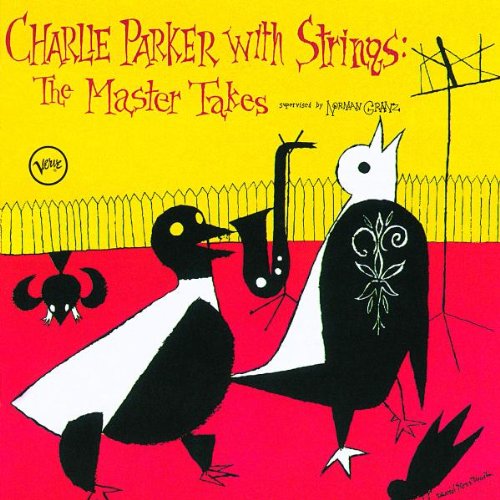
If you're only interested in Bird's famous recordings with a small orchestra, then you can save a little coin with this attractive disc. (It's only fair to say that for just a few extra bucks, $20 on average for used, you can have all the material here plus much more and better liner notes if you buy the Complete Verve Masters.) But as this disc's title indicates, it contains the complete master takes of Bird's famous 1950 sessions with strings. In addition to the 14 tracks contained on the original two LPs by Mercury, the Verve CD contains 10 bonus tracks recorded 1947-1952. The orchestral numbers are all standards, and when they work, it's magic. Some have argued that this was a commercial sell out. It was so successful that it led to a flood of other artists playing with strings. The truth is that Parker himself always wanted to play with an orchestra, and these recordings fulfilled his dream. In the greater context of jazz today, I think it's a stale argument and intentions don't matter. Who cares whose idea it was? Hey, it's Bird, there's some extra musicians, and the result is warm, elegant, and hard to turn off. Whoever can't enjoy such an engagement must be difficult to please. Likewise are my feelings for Cliff Brown, Dizzy, or anybody else who went in the studio with an orchestra in the 1950s.
Labels:
1947,
1948,
1949,
1950,
1951,
1952,
bebop,
bop,
charlie parker,
charlie parker with strings the complete master takes,
mercury,
orchestra,
review,
tenor sax,
tenor saxophone,
verve
Saturday, August 10, 2013
122. Charlie Haden / Night and the City (1996)
Night and the City has an extra attraction for me, because I love the film by Jules Dassin. Anyway, they're not related, but it's a great record. It was recorded for Verve at the Iridium in NYC, home to many a great night of live music (see HughGotIt's excellent uploads of the Ed Palermo Big Band for a glimpse of when the tiny room really gets rocking, and also some of Hugh's other great live video work). This time Haden teams up with Kenny Barron on the keys. Their music is elegant and sparse, but not at all vacant. It's reverent of jazz from an earlier era, and even its title recalls a romantic notion of the city as theater of life. Barron's opening "Twilight Song" sets the pace. The tunes are mostly standards, with one original by Haden ("Waltz for Ruth") and Barron's aforementioned "Twilight" being exceptions. "Body and Soul," as if anyone can get away from it, is thoughtful and majestic and makes a perfectly timed appearance midway through the disc. I think the collection is a treat, and each player exercises a remarkable restraint to let the other sing and breathe as needed. It's thick on mood, but not overly heavy, and I highly recommend it.
Labels:
1996,
bass,
charlie haden,
duo,
iridium,
jazz,
kenny barron,
live,
night and the city,
piano,
review,
standards,
verve
Sunday, July 28, 2013
118. Art Blakey and the Jazz Messengers / Soul Finger (1965)
In 1965, the Jazz Messengers were navigating strange seas. The decade was only half finished but had already seen players like Dolphy, Coltrane, and a host of others. On the other hand, it's like the climate inside the Messengers was oblivious to this. Their music continued ahead, business as usual, driven by Blakey's hailstorm of press rolls and weaponized hi-hat pulse. I feel inclined, or almost obligated, to say what been said a thousand times. I suppose when someone mentions the Messengers, that's the image I conjure: the world's best hard bop band, Blakey at the helm. Yet this lineup feels different than other incarnations of the Messengers, even if it's obvious that no two were the same. The soloists take some unexpected corners, and it's an aggressive front line from the word "go" with Freddie Hubbard and Lee Morgan blowing alongside Gary Bartz and, on one track, Lucky Thompson. They're explosive but the charm, for me, comes between John Hicks in the left channel and Victor Sproles in the right. I hear a lot going on there. Unforgettable is the debut of Gary Bartz on alto. This disc might not be a definitive Messengers date, but there are some critically overlooked moments packed between these grooves, and a little jazz history, as well.
Labels:
1965,
art blakey,
freddie hubbard,
gary bartz,
hard bop,
jazz,
jazz messengers,
john hicks,
lee morgan,
limelight,
lucky thompson,
review,
sextet,
soul finger,
verve,
victor sproles
Saturday, July 27, 2013
117. Ben Webster and Associates (1959)
Similar to the Rollins/Coltrane session Tenor Madness, much of Webster's Ben Webster and Associates feels like friends trying out ideas with relatively no pressure. In other words, a damned good jam session. Of course, with this lineup, the music has a completely different feel than Sonny Rollins and Coltrane. Webster and Co. start off with "In a Mellow Tone," and keep at it for over 20 minutes. It's so enjoyable, it's a shame the tune has to end. There's room for everyone: Webster, Budd Johnson, Hawk, Roy Eldridge, even Ray Brown gets two choruses. The excitement building for the final push to the end isn't to be missed. They next turn up the heat for "De-Dar," a bluesy tune with with a boisterous arrangement that swings hard. As far as the tenors go, I like listening to all the different styles on the same record -- Johnson's streamlined and laconic phrases in double time, Hawk's strident tone emerging like a dark horse, and Webster alternately growling or whispering but always playing straight. "Time After Time" strips Johnson, Hawkins, and Eldridge for a more intimate setting and allows further explorations in the diverse sound that Webster was famous for. So what are you waiting or? Get on the stick! This should be on every shelf.
Friday, April 19, 2013
86. The Oscar Peterson Trio / Night Train (1962)
Probably the most well known of all Oscar Peterson dates, thanks to the archetypal deep swing of the title track. I read that Peterson's father was a railroad porter, and the composition and album are a tribute to him. The leader invests a lot of emotion in these quiet but swinging selections. There's a lot of good material on this record -- "C-Jam Blues," "Georgia on my Mind," "Moten Swing," "Honey Dripper," and "Night Train" are all bona fide classics. Peterson is comparatively quiet behind the keys, humming less and seemingly content while employing bouts of delicious slides and twinkling arpeggios to get his point across. He uses the dynamics of the keyboard very effectively to underscore the emotional impact of each piece. And remember those other two -- Ray Brown and Ed Thigpen -- ain't no slouches, either. I think Ray's about as bluesy as Oscar. Four stars, and a good album for a date.
Thursday, April 18, 2013
85. Lester Young / The Jazz Giants (1956)
The Green-Ramey-Jones factor is in effect here, as Lester blows for the first time alongside the exquisite Roy Eldridge and Vic Dickenson. Teddy Wilson provides piano, his first date with Prez in a decade, and the whole thing really swings. The chemistry is great and it's a good listen. Knowing who is on the session, I love hearing one chorus while waiting for the next guy. Lester does some fireworks (try "Gigantic Blues," also note Eldridge, Wilson and Jones) but he sounds profoundly blue throughout the others. I never bought the description of Prez as lean or
altoesque, or however that's said. He's got a big, sonorous tone
that portrays (and occasionally betrays) every nuance of the piece. These are mostly ballads so it suits this album especially well. In the arrangements, Lester usually goes first followed by Dickenson or Eldridge. When they get to the end, the whole band takes it out. It reminds me of a big band arrangement, and harnesses the septet's additional weight to good effect.
Saturday, April 13, 2013
80. Jimmy Smith & Wes Montgomery / The Dynamic Duo (1966)
The arrangements by Oliver Nelson are assertive but don't sound as if they're intruding on the small group which is at the core of this session. Nelson's robust charts quickly give way to the main attraction, a reactive meeting of the Smith and Montgomery schools. If you liked the big band on Smith's The Cat then you'll appreciate this album's similar vibe. There's intense, crispy drumming from Grady Tate, occasionally complemented by Ray Barretto. Montgomery on rhythm is as impressive as he is on lead, like the high-octane percussive comping in "Down by the Riverside." There's a huge contrast between the two leaders. Montgomery's smooth, melodic lines are the ideal foil for Smith's fiery, organ revival. They play off each other well. Things appear to cool off with "Night Train," but a relaxed tempo only stokes the flames! The second side is more standards, first the dark chart of "13," followed by a lighthearted "Baby it's Cold Outside." If I listen to this too soon after Bags Meets Wes, I invariably wish Smith and Montgomery could have called Bags to join them. What if...
Wednesday, March 27, 2013
63. Lester Young Trio with Nat King Cole and Buddy Rich (1946)
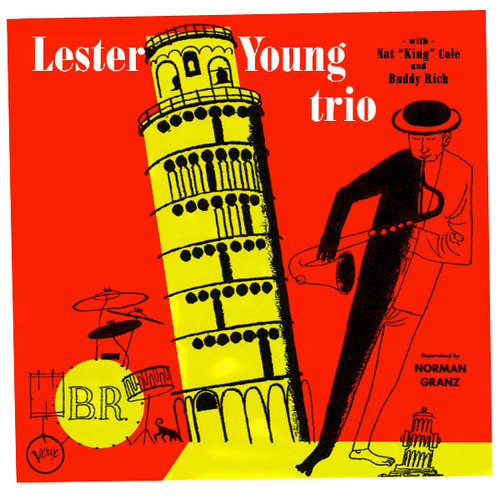
This is Lester Young right after the war, 1946, and leading a piano trio with Nat King Cole and Buddy Rich. It's the comfort food of jazz, and very satisfying. Young's lines are the epitome of their form, sweetly imagined, and sound as much like lines in a conversation as they do lines of melody on a saxophone. It's a good example of Young's casual, easy swinging style, and with just two other guys in the group, it's everywhere on the record. Nat's left hand does somersaults in playful runs, inventive patterns and good rhythmic chording, making the idea of a bass player obviously redundant. Cole interacts with Lester a lot. The pair is constantly trading ideas and listening to one another intently. Rich mostly uses the brushes but makes a relaxed vibe, keeping tempos taut and encouraging the soloists. There's a lot to choose from. The CD issue has two versions of "I Cover the Waterfront" and a handful of outtakes at the end of the disc which are nice.
Friday, March 22, 2013
59. Gato Barbieri / Chapter One: Latin America (1973)
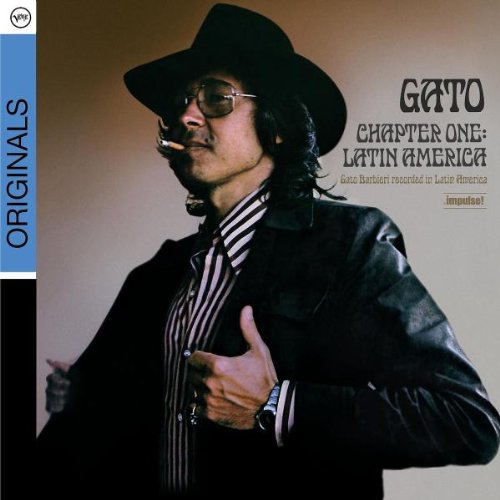
Early on, Barbieri did a series of albums focusing on Latin American music. Chapter One is the first and perhaps the most brilliantly conceived of the bunch, and it is also an album that brought him considerable acclaim outside of Argentina. "Encuentros" and "India" assemble a diverse assortment of instruments and musicians from South America. The proceedings are played on bombas, harps and the charango (yes! a charango). Barbieri's tenor presides over all, weaving in strands of melody and little riffs. At times, the group sounds as if they are imitating the sounds of the jungle, or myriad voices in a crowd. Listening to these pieces together is exhilirating time after time. The second side is comprised of a suite, and several short works. The former is a vast and sweeping work that I don't see having a successor in the Barbieri discography. It's noisy but sometimes gentle, roaring but not overwhelming, with great musicality. I see Chapter One as being of those records that shouldn't be played unless I unplug the phone and don't plan to leave the room until it's over. Aaaaah, that.
Tuesday, March 19, 2013
56. Count Basie / Count Basie at Newport (1957)
This set is a giant. Basie already has a power packed orchestra with Thad Jones, Frank Foster, Frank Wess, Sonny Payne, Freddie Greene, and a handful of others. But he invites superstars from his past bands to join them. Lester Young, Jimmy Rushing, Jo Jones, Joe Williams, and Illinois Jacquet all have a few moments to play with the current band. It's powerful music that is energetic, exciting, inspired, and obviously enjoyed by everyone on the stand and in the crowd. The tracks with Basie's reformed orchestra -- sleek and modern, young but steeped in swing and the blues -- are a nice contrast with older, swing-based musicians like Lester doing "Polka Dots and Moonbeams" followed by a frenetic "Lester Leaps In" and Jimmy Rushing singing the jaw dropping blues "Sent for You Yesterday and Here You Come Today." Rushing's gigantic voice demonstrates what it takes in terms of volume and stage presence to stand out in front of the most motley orchestra in the business. The old chemistry is still there, and this album, like Duke's record from Newport '56, demonstrates that big band wasn't dead yet.
Labels:
1957,
big band,
blues,
count basie,
count basie at newport,
frank foster,
frank wess,
jazz,
jimmy rushing,
jo jones,
joe williams,
kansas city,
lester young,
review,
swing,
thad jones,
verve
Wednesday, March 6, 2013
52. Gerry Mulligan Meets Johnny Hodges (1959)
Once upon a time, Verve (and the other labels, too) did a handful of records where one player "meets" another. These albums are like fantasy baseball for jazz. Some are really good, while others start and finish without really accomplishing anything. This time it clicks. Together, Mulligan and Hodges do a smooth and balanced set comprised of six originals, three from each. On Side 1, Mulligan's "Bunny" and the self-descriptive "What's the Rush?" set the mood, before moving into the swank, bluesy territory of Hodges' "Back Beat" and "What It's All About." Claude Williamson, Buddy Clark and Mel Lewis are the rhythm section, and are good at keying in on what the leaders are doing. Sonically, the saxes are a sweet blend with Claude Williamson and the carefully considered bass lines of Buddy Clark. When Mulligan and Hodges take choruses, the one will start developing where the other left off. There's no requirement for this, it's just good artistry. So instead of going in two personal directions with the rhythm section plodding in tow, Mulligan and Hodges make the album a cohesive and jointly constructed product. No surprises musically speaking, nothing groundbreaking, no one trying to bring down the roof. But does there need to be? It's just really good jazz from five great musicians.
Saturday, February 23, 2013
42. Lester Young with the Oscar Peterson Trio (1952)
For the most part, this disc is all about Lester, who performs admirably but is noticeably shakier and lacks that bright, bursting energy he exhibited a few years earlier. He frequents the lower register in soft, emotionally inflected lines that give the ballads a uniquely personal treatment. It's unmistakably Lester on every track and there is some very keen playing ("I'm Confessin' (That I Love You)" is just one example, or a close approximation of the man we once knew in "Just You, Just Me") but in other places I hear him struggle with timing and the impact of the inventiveness is lost. The dramatic ascents and nose dives he used to do so well seem to sputter like an injured bird, rather than a stunt pilot. Young usually takes the first chorus, and sometimes afterwards I swear I can hear Peterson and Kessel emulating his style on their instruments, playing several "even" bars before throwing the rhythmic weight of the next phrase off to one side and rushing in after it. Even if he isn't in the same form as the recordings from 1946-1949, he's still Lester Young and when it works, it's untouchable.
Tuesday, February 12, 2013
32. The Jimmy Giuffre 3 / The Easy Way (1959)
The Easy Way is darned sneaky, the way it passes so quietly upon first listening. The music is so sparse that it stops your breath like a stillborn moment, a feeling almost too sparse, but the second time around, that same quality forces a closer inspection and reveal ongoing relationships of very dynamic interplay at the heart of the chemistry. I keep going back to it. In this 1959 session, Giuffre swaps bassist Ralph Pena for Ray Brown, trading the busy sound of Pena for Brown's commanding and bluesy style. They work with it. On "Ray's Time" we get an extra dose of the Ray dimension while Jim Hall comps and Giuffre lays out. When Giuffre is playing he is taking a lot of ideas from Brown and Hall, who turn them right back around. The album is divided into two distinct halves: the first comprised of blues like the Ray tune and standards like "Mack the Knife," and a more exploratory or section, marked by "Time Enough," "Montage," and "Off Center."
Labels:
1959,
album,
cool,
jazz,
jim hall,
jimmy guiffre 3,
ray brown,
review,
the easy way,
trio,
verve
Subscribe to:
Posts (Atom)


