Recent listening, current
Archived listening, 2013-2016
Showing posts with label impulse. Show all posts
Monday, November 4, 2013
145. Benny Carter & His Orchestra / Further Definitions (1961)
This octet features the alto saxes of Green and Phil Woods playing across from Coleman Hawkins and Charlie Rouse on tenor. The lineup recreates the famous Green-Hawkins date from Paris 1937 while harkening back to the swing era's "dueling" sax lineups, fashioned after the Basie model. This time, several 30+ year veterans team up with players of the next generation like Woods, Rouse, and Jimmy Garrison. It's a real sympatico affair, a collage of distinctive voices working together in a shared, now classic style. Their danceable, infectious small group swing is a far cry from Impulse's stock and trade just a few years later. Carter's arrangements provide amply for the players, and the set rolls without a hitch. I love "Body and Soul," especially when Hawk plays it. It's a gem, and Carter's chart gives him all the room he wants. Woods' work on "Crazy Rhythm" (a chestnut also from the Paris date) is notable, drawing equally from the work of his mentors and his own developing style. The solid, self-assured vibe feels a lot like Duke Ellington Meets Coleman Hawkins or Verve's Ben Webster and Associates. Comparisons aside, it's something you want to own for its sheer enjoyability, if not for its historical value.
Labels:
1961,
alto saxophone,
benny carter,
charlie rouse,
coleman hawkins,
dick katz,
further definitions,
impulse,
jazz,
jimmy garrison,
jo jones,
john collins,
octet,
phil woods,
review,
tenor sax,
tenor saxophone
Saturday, June 22, 2013
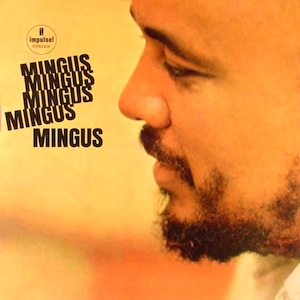
110. Mingus Mingus Mingus Mingus Mingus (1963)
Mingus, the master orchestrator. Mingus the composer. Mingus the performer. He's got so many credits on this album that I marvel at how it doesn't sound one bit overrun by his presence, yet it's distinctly his product. The music swings with a loose and careening vibrancy that is electrified with spontaneity and invention. With just 10 pieces, his arrangements sound as quiet as a quartet or as powerful as a big band. Its performers lend the air of familiarity, dashing in and out of ensemble jams like "Better Get Hit in Yo' Soul" or blending sublimely as in the steamy rendition of "Mood Indigo." Mingus listeners will immediately sense the presence of old friends, because many of the tracks are new treatments of preexisting Mingus tunes. I'll let you figure what is what. As for soloists, I really enjoy Charlie Mariano (bias alert, I just got Blue Camel so I'm on a bit of a bender) or the shambling Walter Perkins on drums.
Wednesday, May 1, 2013
98. John Coltrane / Interstellar Space (1974)
This was actually recorded in 1967, but not released by Impulse! until '74, almost a decade after Coltrane's death. It's famously dense, but not impenetrable. Throughout the album, Coltrane demonstrates a litany of technical ideas by running through scales, stacking chords, and changing meters in snatches of modal improvisation. It is very experimental and obviously one of the more inaccessible works in the Coltrane canon. Interstellar Space was recorded shortly after the session that produced Stellar Regions, so many of these pieces share themes. "Saturn" is the longest piece, also the only one to lack bells in the intro. Some people latch onto "Venus" which is the closest thing to a conventional melody on the record. Rashied Ali plays like a mystic, and I often find myself listening to him more than Coltrane, whose explorations are searching but also noisy and make the ear weary. Ali's rhythms seem to accommodate any of Coltrane's fancies, or rather Coltrane is free to step in and out of them when it suits he is doing. This is huge music for 1967 that has been hotly debated, put down, or academically dissected ad nausea ever since. I'm happy that the package was expanded on CD to include the similarly minded "Leo" and "Jupiter Variation." 2013 has a lot more context for this type of musical activity than there was in 1967, and it's found a happy home with hundreds of people. That's the crime of being ahead of your time, that it takes everyone else that much lonegr to catch up. Gregg Bendian chose this album to recreate with Nels Cline (Interstellar Space Revisited), describing it in the liner as his love letter to free jazz drumming. In that regard, I can't think of a finer template. Listen to both, see where it takes you.
Wednesday, April 3, 2013
70. John Coltrane / Crescent (1964)
I love this album because it is so moody. Only during "Bessie's Blues" does he lighten up, although not for very long. I guess it's fitting that it comes from a different session. Jones sounds like rain to me, even when using sticks. He shuffles, clicks, clacks, swooshes, and bangs, just like a thunderstorm. It's the perfect accompaniment to Coltrane's moody tenor, and rhythmically speaking, gives him a long leash. Tyner contributes in a similar fashion, creating a colorful backdrop of notes that sound very much like the sheets of rain in a storm. The last track is pretty much all Jones, called "The Drum Thing." Contrasting with Trane's more exploratory work, these performances are almost rigidly disciplined. He doesn't abandon what he learned in the intervening years, he just applies it differently. The result is a more mature formulation of the post-bop he was doing during for Prestige, richly imagined and deeply reverent of its roots. It's something of a calm before the storm in the Coltrane canon, considering that the next year witnessed A Love Supreme and the year after, Ascension.
Monday, April 1, 2013
68. Freddie Hubbard / The Artistry of Freddie Hubbard (1962)
This is Hubbard's fifth album as leader, and his first recorded for the Impulse! label. The music is hard bop inside and out, but Hubbard's sextet undergoes some changes with trombone Curtis Fuller, and John Gilmore moonlighting away from the Arkestra. Together they stretch out in some lengthy jams and experimental explorations that lean clearly in the direction of the Impulse! ethos. "Bob's Place," "Summertime," and "The 7th Day" really put eyebrows on the proceedings. The reworking of "Caravan" is interesting, too. Gilmore is especially captivating. Like a musical alchemist, he plays long, sustained notes in lengthy phrases that unmoor the notes from their melodies. On compositions like "The 7th Day" or "Bob's Place" these contrast with the backdrop of the vamp, creating the effect of pure tonal color and presenting the tones themselves in striking relief beside their harmonic relationships. Tommy Flanagan on piano, Louis Hayes does drums, Art Davis bass. I like this side trip from the early Hubbard formula quite a bit.
Sunday, March 31, 2013
67. Duke Ellington Meets Coleman Hawkins (1962)
By all accounts a long time in the making, the result of this collaboration is worth the wait. Scaled back arrangements showcase the soloists and focus, of course, on the eloquent, mellifluous tenor of Coleman Hawkins. It's a relaxed and familiar session, with some hot blowing by everyone, especially Ray Nance ("Wanderlust"), Johnny Hodges ("You Dirty Dog"), and Lawrence Brown, who are clearly inspired by Hawk's presence. The affair starts with the loose and tumbling Latin groove of "Limbo Jazz," recorded secretly by Van Gelder and capturing a riotous continuo scat vocal by Sam Woodyard. Late in the tune, Hawk is invited to join the fun. We are treated to a sublime "Mood Indigo," where the star takes chorus after chorus until bowing out in the last bar. This exhilarating performance always leaves me excited for what comes next. The record really feels like Duke during "Ray Charles' Place" when they do some ensemble figures in powerful, transcendent chords. Hawk dives right in the middle and has ample support from the group who seem to draw up the whole tune up around him. Lawrence Brown has some nice solos throughout the album, notably on 'Wanderlust" and "The Jeep is Jumpin'." I think Hawk's best moments occur in the aforementioned "Mood Indigo" but the honorary "Self Portrait of the Bean" runs a close second and is as near to Hawk's thesis as we're going to get this side of "Body and Soul."
Labels:
1962,
coleman hawkins,
duke ellington,
duke ellington meets coleman hawkins,
impulse,
jazz,
johnny hodges,
lawrence brown,
octet,
ray nance,
review,
sam woodyard,
tenor sax,
tenor saxophone
Friday, March 22, 2013
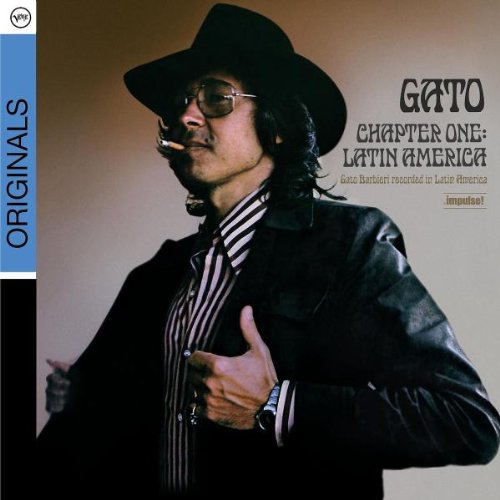
59. Gato Barbieri / Chapter One: Latin America (1973)
Early on, Barbieri did a series of albums focusing on Latin American music. Chapter One is the first and perhaps the most brilliantly conceived of the bunch, and it is also an album that brought him considerable acclaim outside of Argentina. "Encuentros" and "India" assemble a diverse assortment of instruments and musicians from South America. The proceedings are played on bombas, harps and the charango (yes! a charango). Barbieri's tenor presides over all, weaving in strands of melody and little riffs. At times, the group sounds as if they are imitating the sounds of the jungle, or myriad voices in a crowd. Listening to these pieces together is exhilirating time after time. The second side is comprised of a suite, and several short works. The former is a vast and sweeping work that I don't see having a successor in the Barbieri discography. It's noisy but sometimes gentle, roaring but not overwhelming, with great musicality. I see Chapter One as being of those records that shouldn't be played unless I unplug the phone and don't plan to leave the room until it's over. Aaaaah, that.
Thursday, March 7, 2013
53. Alice Coltrane / Journey in Satchidananda (1970)
Alice plays harp and piano, with help from two lineups of New Jazz practitioners (one band for the studio, and one recorded at the Village Vanguard). Coltrane's harp is wild and free, and the diverse instruments of her band make a colorful backdrop of shifting textures and rich tonalities. Pharoah Sanders' tenor and soprano saxes are played with an ear toward Middle Eastern or north African themes, but no on. If you've ever questioned or been curious about the influence of the former on the latter, this as close to a living, breathing side-by-side comparison that you're ever going to get. The liner says something about Coltrane's association with Swami Satchidananda and his doctrine of universal love. While we listen, we are invited to envision ourselves floating on his love for humanity. I'm not sure I prefer to do that over listening to how the musicians choose to stretch out and cooperatively interpret music that is entirely modal in form. I always hear something new, especially from McBee.
Subscribe to:
Posts (Atom)