Recent listening, current

Showing posts with label jazz. Show all posts

Saturday, May 9, 2015

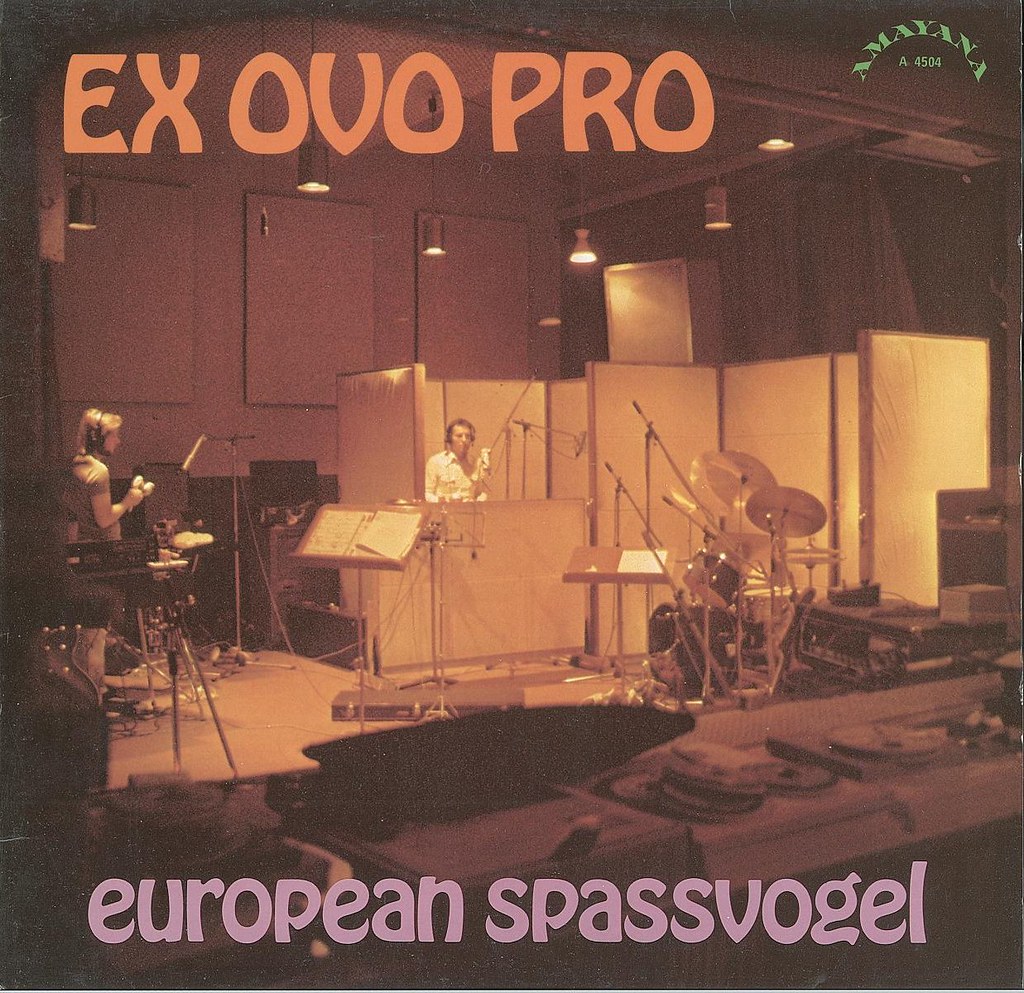
199. Ex Ovo Pro / European Spassvogel (1976)


I don't hear enough of the European jazz scene, past and present, simply because of the music's more limited availability where I live. Thankfully, the web makes the world a little smaller and I was able to locate and hear this out-of-print gem from the Amayana label. European Spassvogel ties a lot of pieces together and after listening to many American groups from the same era, it's refreshing, I really like it. The music is exploratory with anchors in moody vamps and dark melodies. Thankfully, funk is only an ingredient, and the band doesn't dwell on it indefinitely, frequently moving away from it. Wild extemporizations of Mandi Riedelbauch ("In a Locrian Mood") are free and noisy, but the band is really tight. Harald Pompl pounds his traps all around the beat, stuffing the cracks with a unique assortment of percussion and technique. Max Kohler's growly electric bass pours the foundation, and while Pompl does his thing, Kohler keeps time. Hans Kraus-Hubner proviides electric piano, often leading, sometimes coaxing the soloists. It's just a good, chill listen. The songs are concise, and the sides wrap before you can get distracted. If you're like me and get burned out on purely funk-based fusion, this could be what you were looking for.

Friday, April 11, 2014

191. Fred Hersch - Alone at the Vanguard (2011)

Hersch plays in his characteristically slick and lyrical style in this collection of live, solo recordings. The gently meandering set is just over an hour long but was culled from an entire week of performances at the Vanguard in  2010. Hersch's back catalog of superb trio records has given him all the leeway that could be expected from the trio format, but alone, he is free to wander a little farther from the yard, in both time and route, as with Sonny Rollins' "Doxy," or the elegant salute to Thelonious Monk's "Work." In the absence of the drums and bass, he develops sweeping melodic arcs in each piece, and displays refined senses of harmony and dynamics. With several numbers he tips his hat to inspiration from friends and figures like Robert Schumann, Bill Frisell, and Lee Konitz. My favorite piece is the disc's opener that I know as a favorite Frank Sinatra song (although it has been covered countless times since). "In the Wee Small Hours of the Morning" is rendered so poignantly as to touch the emotional depth achieved by Sinatra on the 1955 album.

Friday, January 3, 2014

166. Sonny Rollins / Rollins Plays for Bird (1956)

The medley of post-1950 Charlie Parker tunes that begins this tribute to the late Mr. Parker flows as effortlessly as a river thanks to Wade Legge's piano continuo and Max Roach's drum kit. Rollins and Kenny Dorham do most of the melody and choruses, although Roach gets a fair shake, too. He characteristically mixes it up during the front line's choruses, laying on the cymbals and hard rolls while changing from straight time to double-time and back again, adding a loping feel, building urgency, or cooling it back down as needed. Legge and bassist George Morrow are the only musicians in the quintet to never work with Parker, so there is a familiar intimacy about the music that comes from the friends honoring a friend. Dorham is relaxed and outstanding in the "Star Eyes" segment. He especially soars in "Kids Know," a Rollins original in 3/4 that the band stretches out generously. There are a lot of Charlie Parker tribute albums out there, hundreds since 1955, and some are real time wasters. This date is one of the best, the most genuine, and the most enjoyable.

Monday, December 23, 2013

161. Al Grey & Friends / Christmas Stockin' Stuffer (1990)

If you're not averse to "Christmas jazz" -- practically it's own genre nowadays, a diverse lot encompassing everything from Coltrane to Mindi Abair -- then be sure to track down a copy of Christmas Stockin' Stuffer. The mood is relaxed and bluesy, an enjoyable set replete with vocals, organ, guitar, and of course, Grey's talking trombone. I like its lonesome touch on "Winter Wonderland" and "It Came Upon a Midnight Clear," interspersed with Joe (son of Al) Cohn's funky riffing on the guitar. There are some vocal spots like the opening "Christmas Stockin' Stuffer" (guest vocal by Jon Hendricks), which is a treat. "White Christmas" is arranged with strings adding a warm, homey glow to the playlist. The short but sweet New Orleans inspired "Auld Lang Syne" plays you straight through New Years' Eve, if you can't give up the holiday spirit until January. Not exactly what I would describe as an obscure album, but not exactly easy to find, either, Grey's holiday outing is a must-have for my season.

Thursday, December 12, 2013

159. Buck Hill Quartet / This is Buck Hill (1978)

This is Buck Hill is Hill's recording debut on SteepleChase. From Washington D.C., Hill worked for the post office by day and was a hard driving driving tenor sax leader by night. So by the time we meet him in 1978, he is 51 years old and already possesses a fully developed tone and unique stylistic approach to modal material. Because of this late exposure, he is easy to miss, but he was and continues to be a fantastic player in the tradition of other big tenors that jazz listeners are more familiar with. For the debut he teams up with Billy Hart, Kenny Barron, and Buster Williams. They have a good sound that approaches the Prestige or Blue Note gold standard from two decades earlier. This session lacks the production gloss of newer Hill releases like Relax (which is also excellent). Notably, four of the album's seven tracks are Hill's originals. These are modal explorations with contributions from all members of the group. The four musicians play so well together that it's a hard sell for me to believe they weren't working together a lot longer than they were! Finding the vinyl could be a challenge but the recent CD is a worthwhile purchase and comes with a bonus take of Hill's "S.M.Y."

Tuesday, December 10, 2013

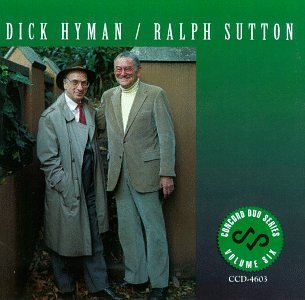
158. Dick Hyman & Ralph Sutton (1993)

This magical live set was recorded at Berkeley's Maybeck Recital Hall in 1993. Both players have a grand command of the keyboard, and a little bit like the piano recordings of Duke Ellington, they render the music with the arranger's ear for an orchestra. Hyman is off to the left, Sutton on the right. Hearing the two styles in opposition is a marvelous thing. Tumbling down the stairs in effervescent flurries from the high end is Hyman, while Sutton provides a canvas of chording and big rhythmic anchor. Sutton's choruses in tunes like "I'm Gonna Sit Right Down and Write Myself a Letter" are comparatively rowdy, bordering on barrel house, filled with booming chords and a topsy-turvy swing. Clocking in just shy of five minutes, I think the tune could easily have gone another round, but what we get is such a skyrocket that it's impossible to complain. "Everything Happens to Me" is a solo feature for Sutton, while Hyman gets "Ol' Man River" all to himself. In the latter, Hyman's lines demonstrate a dazzling fluency in blues, bop, and balladry. A shimmering collection of piano jazz by two undisputed masters of the instrument, I highly recommend this collection.

Monday, December 9, 2013

157. Gene Harris Quartet with Frank Wess / It's the Real Soul (1995)

Recorded live across two nights in March of 1995, these eight tracks feature the Gene Harris Quartet (Ron Eschete, g; Luther Hughes, b; Paul Humphrey, d) in the company of Frank Wess. Wess divides his time between four tracks, playing tenor on "Menage a Bleu" and "Estoril Soul," then flute on "Straight No Chaser" and "My Funny Valentine." He is as expressive on the flute as Harris is on the piano, unleashing a diverse assortment of perky phrases and exciting techniques that frame the Monk tune in a perfectly jaunty way, and adding lots of personality to "My Funny Valentine." Nice as it is to have him around for the proceedings, the core band plays with such a big sound and heavy swing that I don't miss him on the other half of the record. Harris works well with guitarist Eschete. Their cooperation in splitting the breaks of "Lady Be Good" turns the old tune into a memorable affair, their choruses developing patiently until the mood reaches a fever pitch. "That's All," which is the last tune on the album, is a fitting closer. Harris teases "Rhapsody in Blue" before really pounding into fully chorded statements, with the crowd loving it. His style on the keyboard is often described as being rooted in a gospel tradition and tracks like "You Don't Know Me" clearly substantiate those descriptions.  

Saturday, December 7, 2013

156. Chet Baker / The Italian Sessions (1962)

Baker's groups in Europe were a mixed lot. Sometimes they were great but sometimes it was just the opposite. Then after a lifetime of drugs, alcohol, and legal trouble, his tone and technique suffered hugely.  I like this disc because it is none of those things. It features Baker on the front line of a charging hard bop sextet. He holds his own flanked by piano, tenor sax, and guitar. His lines are so forthright and aggressive, so strident and even verbose (for Baker) that it hardly even sounds like him. I'm dying to put it in a blindfold test because it's such a curveball. The high spirited band gets started on the first track. "Well You Needn't" is one of two rhythmically thorny pieces in the session, the other being Charlie Parker's "Barbados." In the Monk tune, Baker careens along filling the space above and below him with a clarion tone and fast but thoughtful flits into the upper register. The drummer, Daniel Humair, drives the thing right over the top. Every track is short and concise -- no wasted space, no excessive showboating, no lost attention or bad takes. If you know the Let's Get Lost Chet Baker, the Californian bebop sensibility, the underplayed moody ballads and minimalistic statements in the lower register only, then you could revise that understanding, or at least enrich it, with these eight performances. They even do "Star Eyes," which is one of my favorite tunes by anyone.

Tuesday, December 3, 2013

154. Gene Ammons and Sonny Stitt / Boss Tenors (1961)

If you've got the stereo disc then Ammons is in the right channel and usually goes first. Stitt is in the left channel and comes next, occasionally doubling on alto. The latter was one of the most inspiring alto players there was, but he gets short shrift. A whiz on the alto, he was equally capable on tenor or even baritone (no barisax on this disc). These two players make wonderful music together. It's a solid dance session, with plenty of fireworks and some intriguing knots in the choruses that may interest more serious listeners. "There is No Greater Love" features Stitt on alto. His exhilirating double-time chourses are a thing to marvel at. While trading jabs with each other, the horns take unexpected sidesteps outside the blues, like in Ammons' first chorus of "Autumn Leaves," or some of Stitt's phrases in the smoking "Blues Up and Down." The rhythm section of John Houston, Buster Williams, and George Brown has a good chemistry. Williams' timekeeping meshes well with Brown, and especially Houston's comping style, which favors chunky, chorded statements emphasizing the beat. Their interplay with the leaders during "Blues Up and Down" really kicks the tune into a higher gear. This is a memorable session, and quite enjoyable, to say the least.

Wednesday, November 6, 2013

146. Wes Montgomery / Smokin' at the Half Note (1965)

Smokin' is the second collaboration between Montgomery and the Wynton Kelly Trio. They played on a couple of his other albums, too, and they make a solid group. The trio is Kelly, Chambers and Cobb. Having said as much I shouldn't have to say more because the names, let alone the music, practically say it all. I'll listen to anything with these guys. Only two of the five tracks on the original LP are actually live from the venue, "If You Could See Mee Now" and "No Blues." The other three are from (where else?) Van Gelder's studio. It doesn't really matter because both dates are terrific. Our opener "No Blues" pushes 13 minutes in length, marked by Montgomery's fat tone and heavy right hand. It's also an interesting piece as far as Miles covers go, dating from his 'casting around' period before the second great quintet formed up. But getting back to Wes, his melodic constructions in "Unit Seven" are something to marvel at. It's refreshingly cogent jazz thinking, replete with strong musicality and inventive spirit. For both live and studio material, Chambers and Cobb are the bedrock while Kelly is probably the perfect pianist for this group, having both the technical facility and bluesy swagger necessary to enhance the brew. If you want to learn what jazz guitar is all about, this is a good entry point.

Monday, November 4, 2013

145. Benny Carter & His Orchestra / Further Definitions (1961)

This octet features the alto saxes of Green and Phil Woods playing across from Coleman Hawkins and Charlie Rouse on tenor. The lineup recreates the famous Green-Hawkins date from Paris 1937 while harkening back to the swing era's "dueling" sax lineups, fashioned after the Basie model. This time, several 30+ year veterans team up with players of the next generation like Woods, Rouse, and Jimmy Garrison. It's a real sympatico affair, a collage of distinctive voices working together in a shared, now classic style. Their danceable, infectious small group swing is a far cry from Impulse's stock and trade just a few years later. Carter's arrangements provide amply for the players, and the set rolls without a hitch. I love "Body and Soul," especially when Hawk plays it. It's a gem, and Carter's chart gives him all the room he wants. Woods' work on "Crazy Rhythm" (a chestnut also from the Paris date) is notable, drawing equally from the work of his mentors and his own developing style. The solid, self-assured vibe feels a lot like Duke Ellington Meets Coleman Hawkins or Verve's Ben Webster and Associates. Comparisons aside, it's something you want to own for its sheer enjoyability, if not for its historical value.

Saturday, October 19, 2013

143. Don Braden / The Voice of the Saxophone (1997)

Braden plays a big sounding  tenor and does an admirable job arranging for his octet (which is occasionally a quartet, as with "After the Rain"). He carries most of the groove but there's also Vincent Herring, Randy Brecker, Frank Lacy and Hamiett Bluiett. The arrangements are nimble, often carried by a piano continuo, and they balance the group's massed power with spaces that feature the soloists. It's clever, and I'll forget that I'm listening to an octet before a big blast reminds me to count the pieces. The opener is Hank Mobley's swinging "Soul Station." There's a lot of good hard bop in the playlist, like Shorter's "See No Evil," or Jimmy Heath's "Voice of the Saxophone." It all sounds fresh. There's also Sam Rivers' tricky "Point of Many Returns" and some solid originals by Braden like "The Dust Kicker" and "Cozy," (nice solo by Brecker here). "Monk's Hat," which is the tune we all know as the theme from the Cosby Show, is appreciated but might be more appropriately placed at the end of the album. Kitsch aside, I like that last one well enough because it reminds me of watching Cosby! Hats off to Braden and crew for an outing that's enjoyable, danceable, and even holds a few surprises.

Saturday, September 21, 2013

141. Monty Alexander, Ray Brown, Herb Ellis / Triple Treat (1982)

For various reasons, the cover of this recording seems oddly appropriate. A photograph of a three-scoop ice cream sundae makes a cheeky pun for the piano trio's sweet and sometimes quirky set of tunes like Blue Mitchell's "Fungi Mama" (with fun quotes by Ellis, and some jangly syncopation by Alexander) or the hot side-opening "(Meet The) Flintstones." Monty Alexander fills the piano chair and I don't think he sounds one bit like Oscar Peterson, in spite of Brown and Ellis being longtime members of that musician's group. The other music on the album is equally sweet and creamy, as with the sumptuous "Body and Soul" and "Sweet Lady," or swinging "When Lights are Low." Also notable is the title track, the "Triple Treat Blues." Chemistry, relaxed atmosphere and slick, baton passing choruses of these three musicians make a buoyant and memorable session that is out of print but worth seeking out. If you enjoy this lineup, be sure to check out their other albums, as well.

Thursday, September 12, 2013

137. Arnett Cobb and Eddie "Lockjaw" Davis / Blow, Arnett, Blow! (1959)

This Prestige date was something of a 'return' for Cobb, who had been recently injured and was retired during recovery. Fans of Mr. Davis should enjoy the album thoroughly because it's exactly the same band as the Cookbook sessions, plus Cobb. Every cut is a wild give and take between Cobb and Davis, a battle for sure. Shirley Scott, making heavy use of the drawbars and tremolo, throws gasoline on the fire more than once. The choice of an organist over a pianist makes a big difference in the total sound and Scott definitely has some good licks. The quintet setting is almost too small to contain the horns, and it does get noisy, but the arrangements are tight. It's well worth seeking out for fans of early soul jazz, or Texas tenor, or anyone studying the small group work of Cobb or Davis who were also well known as big band soloists. The opening chestnut "When I Grow Too Old to Dream" is very nice, also take a look at "Dutch Kitchen Bounce" and "The Eely One." I wonder, is that title a reference to Bud Freeman? Maybe someone in the blogosphere can tell me. One word for this album? Hot!

Thursday, September 5, 2013

132. John Coltrane / Fearless Leader (2006)

Coltrane's Prestige albums have been available in various formats since the 1950s. Another chapter in the flood of repackaged Coltrane on CD, Fearless Leader places his earliest recordings as leader in chronological order. This allows serious listeners to study his development as composer, arranger, and stylist without having to track down the individual records. Moreover, by removing these recordings from their in-album sequences, they exist in a proper or at least more authentic musical context. They transcend the supposition that is imposed by arbitrary sequencing and stand their ground against one another, in the order they were created. Listening to the whole box, or at least a good chunk of it in one sitting, is a rewarding experience. From the outset, Coltrane's groups are well rehearsed and the arrangements are tight. Throughout the progression, it's exciting to hear Coltrane's tone become more sonorous, his technique sharper, more assured. In addition to the leader, there's Paul Chambers, Art Taylor, Red Garland, Mal Waldron, Freddie Hubbard, and others. We hear them take some excellent shots at the blues, as well as Coltrane's peerless balladry in classic chestnuts like "Lush Life" (Donald Byrd around the 9-minute mark, wow), and some early sheets of sound ("Black Pearls," "Russian Lullaby"). Across six discs, there's too much to discuss here. Somebody could, and several people have, written books on this music. The concept of the six-disc set, plus accompanying booklet with copious photos and notes, make it a really attractive package. Unless you want the individual albums, I'd say this is a core collection item.

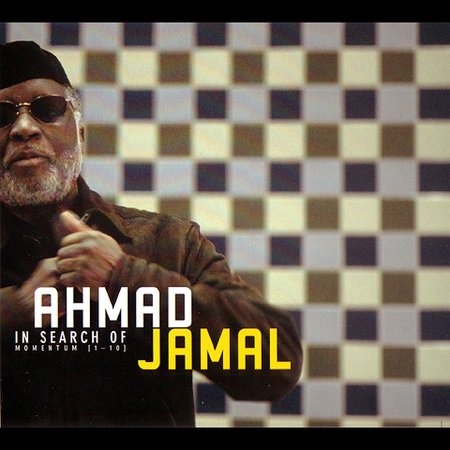
131. Ahmad Jamal / In Search of Momentum (2003)

Jamal is an excellent player, strong as ever and still developing past age 70. In Search of Momentum is a prime example, the kind of record that makes other new things feel stale (here "new" is 2003). His enthusiasm for contrasting percussive block chords with what I like to call 'negative space' on the piano is matchless. His style is ever more rhythm driven, and it's full of energy for standards like "Where Are You." In the opening "In Search Of" he plays with some sly quotes that bring a grin. In "Should I?" he characteristically mixes a heavy left hand with intermittent flourishes of the right, building to thundering crescendos a la Erroll Garner, then reclining in moments of delicate quietude. He works closely with his excellent trio, who are James Cammack on bass and Idris Muhammad (a personal favorite, nice to see him here, too) on drums. Jamal is aggressive and often angular, and his style shouldn't be a stretch for fans of more overtly experimental pianists like Cecil Taylor. O.C. Williams joins Jamal for the beautiful "Whisperings," the album's sole vocal spot and another opportunity for Jamal to stretch out his dynamic approach to the keyboard. And by the way, the liner says that Jamal's hat was designed by Ishmullah's Famous Hats of Oakland, California. Too bad Monk wasn't around long enough to endorse men's haberdashery.

Tuesday, August 20, 2013

126. Babs Gonzales / The Chronological Classics: 1947-1949 (2000)

Babs Gonzales was a fringe character in jazz, although he garnered a devoted fan base. I have a difficult time finding him a slot in my head, which I guess a lot of people must. So I'll file him with King Pleasure on one side and Screamin' Jay Hawkins on the other, not too far from Slim Gaillard and Betty Roche. The chief characteristic of his music is a bebop inflected vocal style somewhere between scat and vocalese, with occasional forays into conventional lyric singing. He had lots of friends on his records: Tadd Dameron, Art Pepper, Sonny Rollins, Bennie Green, and James Moody to name a few. This disc contains just what its title describes. Included are his legendary sides for Blue Note with Dameron on piano, as well as his work for the smaller Apollo and Manor labels (enjoy Green and Moody on Manor). Also here are eight sides recorded by Capitol, three of which were rejected. These groups contain a young Sonny Rollins, Art Pepper, J.J. Johnson, Roy Haynes, as well as Wynton Kelly, and Pee Wee Tinney on guitar. It's a motley bunch of tunes and dudes that are charming ("Running Around"), humorous ("A Lesson in Bopology"), or spooky ("Weird Lullaby"), but always good fun. Appreciate them for containing the work of other notables, or on their own merit. You won't find much like Babs anywhere else.

Saturday, August 10, 2013

122. Charlie Haden / Night and the City (1996)

Night and the City has an extra attraction for me, because I love the film by Jules Dassin. Anyway, they're not related, but it's a great record. It was recorded for Verve at the Iridium in NYC, home to many a great night of live music (see HughGotIt's excellent uploads of the Ed Palermo Big Band for a glimpse of when the tiny room really gets rocking, and also some of Hugh's other great live video work). This time Haden teams up with Kenny Barron on the keys. Their music is elegant and sparse, but not at all vacant. It's reverent of jazz from an earlier era, and even its title recalls a romantic notion of the city as theater of life. Barron's opening "Twilight Song" sets the pace. The tunes are mostly standards, with one original by Haden ("Waltz for Ruth") and Barron's aforementioned "Twilight" being exceptions. "Body and Soul," as if anyone can get away from it, is thoughtful and majestic and makes a perfectly timed appearance midway through the disc. I think the collection is a treat, and each player exercises a remarkable restraint to let the other sing and breathe as needed. It's thick on mood, but not overly heavy, and I highly recommend it.  

Sunday, August 4, 2013

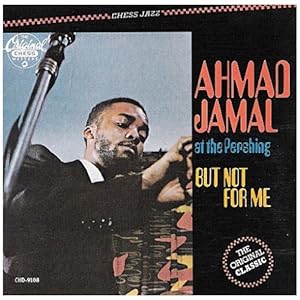
120. Ahmad Jamal / At the Pershing, But Not For Me (1958)

Out of Jamal's handful of live albums, each one a gem, At the Pershing stands out to me as essential listening. It was originally released on Chess Records' Argo label and became a smash hit, a coup for the label that had recorded a goodly variety of music but not broken into the jazz markets held by Blue Note, Verve, Columbia, or smaller labels like Prestige. Widely influential, it's become a classic. Jamal's emergent style is the principal attraction but the trio consisting Israel Crosby and Vernell Fournier isn't to be fooled with. Their brand of jazz is superbly crafted and seamlessly executed. Cooperation and interplay between bass, drums and piano is supernatural. Listen to the sparse but beautiful "Poinciana," demonstrating Jamal's wise but playful use of space and silence while the rhythm section carries a percussive groove. Some of the selections clearly presage the work of Miles Davis' first great quintet. My only complaint? On the original liner, Jamal writes that he himself selected eight tracks of the 43 they recorded 16 January 1958. Gambit's Complete Live at the Pershing Lounge 1958 offers only 20 tracks. I did the math, and while Jamal is still playing dates, it'd be darned nice to have those missing tapes....

Sunday, July 28, 2013

118. Art Blakey and the Jazz Messengers / Soul Finger (1965)

In 1965, the Jazz Messengers were navigating strange seas. The decade was only half finished but had already seen players like Dolphy, Coltrane, and a host of others. On the other hand, it's like the climate inside the Messengers was oblivious to this. Their music continued ahead, business as usual, driven by Blakey's hailstorm of press rolls and weaponized hi-hat pulse. I feel inclined, or almost obligated, to say what been said a thousand times. I suppose when someone mentions the Messengers, that's the image I conjure: the world's best hard bop band, Blakey at the helm. Yet this lineup feels different than other incarnations of the Messengers, even if it's obvious that no two were the same. The soloists take some unexpected corners, and it's an aggressive front line from the word "go" with Freddie Hubbard and Lee Morgan blowing alongside Gary Bartz and, on one track, Lucky Thompson. They're explosive but the charm, for me, comes between John Hicks in the left channel and Victor Sproles in the right. I hear a lot going on there. Unforgettable is the debut of Gary Bartz on alto. This disc might not be a definitive Messengers date, but there are some critically overlooked moments packed between these grooves, and a little jazz history, as well.