Recent listening, current

Showing posts with label 1960. Show all posts

Sunday, June 21, 2015

205. Coleman Hawkins with Eddie "Lockjaw" Davis / Night Hawk (1960)

Enough has been said about Hawk's invention of the wheel when it comes to the tenor sax solo. His influence extends over both horizons and has touched untold numbers of musicians both directly and indirectly. But his work, especially that of the transitional 50's and early 60's, is also a lot of fun to listen to. Hawk's professionalism was so cool it was casual, his technique an enigmatic balance of technical innovation and instinct. Here, in a 1960 session for the Swingville imprint and recorded by Rudy Van Gelder, he is heard with fellow tenor Eddie Davis, Tommy Flanagan, Ron Carter, and Gus Johnson. The title track, 10 minutes of slow blues loosely organized around a theme, is a pickup number that demonstrates the players' knack for the above. The contrast between the tone and styles of Hawkins and Davis on tracks like "In a Mellow Tone" provides an added dimension. Flanagan is in top form playing tastefully between the leads, Carter and Johnson a sympathetic unit whose attention to the music goes beyond timekeeping. As with Duke Ellington Meets Coleman Hawkins recorded for Impulse two years later, a good result from such a meeting of the minds was not a foregone conclusion, but in both cases the outcome was memorable.

Thursday, January 23, 2014

170-173. Four albums by Gigi Gryce Quintet and Gigi Gryce Orch-Tette, 1960-1961

This CD release by Fresh Sound collects the last four LPs by Gigi Gryce: Saying Somethin'; The Hap'nin's; The Rat Race Blues; and Reminiscin'. I think they were originally released on Jazzland, but I have to double-check. Gryce was respected and admired as an altoist and composer, and he is heard on a good many dates by other leaders. But he left performing and recording for the field of education... PS 53 in the Bronx, to be precise. In that regard, he reminds me of people like Nathan Davis, Donald Byrd, or Dave Van Kriedt who quit the scene to become educators. Sadly, Gryce's memory gets lost, because in an age of new ideas, he just kept on playing hard bop and never really made a big splash. What he didn't accomplish by comparison to his peers is irrelevant. As this set shows, Gryce made some excellent music. His effortless, sometimes abrasive lines and unique approach to the blues are rock solid. I know everyone's blues is unique but it's nice to hear a person say it his way. Likewise, Gryce's arrangements of "Summertime," "A Train," "Lover Man," and "Caravan" put a vivid new spark into the old warhorses. I'm thankful we have the recordings he left and if you haven't heard of him, then you now have a new musician to look into.

Wednesday, May 22, 2013

103. Art Farmer / Meet the Jazztet (1960)

I love this album. Art Farmer's Jazztet was a lot like the Jazz Messengers. Their music had a different flavor than the Messengers but each group was stacked with the fine and innovative musicians and each played the picture of hard bop. Benny Golson does the arrangements and the band plays two of his tunes: "I Remember Clifford," the beautiful tribute for which words are woefully inadequate, and "Blues March," an attention-grabbing blues with a startling cadence and spunky arrangement. There are some obligatory standards ("It's Alright with Me," and swanky "It Ain't Necessarily So") during which the band displays its chops like fine silver. Golson and Farmer make ideal foils by themselves, Golson with superheated explosions of verbosity and Farmer with his carefully crafted and natural lyricism. But you can't forget or ignore the contributions of Curtis Fuller, either. He has some really hip parts, with big, brassy punctuation marks or deftly fingered runs that will make you think he's got a cornet. There's mucho variety, the arrangements keep it fresh, and Lex Humphries swings it hard. If you're getting into this type of music, Meet the Jazztet is essential listening.

Sunday, April 28, 2013

95. The Jazz Five featuring Vic Ash and Harry Klein / The Five of Us (1960)

Vic Ash played a sweet clarinet but also came to double on tenor sax, and the latter is what he mostly does here. Harry Klein, the great British barisax, is the other reed, along with a rock solid Malcolm Cecil on bass and the piano of Brian Dee. Their set is slick and refreshing jazz in the deep rhythm and blues vein that should immediately resonate with Blue Note listeners. The twin-sax front line is similar to that of another great, and perhaps more well known, British hard bop super group: The Jazz Couriers featuring Tubby Hayes and Ronnie Scott. Such a comparison is easy to make, but the texture and dynamics of the Jazz Five are quite different than that of the Couriers, without mentioning stylistic differences between the members of the two groups. On "The Five of Us," the group works with an uptempo tune of its own composition, the latter section demonstrating its willingness to exploit the baritone in the arrangement, likewise with "'Pon My Soul." The group swings in a tight arrangement but maintains a freewheeling, loose and savvy spirit that I associate with Charles Mingus. Four of the five members were noted composers, and this EP features mostly their music instead of American-penned standards. That wins points in my book, and I think the quality of the compositions alone should warrant more serious interest from the American jazz community. Certainly someone took note: Riverside renamed the record The Hooter and released in stateside. There is one American tune, the ubiquitous "Autumn Leaves." It's a rather charming arrangement done in sections like vignettes, featuring a contribution from each member. I especially like Malcolm Cecil's pensive and melancholic chorus on the bass, right before it wraps up, and the opposition of the saxes is fantastic. If you're going to listen, and I recommend that you do, then stop! Don't read too much about it beforehand. It's better to just listen cold and let it take you where it will. You can swing by the BritJazz blog for a free download of the EP. If you do, be sure to leave a comment and say hey to the managers.

Wednesday, April 10, 2013

77. Nat Adderley / Work Song (1960)

Some corners of hard bop were already getting funky by 1960 but Nat's classic album still sounds ahead of the curve. Selections are like a hard bop stew, highly inspired music expressed in various forms of funkified rhythm and blues, bop, gospel, and truly aching ballad work. Sam Jones makes an impression on me. He slides all over the place and plays his choruses as if he has a guitar sitting on his lap. His doubling on cello and movement to the front line boldly pays big dividends. Wes Montgomery was in on the session, and between these two there's enough bluesy gumption to hold down that part of the fort. This doesn't stop everyone else from contributing, though. The early "Work Song" and Cannonball's "Sack of Woe" are a fine one-two punch, except they're separated by three equally impacting tracks. At times, Adderley breaks the sextet down to a trio or quartet so there's evidence that this group could be effective hitting on all six or with just half its compliment. It's an album with levels that has staying power for a reason, fine music thoroughly worth its salt.

Tuesday, March 5, 2013

51. Freddie Hubbard / Open Sesame (1960)
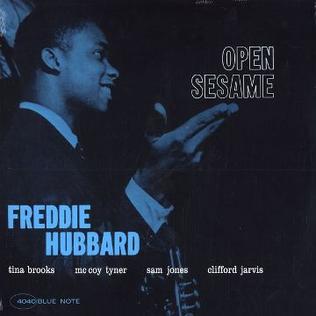
I think: Open Sesame. The title says, as if by magic, Freddie Hubbard has arrived. It's is a very strong debut and an easy mark for the core collection. We also get a great band. Tina Brooks on tenor really tears it up. On the title track, Brooks sinks his teeth into the riffs, blowing these long, stretchy phrases that step across the bars like hurdles and land back in time when he runs out of breath. He's a good man on ballads, too, like the droopy "But Beautiful." Behind the traps is Clifford Jarvis, two years shy of becoming a Saturnian. His energy, polyrhythmical claptrap and close work with Hubbard's improvisations add depth that is a few cuts above the standard hard bop set. Sam Jones plays big round notes in a sentimental and melodic style which at times reminds me of Ray Brown. He's aided everywhere by McCoy Tyner's drizzling fills and colorfully voiced chords. "Gypsy Blue" has a Latin tinge. The head has a cool arrangement where Hubbard and Brooks play in, and then slightly out of phase, hypnotically swinging it along. Hubbard's centerpiece is the rollicking "All or Nothing at All," where he shows off his chops in wild, flashy runs, rubber fingered flourishes, and big brassy blasts in the upper register. The guy's a natural who learned to improvise before he learned to read, and it shows.

Saturday, March 2, 2013

48. Don Wilkerson / Complete Blue Note Sessions (2001)

A nice release from Blue Note, culling tracks from the four LPs they released for Wilkerson from 1960-63. It's a double disc and the remastered sound is on par with the other excellent Blue Note re-releases. Wilkerson was a tenor who worked with a variety of artists including Ray Charles and Cannonball Adderley (no surprise) and was at home playing blues-based and danceable soul jazz that was easily related to ("Senorita Eula," "Drawin' A Tip,"). With a sophisticated sense of melodic variation and good use of legato dynamics, he steps beyond the prereqs for soul jazz and creates a unique blend that rewards if you listen closely. He's also fond of repeated, motivic phrases that carry the groove. The bands he plays with, especially the combo with Graham Greene, know right where he's at, and turn up the heat when he finishes a chorus. Wilkerson's "San Antonio Rose" (with a cooking solo by Greene) stands out to as a particular good take, so does the interesting "Pigeon Peas" which has me listening a few times over to catch what Wilkerson is doing with the drums. It's fine stuff, top to bottom.

Monday, February 25, 2013

44. Harold Land / West Coast Blues! (1960)

Half the group is from New York and the other half from California, but the session doesn't sound like a novel meeting of East and West, and they actually sound like they know each other pretty well. Land is a good leader. He developed his own approach to hard bop on the tenor and was a prolific composer. This record features three of his compositions. He plays with a strong sense for the rhythm, and the influence of the blues haunts each lick. The opener is the sexy but hard swinging "Ursula," as good an introduction to Land's tone and style as any. He gets down to bop and rhythmic counterpoint by next covering Charlie Parker's complicated "Klactoveedsedstene." It's nice to hear Montgomery do a Charlie Parker composition because Bird was such a big influence on him, and of course, he's right at home. Joe Gordon takes some flashy solos and also plays nicely in unison with Land. In Land's provocative tone is the quality of a high harmonic that sounds like a signal just on the verge of breaking up, giving the music an urgency that isn't lost in the fullness of the whole sound. His style is bop-oriented and fluid, but very accessible, a clear intermediary between the music and the audience. 

Thursday, January 24, 2013

13. Hank Mobley / Soul Station (1960)

The title Soul Station sounds like something out of the Jimmy Smith catalog, doesn't it? But it isn't soul jazz. Hank Mobley did not lead his own group often, and this statement of purpose really pops him out. Art Blakey, known to go full bore with the hard sticks, is more restrained and along with Chambers, carries a very laid back but swinging groove for Mobley to steer from the top. Wynton Kelly spreads out behind Mobley, playing a lush accompaniment of chords and his own bluesy licks. Mobley's technique is at the fore of the group, subtly kneading and stretching the signatures like dough. "Spirit Feelin's" has some good playing from everyone, including a short but terrific solo from Blakey. It is followed by the title track, a smoking slow blues jam that reminds me a little bit of Johnny Griffin's "Satin Wrap." But Mobley's patient phrasing and rhythmical construction are wholly different from Griffin's. The album closes with "If I Should Lose You," a standard that is treated similarly to the opener.

Wednesday, January 23, 2013

12. Duke Ellington / Three Suites
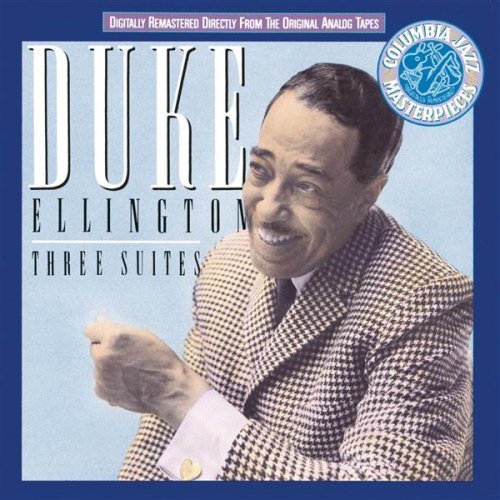
Here we have interpretations of "Nutcracker" and "Peer Gynt," along with the Duke's own "Suite Thursday." Ellington and Strayhorn have the uncanny arranger's sense for wrapping an original composer's ideas around a new score. Yet this classical-to-jazz amalgam goes beyond Gershwin and is apart from what I consider the third stream. It's a new concept of jazz orchestration that sings to the strengths of the soloists, who do a magnificent job breathing life into the music while avoiding the pitfalls of stereotyping. The score crackles with imagination and the performances are a credit to the band as much as the leader. The notion of Paul Gonsalves blowing a chorus for ballet (listen to the rechristened "Peanut Brittle Brigade") is a tough sell on paper, but to hear it executed with success is an inspired feat of musicianship. Grieg's work is treated with similar respect, retaining atmosphere with reimagined orchestral textures, bursting with big chords and hot solos. I grin hearing the archetypal "Hall of the Mountain King," and I have either Carl Stalling or Nintendo's Tetris to thank for that.

Saturday, January 19, 2013

09. Dizzy Gillespie & His Orchestra / A Portrait of Duke Ellington (1960)

This is a portrait of Dizzy Gillespie doing Duke Ellington, and the set doesn't sound a bit like Ellington or Billy Strayhorn. I'm impressed with how clearly Gillespie's voice comes through. For instance, Ellington may have written it, but when he plays the sparse and striking "Things Ain't What They Used to Be," it's all Gillespie's blues. The 15-piece orchestra seems a touch soft or underutilized in Fisher's charts, certainly not as punchy as the Duke's band, but a few of his patiently developed arrangements create additional melancholic depth ("Chelsea Bridge" and "Come Sunday" come to mind). All arrangements put a focus on the leader, and to this end the result is dazzling. Playful orchestral counterpoint is notable in "Caravan," followed by some of the Dizzy's most beautiful playing in "Sophisticated Lady."