Recent listening, current

Showing posts with label cool. Show all posts

Sunday, August 17, 2014

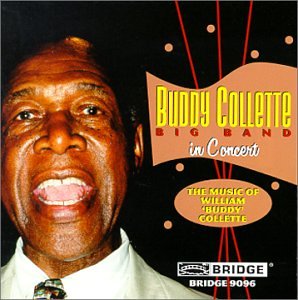
196. Buddy Collette / Live from the Nation's Capital (2000)

Buddy Collette was an originator on the West Coast jazz scene. He cofounded the Chico Hamilton Quintet and devoted his time to education, as well as composing and performing. This live disc from 2000 captures a Collette program for the ages, and its disparate contents cover the arc of his career. Performance and audio production are slick, typical of groups billed on the national stage. There is a lot to enjoy. Professionalism aptly describes the soloists, who play snappy, expressive lines that don't disrupt the cascading harmonies. Arrangements are by several including Collette. No matter the arranger, though, the playlist is unified by breaking the group into combos, building tension, and using the whole ensemble for bursts of energized dramatics. Nothing new under sun as far as big band goes (Gerald Wilson or Sam Rivers orchs are more my style) but the infectious bounce on tracks like "Mr. and Mrs. Goodbye" hold a warm sentimentality for a bygone era while others, like the Afro-Cuban rhythm of "Andre" or improvs on "Blues #4" keep the pace and make good use of variety. Live from the Nation's Capital isn't the most essential big band record in my collection, but it offers a lot of good stuff and demonstrates (in a very straight way) the wide array of styles that Collette worked in throughout his career.

Thursday, September 19, 2013

140. Tal Farlow / The Swinging Guitar of Tal Farlow (1956)

This blues and bop trio date with Farlow, Eddie Costa and Vinnie Burke is easy to listen to, and closer listening reveals a lot going on. The styles of Costa on piano and Farlow's guitar dovetail nicely. Farlow's eloquently phrased and heavy swinging choruses are followed by those of Costa, who plays in a hard-hitting, single-note style and is very rhythmic. Farlow uses the occasional slide, as in "Yardbird Suite," but instead of relying on an arsenal of tricks and stock licks, he is adept in inventing on the fly. The improvisations literally flow from the speakers like they're on tap. With so many ideas being tossed around, there's a lot of interplay between the piano and guitar. Burke plays the bass more or less steadily throughout, occasionally getting a chorus his own. The outtakes of "Taking a Chance on Love," Yardbird," and two (!) extra takes of "Gone with the Wind" are all so good that it's difficult to say how they determined a master. At any rate, the bonuses are much appreciated by this listener! Admirers of Ahmad Jamal's drumless trio with Ray Crawford, the Aladdin dates of Art Pepper, or the Modern Jazz Quartet should take immediately to the music herein.

Tuesday, September 10, 2013

136: Art Pepper / The Return of Art Pepper: The Complete Aladdin Recordings, Vol. 1 (1988)
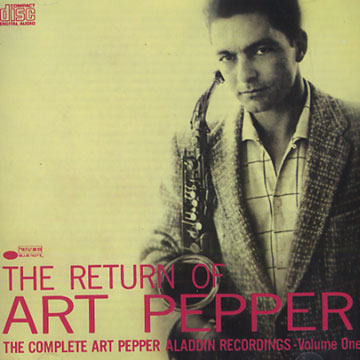
There are two groups here, recorded 1956 and 1957. The first group features Pepper straight out of prison and recording again. It's a somewhat unbalanced group and Pepper's style is intact but languishing. This makes instructive listening, considering how hot he could be on a good recording, I find it fascinating to see between the lines for a few moments while his fingering isn't as nimble and the ideas are developing more slowly. There's some good balladry ("You Go to My Head") and some flashy piano and trumpet from left coasters Russ Freeman and Jack Sheldon. The gems, for me, come in the pickup band on tracks 11-15 with Joe Morello and Red Norvo. This group was put together on the fly, presumably with little or no rehearsal, and the miracle is that it's a really tight date with a really positive chemistry. Morello was leader. "Tenor Blooz," "Yardbird Suite" and "You're Driving Me Crazy" show Pepper's style in full flight. Also, Norvo and Carl Perkins, and Pepper's interplay with Perkins, are not to be missed. If I had the choice to keep one disc out of this Aladdin set, The Return of Art Pepper might not be my first choice, but the Morello/Norvo recordings redeem it.

Saturday, September 7, 2013

134. Chet Baker / Live in '64 and '79 (2006)
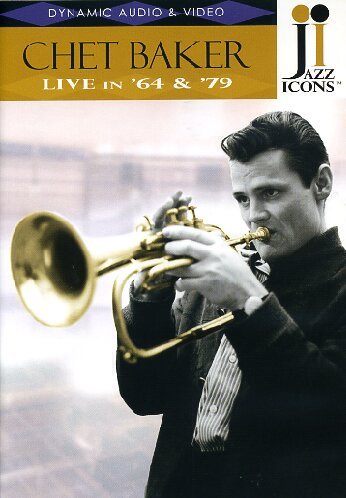
Baker's music definitely matured, although his development is sometimes difficult to appreciate given how his drug habit impacted his life and performances. This DVD from Jazz Icons shows him playing with two European groups, 15 years apart. In the '64 quintet I sense tension between the underplayed Baker and overactive pianist Rene Utreger, who is constantly throwing heavy handed chords at the end of Chet's phrases, sometimes before they appear to be completed. It's like a leadership dispute, and the band or producers clearly have their own ideas about who falls where. In spite, Baker manages a lovely "Time After Time," though the quintet's take on "So What" seems like a missed opportunity. Baker has trouble finding space to express himself and fights with the group, and also has difficulty with the intonation. The second performance is from '79 and begins with an interview that segues into "Blue Train," in progress. Baker says his lyrical approach to improvising has become more subtle with experience and the performance reflects this. The drummerless quartet is much more together than the '64 group, thankfully, and Baker's rich sumptuous tone pervades the set. Although "Blue Train" is truncated (which stinks, because what we do hear is beautiful), we get a heavy swinging and creative take on "Softly As In a Morning Sunrise" with Baker's smoothly flowing melodic improvisation, the occasionally interesting turn of a chord, and overriding melancholic appeal. Also notable are pianist and vibraphonist Michele Graillie and Wolfgang Lackerschmid. I like this installment of Jazz Icons for the contrast it provides between a younger Baker and an older, perhaps wiser player with a more respectful band.  

Tuesday, August 27, 2013

127. The Dave Brubeck Octet (1950)


I find this, the Octet's only studio album, a roaring good listen. I enjoy it alongside the Birth of the Cool by the Miles Davis Nonet. Both are similar in size and in their means of repurposing, so to speak, some of our more venerable standards like "What is this Thing Called Love" or "September in the Rain." The group's personnel is notable too, considering their different trajectories after the Octet: Tjader became known for the vibes, Van Kriedt for education, and Collins for Woody Herman. The pieces have tight arrangements that sound cool and loose, reeling with the energy and excitement of dixieland. But there's an ever present discipline behind them, too, and the innovation of infusing jazz with classical forms of writing and arranging. The soloists are concise, wrapping their choruses in 8 or 12 bars, staying close to the melody with strong voice leading. Many stayed in the repertoire of the Dave Brubeck Quartet so it's fun to compare the bobbing and weaving counterpoint with later performances of the same tunes, like our opener "The Way You Look Tonight," which I associate with Desmond's snarky quotes from Stravinsky and that nasty blues lick from Jazz at Oberlin. In fact, come to think of it, it's been a while since giving that one a spin....

Monday, August 19, 2013

125. Dave Brubeck Quartet / Dave Digs Disney (1957)

For all its thunder and snark, the Brubeck quartet improvised with a childlike curiosity, and Brubeck and Desmond both employed a genuinely sentimental touch with ballads. Maybe it's the music's built-in humor and romance, but I sense something very natural about this group covering Disney songs. Of course, the band was no stranger to the material, so there's the easy explanation, but they're clearly enjoying it. "Alice in Wonderland" is a breezy treat, with Desmond blowing blues into his explorations of the theme before trading jabs with Brubeck. "Heigh-Ho" is rendered at an uptempo clip and with a tough tone by Desmond before a romp by Morello. But it's shortest piece on the album and for all its perkiness, it's almost a footnote. A few pieces retrospectively transcend the Disney brand such as "When You Wish Upon a Star," or "Some Day My Prince will Come." The latter would eventually be made famous by Miles Davis, and is a further example of Brubeck's prescience. I overlooked this set for a long time because I thought it was a novelty act, but I was dead wrong. For further examples of Disney jazz, try Disney Songs the Satchmo Way, Everybody Wants to be a Cat, or Sun Ra's reverently maniacal settings of "Heigh Ho" and "Zip-A-Dee-Doo-Dah," among others.

Saturday, July 6, 2013

112. Paul Desmond / Take Ten (1963)

If you can't get enough of "Take Five," then Take Ten is the album for you. It's one of several excellent slabs made during Desmond's many quartet sessions for RCA Victor. The band is Jim Hall on guitar, a moonlighting Connie Kay on drums and Gene Cherico on bass. Fellow Brubeckian Eugene Wright subs for Cherico on "Take Ten," adding an extra dimension of conceptual continuity to this 10/8 reworking of its famous counterpart. It starts with a familiar vamp that is reminiscent of a studio orchestra trying to avoid paying royalties for the genuine article. But then Desmond starts in on a deep and bluesy riff, finding new territory inside of an old melody. He blows these long and contemplative notes that explore the tonal color of the mode and remind me, in a very limited sense, of later work by Jackie McLean or John Gilmore. It's a treat, especially when he decides to hold on for just a bit longer and sustains the phrase with some vibrato. Proceedings quickly change the course toward Desmond's passion for bossa nova. In spite of an American burnout on the form, Desmond was one of its stalwart practitioners, and originals like "El Prince," "Embarcadero," or "Samba de Orfeu" are fine examples. Kay and Hall give the sessions that extra something it needs. Kay has a nice technique that intertwines his ever present cymbals with a driving attention to the skins. This band gives him elbow room that was impossible in the immaculately executed pieces by MJQ. A normally taciturn Hall takes some interesting breaks mixing chords with short flurries of single notes and a lot of fun riffing, and he is one of my favorite musicians. Together they make a melodically focused disc with good performances and an excited but cool, relaxed vibe that I wholeheartedly recommend. It ends as sweetly as it began, with an uptempo "Out of Nowhere" featuring George Duvivier on bass. The section at the end where Desmond has the floor to himself with punctuation marks by Kay is just magic.    

Sunday, May 26, 2013

107. Desmond, Brubeck, Van Kriedt / Reunion (1957)

This meeting of the minds that have met before on many occasions is as relaxed as it is concise. David Van Kriedt was the tenor and collaborator in the Octet alongside Brubeck and Desmond. He continued into academia, also playing with Stan Kenton, while Brubeck and Desmond became performers. On Reunion, there are some tastes of the fugue style writing for which the Octet was famous (Bach's "Chorale," the only tune without a Van K. credit), although in the mood is, as I mentioned, quite a bit more relaxed than it was in the Octet. Back then, as the record shows, everyone seemed scrambling to out-do his last chorus. This time, while it sometimes sounds as if there's no clear leader, each man gets a fair share of time during improvisations and the music has the feel of care and balance. The group idea of musicality is very strong. Brubeck often picks up where Van Kriedt leaves off, or Desmond does, with occasional episodes that quote slyly from whatever is near at hand. It's soft, sophisticated music with occasional fireworks ("Shouts," listen for the Brubeck boulder that spins Desmond into a tizzy) and superb arrangements by Van Kriedt, like the sumptuous "Prelude." Van Kriedt's tone is smooth and full like Lester Young, and the timbre is the ideal mixer for Desmond's alto.

Tuesday, April 2, 2013

69. Chico Hamilton Quintet with Eric Dolphy / The Original Ellington Suite (1958)
I'm a fan of pianoless jazz groups in general, and no offense to the piano. The dynamics of such a group change without a baby grand to rally around, and a skilled leader like Hamilton can take proceedings into interesting territory. Comping duties fall to guitarist John Pisano (who also has sweet leads) and cellist Nate Gershman. None of this stopped Pacific from losing the tapes and test pressing, rediscovered inside another Chico sleeve in Brighton, England. I'm happy it found its way to Michael Cuscuna who issued the CD, and kudos to the collector who found the test pressing. The music's just great, some of the most refreshing and easygoing jazz I've heard in a while. Dolphy's alto, flute, or clarinet anchor an intimately swinging mood on staples like "In a Sentimental Mood," "I'm Beginning to See the Light," or the talkative "It Don't Mean a Thing." But all the cuts are good. If you're not sold on the cello, listen to that last track, or maybe its warm and reedy tone on "Day Dream" which retains all the emotional import the melody should have, but lacks the sometimes corny sentimentality of a violin.

Wednesday, February 13, 2013

33. The Dave Brubeck Quartet / Jazz: Red Hot and Cool (1955)

Recorded live at New York's Basin Street club across three nights, this quartet isn't the same one that gelled on "Take Five," but the Joe Dodge/Bob Bates team sounds fine and contributes to the Brubeck formula admirably with rhythmical inspiration and some interesting polyrhythmic steering from Dodge. The pieces for the Morello-Wright band are already in place, like polytonality, polyrhythm and fugue-like structures. But these were already present during the days of the Dave Brubeck Octet, and earlier still during formative late nights at the Blackhawk. So if you're into Brubeck then there's plenty of good music here to enjoy. Sonny Rollins is credited in the notes of Saxophone Colossus for being the first jazz musician to develop his improvisations with an ear toward their musicality, as spontaneous compositions. That makes sense if Ira Gitler wasn't looking at the West Coast where Brubeck was doing exactly that. Full shifts in signatures mid tune, Desmond responding on the fly to Brubeck's harmonic cues -- as Brubeck's groups ever were, interesting music that rewards deep listening. 

Tuesday, February 12, 2013

32. The Jimmy Giuffre 3 / The Easy Way (1959)

The Easy Way is darned sneaky, the way it passes so quietly upon first listening. The music is so sparse that it stops your breath like a stillborn moment, a feeling almost too sparse, but the second time around, that same quality forces a closer inspection and reveal ongoing relationships of very dynamic interplay at the heart of the chemistry. I keep going back to it. In this 1959 session, Giuffre swaps bassist Ralph Pena for Ray Brown, trading the busy sound of Pena for Brown's commanding and bluesy style. They work with it. On "Ray's Time" we get an extra dose of the Ray dimension while Jim Hall comps and Giuffre lays out. When Giuffre is playing he is taking a lot of ideas from Brown and Hall, who turn them right back around. The album is divided into two distinct halves: the first comprised of blues like the Ray tune and standards like "Mack the Knife," and a more exploratory or section, marked by "Time Enough," "Montage," and "Off Center."

Sunday, February 3, 2013

24. Teddy Charles / The Teddy Charles Tentet (1956)

The credits on this impressive cool jazz album include J.R. Monterose, Gigi Gryce, Jimmy Raney, and arrangements by Gil Evans, Mal Waldron, and Jimmy Giuffre, as well as Teddy Charles. Those arrangements predominate: they are tight, fluid, and very cool. I love the orchestration, which uses both brass and reeds to cover the baritone, tenor, and alto ranges. In George Russell's "Lydian M-1," there are alternately brasses or reeds pinning down the top and bottom, while Monterose and Gryce take turns filling in the middle, and Peter Urban's brassy cornet soars above the continuo by Charles and Waldron. The instrumental textures mesh nicely, and each player has a strong sense of ensemble playing as well as a creatively swinging solo voice. Raney's solo in "Nature Boy" is sensitive and the perfect compliment to Charles soft work on the vibes. If you rule out the Miles Davis projects with Gil Evans from the next year, this album is quite different than anything going on in 1956.