Recent listening, current
Archived listening, 2013-2016
Showing posts with label mccoy tyner. Show all posts
Monday, November 18, 2013
150. Wayne Shorter / Juju (1964)
Shorter's second LP for Blue Note finds him branching out as a composer and even experimenting with a different sound from his reed. There's no Lee Morgan in this group, but the rest is the same as on Night Dreamer. On the opening "Juju" he uses a harsher tone and plays stretchy, contemplative phrases that explore his interpretation of a chant-like African melody through the repetition of its few tonalities. The rhythm section pins down the whole thing, and often with Shorter sketching and resketching the vaguest of melodic ideas, it's Reggie Workman and McCoy Tyner who indicate where the melody actually is. In a word, spooky. Elvin Jones gets behind it (seemingly several times at once) and it works. The group's dynamic for much of the album is the same as it was with Coltrane's band, and it's instructional to listen to Juju's tracks mixed at random with Coltrane's Live at the Village Vanguard. Try that and tell me what you think. The fabled Workman-Tyner-Jones unit is like one animal, it has one sound, and it's a very distinctive one. Then you've got the tenor on top of that, either the master or his understudy, and either way it's magic. Like Night Dreamer before it, Juju clearly originates in blues and bop, but turn around and you'll find that shoreline quickly vanishing behind you.
Wednesday, May 22, 2013
103. Art Farmer / Meet the Jazztet (1960)
I love this album. Art Farmer's Jazztet was a lot like the Jazz Messengers. Their music had a different flavor than the Messengers but each group was stacked with the fine and innovative musicians and each played the picture of hard bop. Benny Golson does the arrangements and the band plays two of his tunes: "I Remember Clifford," the beautiful tribute for which words are woefully inadequate, and "Blues March," an attention-grabbing blues with a startling cadence and spunky arrangement. There are some obligatory standards ("It's Alright with Me," and swanky "It Ain't Necessarily So") during which the band displays its chops like fine silver. Golson and Farmer make ideal foils by themselves, Golson with superheated explosions of verbosity and Farmer with his carefully crafted and natural lyricism. But you can't forget or ignore the contributions of Curtis Fuller, either. He has some really hip parts, with big, brassy punctuation marks or deftly fingered runs that will make you think he's got a cornet. There's mucho variety, the arrangements keep it fresh, and Lex Humphries swings it hard. If you're getting into this type of music, Meet the Jazztet is essential listening.
Thursday, April 25, 2013
92. Hank Mobley / A Slice of the Top (1966)
I just picked up this 1966 session by Hank Mobley and it's an odd one. Mobley is featured in the midst of several other interesting young players: McCoy Tyner does piano, Reggie Workman on bass and Billy Higgins on drums -- a good rhythm section of highly individualistic voices, plus Lee Morgan, Kiane Zawadi, Howard Johnson, and James Spaulding. The record is odd for choice of instrumentation, containing euphonium and tuba in addition to tenor, flute, and alto sax. Arrangements by Duke Pearson try to give order to this motley bunch but I can't help feeling that that the whole thing is a little awkward. It's a quartet (or quintet), that looks to be struggling to accommodate the extra pieces in a way that is relevant. At times the octet plods along like two people walking in the same pair of pants, instead of swinging in a tight but dangerously crowded arrangement, as demonstrated by similarly orchestrated groups of Charles Mingus or Thelonious Monk. I'll have to keep listening and I get the keen feeling that this one will grow on me. Look out!
Labels:
1966,
a slice of the top,
alto saxophone,
billy higgins,
blue note,
duke pearson,
euphonium,
hank mobley,
howard johnson,
james spaulding,
kiane zawadi,
lee morgan,
mccoy tyner,
octet,
reggie workman,
tenor sax,
tuba
Wednesday, April 3, 2013
70. John Coltrane / Crescent (1964)
I love this album because it is so moody. Only during "Bessie's Blues" does he lighten up, although not for very long. I guess it's fitting that it comes from a different session. Jones sounds like rain to me, even when using sticks. He shuffles, clicks, clacks, swooshes, and bangs, just like a thunderstorm. It's the perfect accompaniment to Coltrane's moody tenor, and rhythmically speaking, gives him a long leash. Tyner contributes in a similar fashion, creating a colorful backdrop of notes that sound very much like the sheets of rain in a storm. The last track is pretty much all Jones, called "The Drum Thing." Contrasting with Trane's more exploratory work, these performances are almost rigidly disciplined. He doesn't abandon what he learned in the intervening years, he just applies it differently. The result is a more mature formulation of the post-bop he was doing during for Prestige, richly imagined and deeply reverent of its roots. It's something of a calm before the storm in the Coltrane canon, considering that the next year witnessed A Love Supreme and the year after, Ascension.
Thursday, March 21, 2013
58. John Coltrane / My Favorite Things (1961)
Coltrane's fluidity and eloquence with modal jazz hit a stride during these sessions, and the resulting albums (including also Coltrane Plays the Blues, Coltrane's Sound and Coltrane Legacy) are watershed recordings in the Coltrane oeuvre. And who better to support his statement of purpose than Elvin Jones and McCoy Tyner? Tyner's creative inversions and voicings rain down with a lush selection of harmonic possibilities and the mystically driven Jones shuffles through several rhythms at once, giving Coltrane maximum flexibility for his improvisations. Steve Davis plays wonderful bass, sometimes suggesting a single static harmonic element while Coltrane and Tyner wrap blizzards of changing ideas around it. The music is pleasant and listenable, infused equally with strains of Eastern ragas and the blues. Coltrane's soprano sax is haunting and delicate, assertive but not an overriding presence. It's remarkable that such individualistic music comes from a set without a single original. "But Not For Me" deftly reharmonized with Coltrane changes, and his long tenor solo is one of my favorite choruses from any musician, hands down.
Tuesday, March 5, 2013
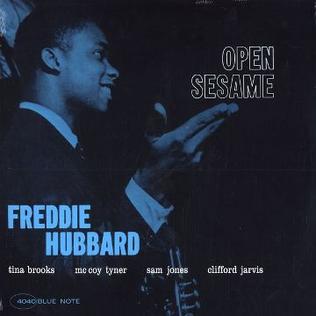
51. Freddie Hubbard / Open Sesame (1960)
I think: Open Sesame. The title says, as if by magic, Freddie
Hubbard has arrived. It's is a very strong debut and an easy mark for
the core collection. We also get a great band. Tina Brooks on tenor really tears it up. On the title track, Brooks sinks his teeth into the riffs, blowing these long, stretchy phrases that step across the bars like hurdles and land back in time when he runs out of breath. He's a good man on ballads, too, like the droopy "But Beautiful." Behind the traps is Clifford Jarvis, two years shy of becoming a Saturnian. His energy, polyrhythmical claptrap and close work with Hubbard's improvisations add depth that is a few cuts above the standard hard bop set. Sam Jones plays big round notes in a sentimental and melodic style which at times reminds me of Ray Brown. He's aided everywhere by McCoy Tyner's drizzling fills and colorfully voiced chords. "Gypsy Blue" has a Latin tinge. The head has a cool arrangement where Hubbard and Brooks play in, and then slightly out of phase, hypnotically swinging it along. Hubbard's centerpiece is the rollicking "All or Nothing at All," where he shows off his chops in wild, flashy runs, rubber fingered flourishes, and big brassy blasts in the upper register. The guy's a natural who learned to improvise before he learned to read, and it shows.
Subscribe to:
Posts (Atom)