This music we have come to call jazz is long and storied, its course determined by thousands of musicians, singers, bandleaders, producers, patrons, and hangers on. Music is more than harmonically related pitches that sound off in regularly timed intervals. It's a living and growing mode of expression, a self-description of our culture. a sentimental record of our times. Bill Crow's Jazz Anecdotes is exactly what the title implies. Drawn from many sources, readers are treated to a rich assortment of personal recollections, rumors, legends, inside jokes, and more than a few stories with very long legs. In his introduction, Crow shares a fundamental truth about storytelling: every good tale has a life of its own, eclipsing even the storyteller. In this way, real or imagined, the contents of Crow's compendium leap right off the pages, straight into the annals of popular culture. I'll equate jazz with my favorite sport, baseball. A listener can enjoy a song without knowing the musicians much like how a spectator can enjoy a ballgame without knowing too much about the players. But understanding the personal dimension of their collective small-game and their colorful arc of backstory enriches the experience tenfold. If you stay interested for your entire life, it's more than 18 guys on a diamond. The sport actually fulfills the obligation of a cultural phenomenon in which the spectator is a willing participant in the creation of its legend.
But back to jazz... Through Crow's work, which is subdivided into manageable sections covering certain musicians or styles, or certain aspects of being a musician, you get all the behind-the-scenes gossip, juicy tidbits, and wild memories of the women and men who made the music happen. In other words, the material is so vivid, it's as if the subjects are right there in the room, talking to you. In his acknowledgements, Crow thanks Nat Hentoff, whose book Hear Me Talkin' to Ya is a similar work that bears mention here. Likewise, and with a stronger recommendation for its beautiful prose and sense of relational self identity, please see Living with Music: Ralph Ellison's Jazz Writings. I'll close by saying this: When I put the book in the nightdrop and left it there to resume a lonely life on the shelf for two or three more years, whenever the next patron should come along, I actually said goodbye. Startlingly, as I drove off in my car, I felt like someone heard me.
Recent listening, current
Archived listening, 2013-2016
Showing posts with label 1990. Show all posts
Wednesday, May 7, 2014
Monday, December 23, 2013
161. Al Grey & Friends / Christmas Stockin' Stuffer (1990)
If you're not averse to "Christmas jazz" -- practically it's own genre nowadays, a diverse lot encompassing everything from Coltrane to Mindi Abair -- then be sure to track down a copy of Christmas Stockin' Stuffer. The mood is relaxed and bluesy, an enjoyable set replete with vocals, organ, guitar, and of course, Grey's talking trombone. I like its lonesome touch on "Winter Wonderland" and "It Came Upon a Midnight Clear," interspersed with Joe (son of Al) Cohn's funky riffing on the guitar. There are some vocal spots like the opening "Christmas Stockin' Stuffer" (guest vocal by Jon Hendricks), which is a treat. "White Christmas" is arranged with strings adding a warm, homey glow to the playlist. The short but sweet New Orleans inspired "Auld Lang Syne" plays you straight through New Years' Eve, if you can't give up the holiday spirit until January. Not exactly what I would describe as an obscure album, but not exactly easy to find, either, Grey's holiday outing is a must-have for my season.
Thursday, July 11, 2013
114. Angelo Badalamenti / Music from Twin Peaks (1990)
David Lynch's highly individualistic and genre defying films have a niche all their own. A great part of the magic in films like Blue Velvet, Mulholland Drive, or the series Twin Peaks, can be credited to the composer Angelo Badalamenti whom Lynch has hired time and time again. Lynch is an auteur and when he finds something that works, he sticks with it. Other directors have famously created an arc of conceptual continuity by hiring the same actors and composers for multiple films (reluctantly, Tim Burton springs to mind) but Lynch has avoided typecasting, banality, and the curse of repeating himself. Lynch manages to work new and frightening ideas into each film while creating a mood that is distinctly a product of his own making. This soundtrack by Badalamenti is a prime example of how the composer contributes to essential mood magic. The tracks run the gamut from low key, enigmatic synthesizer statements ("Theme from Twin Peaks," "Laura Palmer's Theme") to steamy blues (like the spidery threads of "Bookhouse Boys"), and moments of rare beauty ("Love Theme from Twin Peaks"). There are some vocal spots, too, by Julee Cruise singing lyrics by Lynch and dreamy music in the vein of "Sleepwalker." And that is the operative word, here: dreamy. Remember, it's a Lynchian dream where nothing is as it seems.
Sunday, April 7, 2013
74. Louis Armstrong / The Hot Fives, Vol. 1 (1990)
Another set of essentials where the remastered audio leaves much to be desired. It's quite muddy and as I own several of these sides on 78 rpm disc, I can attest that there is a big (well, huge) difference and I prefer those originals. But considering this disc sells on Amazon for less than a dollar, it's worth a punt until you buy an upgrade. Supposedly this box set remastered by John R.T. Davies did not apply the same noise reduction, or rather kept the hiss, preserving more character in the high end. But I haven't listened to that collection. Reviews all point to it being a considerable improvement. If you are a more casual listener, or feel like many do that an old recording sounds like an old recording, and don't mind cloudy audio, then here you'll find plenty to enjoy. Take archetypal Louies like "Cornet Chop Suey," "Gutbucket Blues" or "Muskrat Ramble," plus that famous scat vocal on "Heebie Jeebies." Thankfully, as with other Columbia remasters, the detailed liners make up for the sub-par audio.
Labels:
1920,
1990,
columbia,
cornet,
dixieland,
hot fives,
jazz,
louis armstrong,
new orleans,
quintet,
trumpet
Monday, March 18, 2013
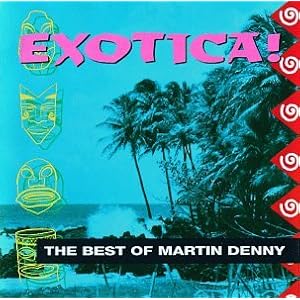
55. Martin Denny / Exotica! The Best of Martin Denny (1990)
Is it jazz? Well, it might as well be, if we accept that Louie Armstrong and John Zorn occupy the same section at the record store. Martin Denny purveyed a style of lounge music that re-imagined common melodies with elaborate orchestration to create atmosphere with an "exotic" flavor. It was ideal background music for transporting you to another place. So Tiki culture, African drumming, cha-cha, tribal chanting, bird calls, etc., are all fair game. Exotica albums were made by hundreds of composers and orchestras, but Denny's work was always a few cuts above the rest, maintaining a unique sensibility that was frequently imitated by others. Exotica! The Best of Martin Denny was compiled from several LPs released in the 1950s. It begins with the quintessential "Quiet Village" and Denny's signature bird calls, howling, and other aural oddities sure to raise eyebrows at your next cocktail party. They do a lot of Lex Baxter compositions, but typical of Denny's style, there are other chestnuts, too. For instance, Duke's "Caravan," the town bicycle, is treated here with sufficient aplomb (which means a grab bag of interesting percussion and a wry grin). I was initially concerned that without the thematic context of each album, this compilation would sound disjointed. But surprisingly, I found that not just the pieces themselves, but their themes, dovetail nicely. And Denny keeps listeners awake during each song by scoring for a bewildering array of world percussion instruments. More academically inclined listeners might notice the mischievous melodies, ever present vibraphone, and humorous character all point toward Danny Elfman and Frank Zappa. If you made the mistake of thinking grown men who call like monkeys, birds, and tropical insects can't influence musical history, perhaps think again.
Sunday, March 17, 2013
54. Count Basie / The Essential Count Basie, Vol. 1 (1990)
Like some other Columbia reissues, the sound quality of this disc lacks, given the NR that Columbia used to remove imperfections in source material. It's a baffling misstep. I agree, the sonics of the Complete Decca Recordings are far superior and the differences are plain. That's a shame, because the music is great. Here you get the legendary late 1930s Basie band, with the usual suspects and buoyant arrangements. But try as they might to lift you off the floor, the particular digital medium has sucked the life and dynamics right out of it. Regardless, you've got a heart of stone if you can't enjoy "Taxi War Dance," "Goin' to Chicago Blues," "Miss Thing," or "Lady Be Good." Regarding that last number, and the iconic Lester Young solo: what is his first, I've also heard called his finest solo on disc. Such reductive comments leave me wondering if critics ever listened to the rest of his career, especially that period following the war when his playing acquired a mature, refined sensibility that was intensely personal and wholly unique. Sometimes it feels like I am the only person who feels this way.
Monday, February 18, 2013
38. Miles Davis / Ballads (1990)
Talk about the quintessential nonessential Miles Davis CD, this is it. Columbia compiled a scanty eight tracks recorded between 1961 and '63, and released them here with a ballads-only theme. Very little about Miles Davis in the sixties sounds dated or anachronistic to my ears, but in today's climate of iPods and customized playlists, such a compilation album doesn't have the same role it did in 1990. And this product, as a whole, hasn't aged well even if the opposite is true for the selections themselves. I say it didn't age well but I'm not sure it would have made sense 20 years ago, either. First, it's an odd choice of material if you're trying to showcase what Davis could do with a ballad. Five tracks by the Gil Evans orchestra, two by the quintet with George Coleman and a live cut by the Mobley quintet is a rather baffling sequence. Are we doing Evans, or a club date? Because the two are so unlike each other that the program seems interrupted when the group changes. The very context of the Gil Evans orchestra was so different than that of a street group, any street group, that a ballad within its fold is a thing transmuted, a wholly different musical animal. Good work from everyone involved musically, but shame on Columbia for ever selling this.
Labels:
1961,
1962,
1963,
1990,
ballad,
ballads,
columbia,
compilation,
cornet,
george coleman,
gil evans,
hank mobley,
jazz,
miles davis,
orchestra,
quintet,
trumpet
Subscribe to:
Posts (Atom)