Recent listening, current
Archived listening, 2013-2016
Showing posts with label 1967. Show all posts
Tuesday, July 9, 2013
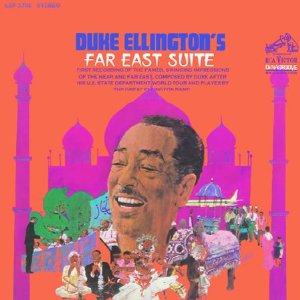
113. Duke Ellington / Far East Suite (1967)
Last month, I rolled down the windows of my car after working a 12-hour day, twisted the cap off an ice cold Virgil's Orange Cream soda, and enjoyed the drive
home while listening to this record. The Far East Suite is one of Duke's last recorded works, and one whose material might sport the familiar names and faces of orchestras past but its compositions have a unique flavor among others in the Duke canon. It's been on regular rotation at my house since that evening with the soda pop. Between the grooves are yards of punchy counterpoint between reeds and brass, and some of Johnny Hodges' sweetest work on wax ("Isfahan"). And of course we are treated to equally fine work by the likes of Cootie Williams, Cat Anderson, Russell Procope, Harry Carney, et al. The recording is memorable throughout thanks to Duke's direction of the sublimely cohesive band. It is nice to hear Duke melding his percussive piano blues with sophisticated orchestral textures and touches of middle eastern music or orientalism in tracks like "Mount Harissa," "Ad Lib on Nippon" or the opening "Tourist Point of View." I was swept up by the tidal wave of sound, which is what usually happens when I listen to Mr. Ellington.
Labels:
1967,
big band,
bluebird,
cootie williams,
duke ellington,
far east suite,
harry carney,
isfahan,
jazz,
johnny hodges,
orientalism,
paul gonsalves,
piano,
rca,
review,
russell procope
Monday, May 27, 2013
108. Duke Ellington / On the Road with Duke Ellington (1967)
On the Road is a documentary film from 1967 by Robert Drew. For an artist so prolific, Duke left behind precious few film documentaries. There is music performed in the film that'll give you goosebumps but the subject isn't the music itself, it's Duke and how he lives and works. The picture is grainy and saturated like an old Super 8, the audio is muddy, and you'll instantly disregard that because from the outset, you're aware that this is the best film on Duke Ellington that there is. It's delicious, for a Duke fan like me. The camera follows him in his daily routine as he opens his mail, lingers too long backstage on the piano, composes a new tune, or has his breakfast -- hot water, steak and potato, the same breakfast he's had for 40 years. Duke is a funny, funny guy. He's an autocratic employer, an eloquent speaker, and madly devoted to his craft. You see him flirting with fans at the airport, or backstage having a natter with Louis Armstrong, just talking like two old friends, which is extremely interesting. The bottom line is that Duke Ellington runs the show whether it's on the road, at home, or accepting an honorary doctorate. He works all nighters while he's not performing and performs when he's not working. At one point, he tells the crew that he can't imagine what retirement means because stagnation will not look good on him. And it's true, he worked until his death six years later. I think I learned that if I truly want what I think I want, then I know I'm not working hard enough. Like a thunderstorm, the power, sophistication, and beauty of Duke's orchestras always excited and impressed me. Watching it happen in the making reinforced that notion.
Wednesday, May 1, 2013
98. John Coltrane / Interstellar Space (1974)
This was actually recorded in 1967, but not released by Impulse! until '74, almost a decade after Coltrane's death. It's famously dense, but not impenetrable. Throughout the album, Coltrane demonstrates a litany of technical ideas by running through scales, stacking chords, and changing meters in snatches of modal improvisation. It is very experimental and obviously one of the more inaccessible works in the Coltrane canon. Interstellar Space was recorded shortly after the session that produced Stellar Regions, so many of these pieces share themes. "Saturn" is the longest piece, also the only one to lack bells in the intro. Some people latch onto "Venus" which is the closest thing to a conventional melody on the record. Rashied Ali plays like a mystic, and I often find myself listening to him more than Coltrane, whose explorations are searching but also noisy and make the ear weary. Ali's rhythms seem to accommodate any of Coltrane's fancies, or rather Coltrane is free to step in and out of them when it suits he is doing. This is huge music for 1967 that has been hotly debated, put down, or academically dissected ad nausea ever since. I'm happy that the package was expanded on CD to include the similarly minded "Leo" and "Jupiter Variation." 2013 has a lot more context for this type of musical activity than there was in 1967, and it's found a happy home with hundreds of people. That's the crime of being ahead of your time, that it takes everyone else that much lonegr to catch up. Gregg Bendian chose this album to recreate with Nels Cline (Interstellar Space Revisited), describing it in the liner as his love letter to free jazz drumming. In that regard, I can't think of a finer template. Listen to both, see where it takes you.
Subscribe to:
Posts (Atom)
