Listening to Miles go electric 40 years ago, critics were in a different position. They took issue with his stylistic developments, because 1974 was much different than 1954. They were too close to see that the intervening years would witness Davis' massive influence on successive generations. Today we see what happened, so we evaluate their merits on another scale. It bears mentioning that these aren't records I can listen to every day. I don't have that kind of time to invest on a daily basis. Like Bitches Brew, the music on Big Fun explores modality through orchestration and arrangement. The tracks are brimming with textures, melodic ideas, and moods. Themes are played and repeated, then recalled, then played again. The effect is haunting, like beasts looming in a fog, vanishing and reappearing. After 22 mnutes, the effect is glacial. Like it says in the liner to Coltrane's Ascension, you shouldn't turn it on without expecting to hear at least a whole side. You can't be interrupted for a few minutes without the magic being broken, and the arc is lost with just a few minutes of play time. Collaborations with Zawinul like "Recollections" or "Great Expectations" fulfill the promise, and typify what's found elsewhere throughout the record. As if you really need a curveball, Davis added sitar and tabla.
Recent listening, current
Archived listening, 2013-2016
Saturday, November 23, 2013
Thursday, November 21, 2013
152. Tom Principato / Smokin' (1985)
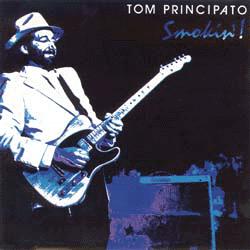
Principato is well known on the East Coast circuit. In the 70s, he made a pair of legendary albums with fellow Tele-wizard Danny Gatton (Blazing Telecasters and More Blazing Telecasters). But outside of the South, his name is more obscure. Principato's nimble, string bending, Fender-driven brand of electric blues combines a stripped down Chcago style with Texas and Southern flavors. Like the discs he did with Gatton (and much of Gatton's work, Tom or no), it draws from all over the blues tradition, a swirling cocktail of jump, boogie, rock, country, and swing. There's a tinge of honky tonk and each lick is rendered with gratuitous twang. Principato's sustain on sweeping string bends gives each note its own zip code. Smokin' is the perfect title. The album cooks on high from the first note until the last. For verse sections, Principato plays riffs close to the nut in a deep, growly sound. He soon flies up the neck in a combination of slick, fluid phrases that are interspersed with chunky bends and exciting slides. "Lipstick, Powder & Paint" continues the twangy blues vibe, likewise "Fish Fry." Harder rocking tracks include Principato's "Talkin' Trash" and the closing "Hard Livin'." Fans of Stevie Ray or any of the usual suspects will find this to be an infectious delight. Be warned: buying one album may lead to buying three or four more...
Tuesday, November 19, 2013
151. Hank Mobley / Workout (1961)
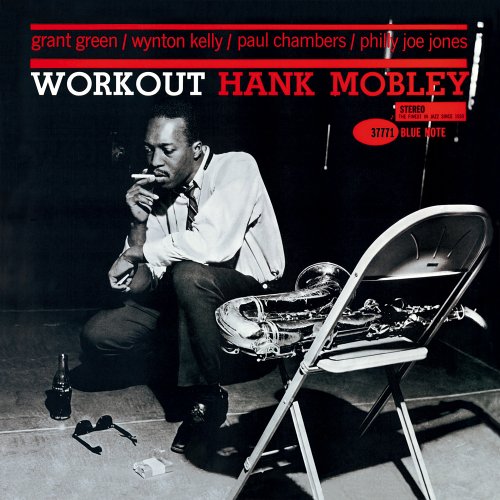
The band is Mobley with Wynton Kelly, Paul Chambers, and Philly Joe Jones playing typically of the period. I can't help but feel that Mobley is underrated as a composer and stylist, though. He's in that club with George Coleman and a few others, seemingly overshadowed by the giants they came up with. There's a lot of blues on this record, dotted here and there with elastic phrases and effervescent flurries by Mobley. Four of the six tunes are Mobley's originals, the exceptions being "The Best Things in Life are Free" and "Three Coins in the Fountain." They're interesting covers, one being rather old and the other an oddball. I like Mobley's melodic inventions and improvised embellishments of the melody. His colorful palette combined with a hard charging, muscular sound occasionally reminds me of Dexter Gordon. In the rhythm section, Jones and Chambers keep the soloists busy by mixing up the tempo, Jones occasionally very aggressive with crashes and rolls, playing melodically, not just rhythmically. Green and Kelly often solo in that order. Green has no trouble in the bebop idiom, spinning single-note solos like a bluesy sax. You can't go wrong with this or Another Workout, but for Mobley beginners, I'd start with Soul Station.
Monday, November 18, 2013
150. Wayne Shorter / Juju (1964)
Shorter's second LP for Blue Note finds him branching out as a composer and even experimenting with a different sound from his reed. There's no Lee Morgan in this group, but the rest is the same as on Night Dreamer. On the opening "Juju" he uses a harsher tone and plays stretchy, contemplative phrases that explore his interpretation of a chant-like African melody through the repetition of its few tonalities. The rhythm section pins down the whole thing, and often with Shorter sketching and resketching the vaguest of melodic ideas, it's Reggie Workman and McCoy Tyner who indicate where the melody actually is. In a word, spooky. Elvin Jones gets behind it (seemingly several times at once) and it works. The group's dynamic for much of the album is the same as it was with Coltrane's band, and it's instructional to listen to Juju's tracks mixed at random with Coltrane's Live at the Village Vanguard. Try that and tell me what you think. The fabled Workman-Tyner-Jones unit is like one animal, it has one sound, and it's a very distinctive one. Then you've got the tenor on top of that, either the master or his understudy, and either way it's magic. Like Night Dreamer before it, Juju clearly originates in blues and bop, but turn around and you'll find that shoreline quickly vanishing behind you.
Friday, November 15, 2013
149. Cannonball Adderley Quintet in Chicago (1959)
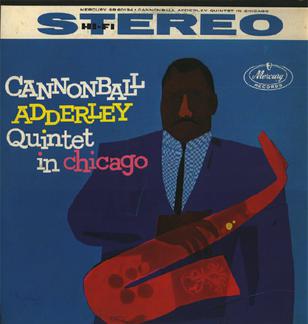
Cannonball Adderley Quintet in Chicago (aka Cannonball & Coltrane on Limelight LS 86009) is a splendid disc from the core band that recorded Kind of Blue. "Limehouse Blues" stands ragtime roots on their head in the attitude of hard bop. A sparring match between alto and tenor proceeds at breathtaking pace until the tune reels in for a final, punctual tutti on the main theme. "Stars Fell on Alabama" is next and features very sensitive embellishments from Adderley. Kelly goes next, tinkling single notes into the dusty register. As saxes go, it's a pleasure to hear the two styles in opposition. Adderley and Coltrane ride atop the rhythmic swell and strike the bar at will. But the two players are not very similar. Contrast their rhythmic interpretations of "Wabash," or technique in "Grand Central," which crackles with Trane's rhythmic inventions in fast triplets. The ballad "You're a Weaver of Dreams" is handed to Coltrane, and Kelly strolls through some jaunty figures that recall the old school with aplomb. On each track, whether it's Adderley busting open the guts of the melody and improvising endlessly thoughtful variations on its theme, or Coltrane boldly probing the rhythmic and harmonic architecture, there's always something to hang an ear on. This disc is a fine compliment to Kind of Blue, Somethin' Else, and At Newport 1958.
Thursday, November 14, 2013
148. Fenton Robinson / Somebody Loan Me a Dime (1974)
I like this debut for Alligator a lot because Robinson's guitar and vocals combine much of what I love about Texas, Chicago, jazz, and soul all in one place. It has a pureness, a genuine flavor that is unmistakable, yet it is not adequately described by any one of those styles. It all starts with the vocals and guitar which are backed by a straight ahead band including Bill Heid and Mighty Joe Young. Robinson's voice is a deep baritone, capable of rich emotional detail while its timbre is smooth enough to imply a dimension of gentleness. This distinguishes him from the haughty, barkingly self-assured styles of singers like Muddy Waters and Howlin' Wolf (just saying). And it's a big voice, too. They needed a microphone for the sessions but it's easy to see him singing without one. For "mikeless" cred, he even covers Big Joe Williams' "You Say You're Leaving," and to devastating effect. His unique blues guitar style is evident from the first track, "Somebody Loan Me a Dime." Robinson plays smart licks in a call-and-response style, but draws jazzy patterns from a more colorful pallet than your typical player. The tone is dirty and overdriven, without reverb, and sounds pretty much right from the wire. This is essential for fans of Chicago or Texas blues because it's good for character, and an easy like for fans of Grant Green or anyone with a penchant for soul jazz.
Labels:
1974,
alligator,
bill heid,
bill mcfarland,
blues,
chicago,
cornelius boyson,
dave baldwin,
debut,
elmer brown,
fenton robinson,
guitar,
mighty joe young,
norval hodges,
somebody loan me a dime,
texas,
tony gooden
Thursday, November 7, 2013
147. Either/Orchestra / The Calculus of Pleasure (1992)
Labels:
1992,
bob nieske,
calculus of pleasure,
charlie kohlhase,
curtis hasselbring,
douglas yates,
either orchestra,
john carlson,
john medeski,
live,
matt wilson,
russ gershon,
russell jewell,
tentet,
tom halter
Wednesday, November 6, 2013
146. Wes Montgomery / Smokin' at the Half Note (1965)
Smokin' is the second collaboration between Montgomery and the Wynton Kelly Trio. They played on a couple of his other albums, too, and they make a solid group. The trio is Kelly, Chambers and Cobb. Having said as much I shouldn't have to say more because the names, let alone the music, practically say it all. I'll listen to anything with these guys. Only two of the five tracks on the original LP are actually live from the venue, "If You Could See Mee Now" and "No Blues." The other three are from (where else?) Van Gelder's studio. It doesn't really matter because both dates are terrific. Our opener "No Blues" pushes 13 minutes in length, marked by Montgomery's fat tone and heavy right hand. It's also an interesting piece as far as Miles covers go, dating from his 'casting around' period before the second great quintet formed up. But getting back to Wes, his melodic constructions in "Unit Seven" are something to marvel at. It's refreshingly cogent jazz thinking, replete with strong musicality and inventive spirit. For both live and studio material, Chambers and Cobb are the bedrock while Kelly is probably the perfect pianist for this group, having both the technical facility and bluesy swagger necessary to enhance the brew. If you want to learn what jazz guitar is all about, this is a good entry point.
Labels:
1965,
blues,
guitar,
hard bop,
jazz,
jimmy cobb,
live,
paul chambers,
quartet,
review,
rhythm and blues,
smokin at the half note,
soul jazz,
wes montgomery,
wynton kelly,
wynton kelly trio
Monday, November 4, 2013
145. Benny Carter & His Orchestra / Further Definitions (1961)
This octet features the alto saxes of Green and Phil Woods playing across from Coleman Hawkins and Charlie Rouse on tenor. The lineup recreates the famous Green-Hawkins date from Paris 1937 while harkening back to the swing era's "dueling" sax lineups, fashioned after the Basie model. This time, several 30+ year veterans team up with players of the next generation like Woods, Rouse, and Jimmy Garrison. It's a real sympatico affair, a collage of distinctive voices working together in a shared, now classic style. Their danceable, infectious small group swing is a far cry from Impulse's stock and trade just a few years later. Carter's arrangements provide amply for the players, and the set rolls without a hitch. I love "Body and Soul," especially when Hawk plays it. It's a gem, and Carter's chart gives him all the room he wants. Woods' work on "Crazy Rhythm" (a chestnut also from the Paris date) is notable, drawing equally from the work of his mentors and his own developing style. The solid, self-assured vibe feels a lot like Duke Ellington Meets Coleman Hawkins or Verve's Ben Webster and Associates. Comparisons aside, it's something you want to own for its sheer enjoyability, if not for its historical value.
Labels:
1961,
alto saxophone,
benny carter,
charlie rouse,
coleman hawkins,
dick katz,
further definitions,
impulse,
jazz,
jimmy garrison,
jo jones,
john collins,
octet,
phil woods,
review,
tenor sax,
tenor saxophone
Tuesday, October 22, 2013
144. Yma Sumac / Voice of the Xtabay (1950)
Xtabay is the Peruvian soprano's famous American debut. Its release was in 1950 when she signed to Capitol and began thrilling audiences with an astonishing range of nearly five octaves. The songs were composed and arranged by Les Baxter along with husband Moises Vivanco, and John Rose. Exotica aficionados will appreciate the presence of Baxter but Vivanco actually gets most of the credits. Some of these tracks, or at least snippets of them, have appeared in advertising campaigns and movie soundtracks, so there could be many listeners who are familiar with the voice but unaware of who it is. Selections combine catchy snatches and "exotic" percussion with lush jazz instrumentation and strains of Peruvian folk music. Some songs are haunting and ethereal ("Virgin of the Sun God"), some are delightfully quirky ("Monos"), and all feature Sumac's captivating voice. She doesn't just sing, either, but breathes, chants, yelps, croons, and shouts. It's invigorating! If you're new to this vocalist, then you could get one of those greatest hits compilations, but you'd do just as well to start here, and it's a very nice item for the shelf.
Labels:
1950,
capitol,
debut,
exotica,
john rose,
latin,
les baxter,
lounge,
moises vivanco,
orchestra,
peru,
vocal,
vocalist,
xtabay,
yma sumac
Saturday, October 19, 2013
143. Don Braden / The Voice of the Saxophone (1997)
Braden plays a big sounding tenor and does an admirable job arranging for his octet (which is occasionally a quartet, as with "After the Rain"). He carries most of the groove but there's also Vincent Herring, Randy Brecker, Frank Lacy and Hamiett Bluiett. The arrangements are nimble, often carried by a piano continuo, and they balance the group's massed power with spaces that feature the soloists. It's clever, and I'll forget that I'm listening to an octet before a big blast reminds me to count the pieces. The opener is Hank Mobley's swinging "Soul Station." There's a lot of good hard bop in the playlist, like Shorter's "See No Evil," or Jimmy Heath's "Voice of the Saxophone." It all sounds fresh. There's also Sam Rivers' tricky "Point of Many Returns" and some solid originals by Braden like "The Dust Kicker" and "Cozy," (nice solo by Brecker here). "Monk's Hat," which is the tune we all know as the theme from the Cosby Show, is appreciated but might be more appropriately placed at the end of the album. Kitsch aside, I like that last one well enough because it reminds me of watching Cosby! Hats off to Braden and crew for an outing that's enjoyable, danceable, and even holds a few surprises.
Labels:
1997,
cecil brooks iii,
darrell grant,
don braden,
dwayne burno,
frank lacy,
hamiet bluiett,
hard bop,
jazz,
octet,
randy brecker,
rca,
review,
tenor sax,
tenor saxophone,
the voice of the saxophone,
vincent herring
Thursday, October 3, 2013
142. Miles Davis / Miles Ahead (1957)
This album is the natural progression out of the Miles Davis Nonet style that was documented on The Complete Birth of the Cool. Davis and Evans deliver on the promise with a new band almost double in size. Davis is the only soloist, playing flugelhorn instead of trumpet. Evans is composer and arranger. The sound of the orchestra is lush and slick, clear evidence of the project's bigger budget. Evans' arrangements elegantly capitalize on the power of the massed pieces, and with Davis on the flugelhorn, there's a stately majesty at play. The playlist is arranged like one continuous performance (see Such Sweet Thunder by Duke Ellington). I love the way all the moods melt into one another, contrasting against a greater arc of musical story. The Spanish tinge of "Maids of Cadiz," for example, or the hard swinging "New Rhumba" (Ahmad Jamal) that explodes from "Blues for Pablo." It's magic, and essential listening for all jazz fans. No excuses!
Saturday, September 21, 2013
141. Monty Alexander, Ray Brown, Herb Ellis / Triple Treat (1982)
For various reasons, the cover of this recording seems oddly appropriate. A photograph of a three-scoop ice cream sundae makes a cheeky pun for the piano trio's sweet and sometimes quirky set of tunes like Blue Mitchell's "Fungi Mama" (with fun quotes by Ellis, and some jangly syncopation by Alexander) or the hot side-opening "(Meet The) Flintstones." Monty Alexander fills the piano chair and I don't think he sounds one bit like Oscar Peterson, in spite of Brown and Ellis being longtime members of that musician's group. The other music on the album is equally sweet and creamy, as with the sumptuous "Body and Soul" and "Sweet Lady," or swinging "When Lights are Low." Also notable is the title track, the "Triple Treat Blues." Chemistry, relaxed atmosphere and slick, baton passing choruses of these three musicians make a buoyant and memorable session that is out of print but worth seeking out. If you enjoy this lineup, be sure to check out their other albums, as well.
Labels:
1982,
bass,
concord,
guitar,
herb ellis,
jazz,
monty alexander,
piano,
piano trio,
ray brown,
review,
trio,
triple treat
Thursday, September 19, 2013
140. Tal Farlow / The Swinging Guitar of Tal Farlow (1956)
This blues and bop trio date with Farlow, Eddie Costa and Vinnie Burke is easy to listen to, and closer listening reveals a lot going on. The styles of Costa on piano and Farlow's guitar dovetail nicely. Farlow's eloquently phrased and heavy swinging choruses are followed by those of Costa, who plays in a hard-hitting, single-note style and is very rhythmic. Farlow uses the occasional slide, as in "Yardbird Suite," but instead of relying on an arsenal of tricks and stock licks, he is adept in inventing on the fly. The improvisations literally flow from the speakers like they're on tap. With so many ideas being tossed around, there's a lot of interplay between the piano and guitar. Burke plays the bass more or less steadily throughout, occasionally getting a chorus his own. The outtakes of "Taking a Chance on Love," Yardbird," and two (!) extra takes of "Gone with the Wind" are all so good that it's difficult to say how they determined a master. At any rate, the bonuses are much appreciated by this listener! Admirers of Ahmad Jamal's drumless trio with Ray Crawford, the Aladdin dates of Art Pepper, or the Modern Jazz Quartet should take immediately to the music herein.
Monday, September 16, 2013
139. Jimmie Lunceford / Strictly Lunceford (2007)
Today, Lunceford is lesser known than his peers. This four-disc set from Proper provides a good introduction to Lunceford's work across numerous record labels. Audio and notes in the accompanying 28-page booklet are commendable. Considering how good this band was, any neglect by record companies or listeners seems a real shame: Lunceford's band replaced Cab's at the Cotton Club, an appointment that was no mean feat. Then and now, they have a lot to offer. The famously diverse repertoire uses vocals, novelty songs, and barn burning dance music on par with other great orchestras. Lunceford's driving two-beat pulse appears in tracks like "Lunceford Special." I find it instructive to compare arrangements by Sy Oliver to those done by his successor, Billy Moore, as well as the other arrangers in the group. All crackle with originality. I love Oliver's muted brass ensemble in "Chillun, Get Up!" but Wille Smith's radical take on "Mood Indigo," replete with staccato phrases and soaring three-octave accompaniment on reeds and brass, isn't to be tangled with, either. On every track, the soloists are poignantly melodic and very sweet, like Eddie Tompkins on trumpet or the aforementioned Willie Smith on alto. The eagle-eyed (or eared?) listener will also spot the likes of Snooky Young and Gerald Wilson. Don't overlook this set!
Friday, September 13, 2013
138. Roy Eldridge / The Nifty Cat (1970)
Roy Eldridge as leader? Has the moon come down? He didn't lead much, didn't even record much after 1960, and I wasn't aware of this disc until spotting it at my library. The personnel is interesting. There's Budd Johnson whose skills in arranging, tenor and soprano sax are the perfect fit for Eldridge's brand of jump and small group swing. The bass is by Tommy Bryant, a musician of great skill and style, and one who seems underappreciated today. On drums is perennial session man Oliver Jackson, piano is 'Countalike' Nat Pierce, and perhaps my favorite man on the album is Benny Morton on trombone. His inventory of different sounds and licks is inexhaustible and the 'bone brings a touch of old school class to the proceedings (check him out on the lazy "Jolly Hollis," or "Ball of Fire"). "Cotton" is a deep and stormy blues carried by an appealingly mysterious piano and bass figure. Eldridge sings the humorous blues "Wineola," also getting a nice solo in the tune, and things really cook with Eldridge's "Ball of Fire," filled by a lot of riffing and Eldridge showing off his famous range. The closer is the title track with solid work from everyone. I especially enjoy Eldridge's first solo. There's a good mood throughout the set, and I'm thankful for this disc given how much the trumpeter worked but did not record. It's definitely worth finding.
Thursday, September 12, 2013
137. Arnett Cobb and Eddie "Lockjaw" Davis / Blow, Arnett, Blow! (1959)
This Prestige date was something of a 'return' for Cobb, who had been recently injured and was retired during recovery. Fans of Mr. Davis should enjoy the album thoroughly because it's exactly the same band as the Cookbook sessions, plus Cobb. Every cut is a wild give and take between Cobb and Davis, a battle for sure. Shirley Scott, making heavy use of the drawbars and tremolo, throws gasoline on the fire more than once. The choice of an organist over a pianist makes a big difference in the total sound and Scott definitely has some good licks. The quintet setting is almost too small to contain the horns, and it does get noisy, but the arrangements are tight. It's well worth seeking out for fans of early soul jazz, or Texas tenor, or anyone studying the small group work of Cobb or Davis who were also well known as big band soloists. The opening chestnut "When I Grow Too Old to Dream" is very nice, also take a look at "Dutch Kitchen Bounce" and "The Eely One." I wonder, is that title a reference to Bud Freeman? Maybe someone in the blogosphere can tell me. One word for this album? Hot!
Labels:
1959,
arnett cobb,
arthur edgehill,
eddia lockjaw davis,
george duvivier,
jazz,
organ,
prestige,
quintet,
review,
rhythm and blues,
shirley scott,
soul jazz,
tenor sax,
tenor saxophone,
texas
Tuesday, September 10, 2013
136: Art Pepper / The Return of Art Pepper: The Complete Aladdin Recordings, Vol. 1 (1988)
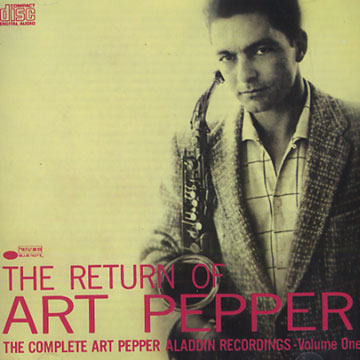
There are two groups here, recorded 1956 and 1957. The first group features Pepper straight out of prison and recording again. It's a somewhat unbalanced group and Pepper's style is intact but languishing. This makes instructive listening, considering how hot he could be on a good recording, I find it fascinating to see between the lines for a few moments while his fingering isn't as nimble and the ideas are developing more slowly. There's some good balladry ("You Go to My Head") and some flashy piano and trumpet from left coasters Russ Freeman and Jack Sheldon. The gems, for me, come in the pickup band on tracks 11-15 with Joe Morello and Red Norvo. This group was put together on the fly, presumably with little or no rehearsal, and the miracle is that it's a really tight date with a really positive chemistry. Morello was leader. "Tenor Blooz," "Yardbird Suite" and "You're Driving Me Crazy" show Pepper's style in full flight. Also, Norvo and Carl Perkins, and Pepper's interplay with Perkins, are not to be missed. If I had the choice to keep one disc out of this Aladdin set, The Return of Art Pepper might not be my first choice, but the Morello/Norvo recordings redeem it.
Labels:
1956,
1957,
1988,
aladdin,
alto,
alto saxophone,
art pepper,
bebop,
blue note,
bop,
cool,
joe morello,
quintet,
red norvo,
sheldon,
the complete aladdin recordings volume 1,
the return of art pepper,
west coast
Sunday, September 8, 2013
135. Ryan Kisor / Minor Mutiny (1992)
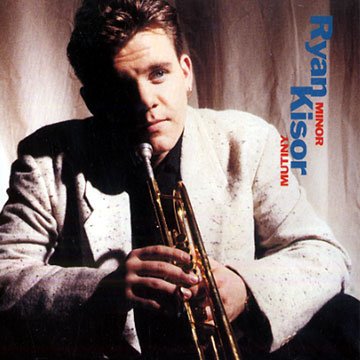
The cover, which apes Chet Baker, first grabbed me. I saw a young guy, similar features, sport coat, trumpet, and dramatic lighting. I thought, okay, let's try this out. The second thing, first hearing then reading, was the personnel including Ravi Coltrane, Lonnie Plaxico, Michael Cain, and either Jeff Siegel or producer Jack DeJohnette on drums. It's a sweet debut, a sort of double debut if you count Siegel. I was immediately swept up by the beautifully lonesome "One For Miles," which evokes Davis' "Basin Street Blues" from Seven Steps to Heaven. Kisor pays through the mute and it's a spot on, glowing tribute. My reaction was, "If this guy doesn't sound like Miles!" Yet in spite of Kisor's obvious reverence for the master, the performance isn't cliche and the style is all his own. Then there's the work by Ravi Coltrane on tenor and soprano. His tone and intonation on soprano are exemplary and the choruses take possibly the most unique voice in the group. Juxtaposition of drummers Siegel and DeJohnette do not ruin the continuity. Siegel is fantastic, playing responsively in intricate patterns all around the beat, and doesn't suffer for following an experienced musician like DeJohnette. You'll find that Siegel's playing even starts the melancholy album (there is some great mood on this disc), and he is only supplanted by DeJohnette on two tracks.
Labels:
1992,
columbia,
debut,
jack dejohnette,
jeff siegel,
lonnie plaxico,
michael cain,
minor mutiny,
quintet,
ravi coltrane,
ryan kisor,
soprano sax,
tenor sax,
tenor saxophone,
tribute,
trumpet
Saturday, September 7, 2013
134. Chet Baker / Live in '64 and '79 (2006)
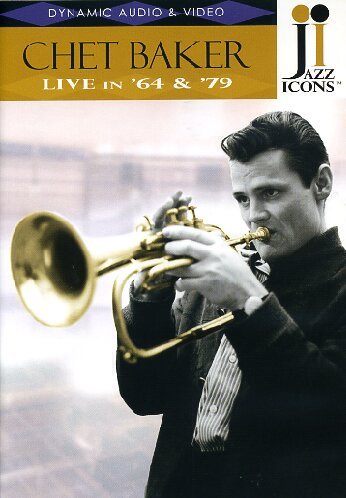
Baker's music definitely matured, although his development is sometimes difficult to appreciate given how his drug habit impacted his life and performances. This DVD from Jazz Icons shows him playing with two European groups, 15 years apart. In the '64 quintet I sense tension between the underplayed Baker and overactive pianist Rene Utreger, who is constantly throwing heavy handed chords at the end of Chet's phrases, sometimes before they appear to be completed. It's like a leadership dispute, and the band or producers clearly have their own ideas about who falls where. In spite, Baker manages a lovely "Time After Time," though the quintet's take on "So What" seems like a missed opportunity. Baker has trouble finding space to express himself and fights with the group, and also has difficulty with the intonation. The second performance is from '79 and begins with an interview that segues into "Blue Train," in progress. Baker says his lyrical approach to improvising has become more subtle with experience and the performance reflects this. The drummerless quartet is much more together than the '64 group, thankfully, and Baker's rich sumptuous tone pervades the set. Although "Blue Train" is truncated (which stinks, because what we do hear is beautiful), we get a heavy swinging and creative take on "Softly As In a Morning Sunrise" with Baker's smoothly flowing melodic improvisation, the occasionally interesting turn of a chord, and overriding melancholic appeal. Also notable are pianist and vibraphonist Michele Graillie and Wolfgang Lackerschmid. I like this installment of Jazz Icons for the contrast it provides between a younger Baker and an older, perhaps wiser player with a more respectful band.
Friday, September 6, 2013
133. Roland Kirk / We Free Kings (1961)
This early album by Roland Kirk demonstrates some of the things he became known for a bit later on. It's a polished, enjoyable, and provocative album. Most notably, throughout the blues and soul inflected set, he plays two or sometimes three instruments at once and switches between them at lightning speed. While blowing the blues on the flute, he likes to screech, howl, and sing along. There aren't any drop-ins from the board, no spliced takes. Obviously with one man filling four chairs, the arrangements revolve around him. As a testament to his talent, it works seamlessly. Kirk has an inspiring technique and sweet tone on all instruments. His style of improvising, I think, clearly departs from the Coltrane bag he was once lumped into. The band is Hank Jones or Richard Wyands, drums is Charlie Persip (great choice), and bass is Art Davis or Wendell Marshall. Through his technique and instrumentation, Kirk puts a unique spin on old tunes, and kicks out his own compositions, as well. After this album, Kirk's journey continued to seek new directions, ever expanding, ever exploring. We Free Kings isn't just nice for listening, it's also nice for perspective. It shows his music is steeped deeply in blues and bop, but the trajectory for future dates would always be farther out than before.
Labels:
1961,
art davis,
charlie persip,
flute,
hank jones,
hard bop,
manzello,
mercury,
quartet,
review,
richard wyands,
roland kirk,
stritch,
tenor sax,
tenor saxophone,
verve,
we free kings,
wendell marshall
Thursday, September 5, 2013
132. John Coltrane / Fearless Leader (2006)
Coltrane's Prestige albums have been available in various formats since the 1950s. Another chapter in the flood of repackaged Coltrane on CD, Fearless Leader places his earliest recordings as leader in chronological order. This allows serious listeners to study his development as composer, arranger, and stylist without having to track down the individual records. Moreover, by removing these recordings from their in-album sequences, they exist in a proper or at least more authentic musical context. They transcend the supposition that is imposed by arbitrary sequencing and stand their ground against one another, in the order they were created. Listening to the whole box, or at least a good chunk of it in one sitting, is a rewarding experience. From the outset, Coltrane's groups are well rehearsed and the arrangements are tight. Throughout the progression, it's exciting to hear Coltrane's tone become more sonorous, his technique sharper, more assured. In addition to the leader, there's Paul Chambers, Art Taylor, Red Garland, Mal Waldron, Freddie Hubbard, and others. We hear them take some excellent shots at the blues, as well as Coltrane's peerless balladry in classic chestnuts like "Lush Life" (Donald Byrd around the 9-minute mark, wow), and some early sheets of sound ("Black Pearls," "Russian Lullaby"). Across six discs, there's too much to discuss here. Somebody could, and several people have, written books on this music. The concept of the six-disc set, plus accompanying booklet with copious photos and notes, make it a really attractive package. Unless you want the individual albums, I'd say this is a core collection item.
Labels:
1957,
1958,
2006,
fearless leader,
hard bop,
jazz,
john coltrane,
post bop,
prestige,
quartet,
quintet,
sextet,
tenor sax,
tenor saxophone,
trio
131. Ahmad Jamal / In Search of Momentum (2003)

Jamal is an excellent player, strong as ever and still developing past age 70. In Search of Momentum is a prime example, the kind of record that makes other new things feel stale (here "new" is 2003). His enthusiasm for contrasting percussive block chords with what I like to call 'negative space' on the piano is matchless. His style is ever more rhythm driven, and it's full of energy for standards like "Where Are You." In the opening "In Search Of" he plays with some sly quotes that bring a grin. In "Should I?" he characteristically mixes a heavy left hand with intermittent flourishes of the right, building to thundering crescendos a la Erroll Garner, then reclining in moments of delicate quietude. He works closely with his excellent trio, who are James Cammack on bass and Idris Muhammad (a personal favorite, nice to see him here, too) on drums. Jamal is aggressive and often angular, and his style shouldn't be a stretch for fans of more overtly experimental pianists like Cecil Taylor. O.C. Williams joins Jamal for the beautiful "Whisperings," the album's sole vocal spot and another opportunity for Jamal to stretch out his dynamic approach to the keyboard. And by the way, the liner says that Jamal's hat was designed by Ishmullah's Famous Hats of Oakland, California. Too bad Monk wasn't around long enough to endorse men's haberdashery.
Wednesday, September 4, 2013
130. Charlie Parker / Charlie Parker with Strings: The Master Takes (1995)
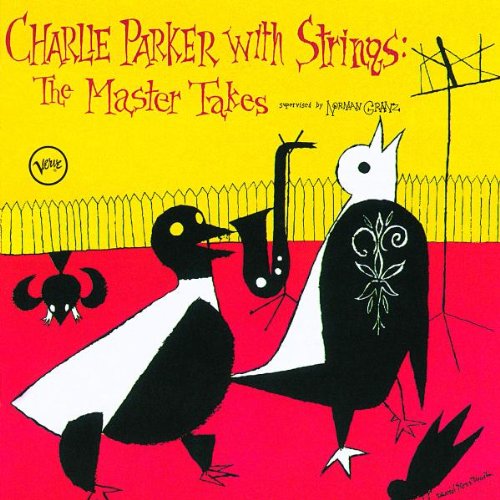
If you're only interested in Bird's famous recordings with a small orchestra, then you can save a little coin with this attractive disc. (It's only fair to say that for just a few extra bucks, $20 on average for used, you can have all the material here plus much more and better liner notes if you buy the Complete Verve Masters.) But as this disc's title indicates, it contains the complete master takes of Bird's famous 1950 sessions with strings. In addition to the 14 tracks contained on the original two LPs by Mercury, the Verve CD contains 10 bonus tracks recorded 1947-1952. The orchestral numbers are all standards, and when they work, it's magic. Some have argued that this was a commercial sell out. It was so successful that it led to a flood of other artists playing with strings. The truth is that Parker himself always wanted to play with an orchestra, and these recordings fulfilled his dream. In the greater context of jazz today, I think it's a stale argument and intentions don't matter. Who cares whose idea it was? Hey, it's Bird, there's some extra musicians, and the result is warm, elegant, and hard to turn off. Whoever can't enjoy such an engagement must be difficult to please. Likewise are my feelings for Cliff Brown, Dizzy, or anybody else who went in the studio with an orchestra in the 1950s.
Labels:
1947,
1948,
1949,
1950,
1951,
1952,
bebop,
bop,
charlie parker,
charlie parker with strings the complete master takes,
mercury,
orchestra,
review,
tenor sax,
tenor saxophone,
verve
Saturday, August 31, 2013
129. Hank Jones and Frank Wess / Hank and Frank (2006)
Requiring no introduction, Hank Jones and Frank Wess have one of the best jazz albums of the past 20 years. Aside from Jones and Wess, bassist John Webber (try "You Made a Good Move") guitarist Ilya Lushtak, and drummer Mickey Roker make an appreciable impact, too. This is uber classic jazz with universal appeal. The joy in listening, for me, comes from how together the group is. Playing this music is beyond natural to the co-leaders and on the record, the product of their skills sounds as easy as breathing. Wess doubles on tenor and flute. To make a play on that line about "breathing," try listening to his beautiful lines on ""The Very Thought of You." There is a wide variety of material from blues to bossa nova, and don't miss the four originals by Wess or the tune by Mr. Parker like "Barbados." Best of all, if you can't get enough of Hank and Frank then you can always buy the second volume. Yes, there is a second volume.
Labels:
2006,
blues,
bossa nova,
flute,
frank wess,
hank and frank,
hank jones,
hard bop,
ilya lushtak,
john webber,
lineage,
mickey roker,
piano,
quintet,
review,
tenor sax,
tenor saxophone
Friday, August 30, 2013
128. Rabih Abou-Khalil / Blue Camel (1992)
Like Bukra, 1992's Blue Camel is a stimulating set of jazz fusion with roots in traditional Turkish and Middle Eastern music. Rabih Abou-Khalil's catalog is like a treasure box filled with gems but I think this collection ranks among his best efforts. Instrumentation (alto sax, oud, frame drums, percussion, trumpets, and bass) is similar to the aforementioned Bukra and has similar personnel in Ramesh Shotham. Certainly Charlie Mariano is capable of fusing these disparate musical worlds, and his improvisations with the alto are notable. The album begins with Mariano's tacit, contemplative solo introduction to "Sahara." It sounds like a gently intoned prayer, wafting melodiously through the speakers until Abou-Khalil and the group's other voices join him one by one. Kenny Wheeler on trumpet and flugelhorn is a good choice and his sound adds additional depth to the band. His technique treats the music nicely, like the nimble fingered flair in "Tsarka" and elsewhere. The arrangements develop the compositions with patience, and there is much interplay with the percussionists, which is integral.
Labels:
1992,
alto,
blue camel,
charlie mariano,
flugelhorn,
frame drums,
fusion,
kenny wheeler,
milton cardona,
nabil khaiat,
oud,
quintet,
rabih abou-khalil,
ramesh shotham,
review,
sextet,
steve swallow,
trumpet
Tuesday, August 27, 2013
127. The Dave Brubeck Octet (1950)
I find this, the Octet's only studio album, a roaring good listen. I enjoy it alongside the Birth of the Cool by the Miles Davis Nonet. Both are similar in size and in their means of repurposing, so to speak, some of our more venerable standards like "What is this Thing Called Love" or "September in the Rain." The group's personnel is notable too, considering their different trajectories after the Octet: Tjader became known for the vibes, Van Kriedt for education, and Collins for Woody Herman. The pieces have tight arrangements that sound cool and loose, reeling with the energy and excitement of dixieland. But there's an ever present discipline behind them, too, and the innovation of infusing jazz with classical forms of writing and arranging. The soloists are concise, wrapping their choruses in 8 or 12 bars, staying close to the melody with strong voice leading. Many stayed in the repertoire of the Dave Brubeck Quartet so it's fun to compare the bobbing and weaving counterpoint with later performances of the same tunes, like our opener "The Way You Look Tonight," which I associate with Desmond's snarky quotes from Stravinsky and that nasty blues lick from Jazz at Oberlin. In fact, come to think of it, it's been a while since giving that one a spin....
Labels:
1950,
bob collins,
cal tjader,
classical,
cool,
dave brubeck,
dave brubeck octet,
dave van kriedt,
dick collins,
fantasy,
jack weeks,
octet,
paul desmond,
piano,
standards,
west coast,
william smith
Tuesday, August 20, 2013
126. Babs Gonzales / The Chronological Classics: 1947-1949 (2000)
Babs Gonzales was a fringe character in jazz, although he garnered a devoted fan base. I have a difficult time finding him a slot in my head, which I
guess a lot of people must. So I'll file him with King Pleasure on
one side and Screamin' Jay Hawkins on the other, not too far from Slim Gaillard and Betty
Roche. The chief characteristic of his music is a bebop inflected vocal style somewhere between scat and vocalese, with occasional forays into conventional lyric singing. He had lots of friends on his records: Tadd Dameron, Art Pepper, Sonny Rollins, Bennie Green, and James Moody to name a few. This disc contains just what its title describes. Included are his legendary sides for Blue Note with Dameron on piano, as well as his work for the smaller Apollo and Manor labels (enjoy Green and Moody on Manor). Also here are eight sides recorded by Capitol, three of which were rejected. These groups contain a young Sonny Rollins, Art Pepper, J.J. Johnson, Roy Haynes, as well as Wynton Kelly, and Pee Wee Tinney on guitar. It's a motley bunch of tunes and dudes that are charming ("Running Around"), humorous ("A Lesson in Bopology"), or spooky ("Weird Lullaby"), but always good fun. Appreciate them for containing the work of other notables, or on their own merit. You won't find much like Babs anywhere else.
Subscribe to:
Posts (Atom)

