Recent listening, current
Archived listening, 2013-2016
Showing posts with label 1956. Show all posts
Saturday, December 27, 2014
198. Frank Wess / Opus in Swing (1956)
This pianoless quintet led by the flute of Frank Wess also lacks his other instrument, the alto sax. Accordingly, he's in top form whether it's pounding high notes in the blue gloom of "Southern Exposure" or adding harmonic color to the serpentine leads of "Somewhere Over the Rainbow." Also moonlighting from the Basie Band are Eddie Jones and Freddie Green who keep time with Kenny Clarke so tight it's telepathic. The quintet excels in the same music that Basie's bands made famous. Like Basie's, their combo has an undeniable group dynamic, but every man is heard as his own solo artist. Together, they drive the music with one mind, then shine forth as individuals during the moments when one man stands alone. It's impossible to appreciate one quality without noticing the other. Kenny Burrell is notable. Listen to "East Wind." Green trades chording for a more pianolike approach that walks, while Klook keeps time with the cymbals and Wess sketches the heavy mood with dense vibrato. When he lays out, Burrell bursts the seams with bluesy runs and relevant single note phrases that underscore the character of the melody and polish the rhythm. It's choice stuff, a potent brew of Kansas City swing that has been seasoned with the developments of postwar New York.
Friday, January 3, 2014
166. Sonny Rollins / Rollins Plays for Bird (1956)
The medley of post-1950 Charlie Parker tunes that begins this tribute to the late Mr. Parker flows as effortlessly as a river thanks to Wade Legge's piano continuo and Max Roach's drum kit. Rollins and Kenny Dorham do most of the melody and choruses, although Roach gets a fair shake, too. He characteristically mixes it up during the front line's choruses, laying on the cymbals and hard rolls while changing from straight time to double-time and back again, adding a loping feel, building urgency, or cooling it back down as needed. Legge and bassist George Morrow are the only musicians in the quintet to never work with Parker, so there is a familiar intimacy about the music that comes from the friends honoring a friend. Dorham is relaxed and outstanding in the "Star Eyes" segment. He especially soars in "Kids Know," a Rollins original in 3/4 that the band stretches out generously. There are a lot of Charlie Parker tribute albums out there, hundreds since 1955, and some are real time wasters. This date is one of the best, the most genuine, and the most enjoyable.
Thursday, September 19, 2013
140. Tal Farlow / The Swinging Guitar of Tal Farlow (1956)
This blues and bop trio date with Farlow, Eddie Costa and Vinnie Burke is easy to listen to, and closer listening reveals a lot going on. The styles of Costa on piano and Farlow's guitar dovetail nicely. Farlow's eloquently phrased and heavy swinging choruses are followed by those of Costa, who plays in a hard-hitting, single-note style and is very rhythmic. Farlow uses the occasional slide, as in "Yardbird Suite," but instead of relying on an arsenal of tricks and stock licks, he is adept in inventing on the fly. The improvisations literally flow from the speakers like they're on tap. With so many ideas being tossed around, there's a lot of interplay between the piano and guitar. Burke plays the bass more or less steadily throughout, occasionally getting a chorus his own. The outtakes of "Taking a Chance on Love," Yardbird," and two (!) extra takes of "Gone with the Wind" are all so good that it's difficult to say how they determined a master. At any rate, the bonuses are much appreciated by this listener! Admirers of Ahmad Jamal's drumless trio with Ray Crawford, the Aladdin dates of Art Pepper, or the Modern Jazz Quartet should take immediately to the music herein.
Tuesday, September 10, 2013
136: Art Pepper / The Return of Art Pepper: The Complete Aladdin Recordings, Vol. 1 (1988)
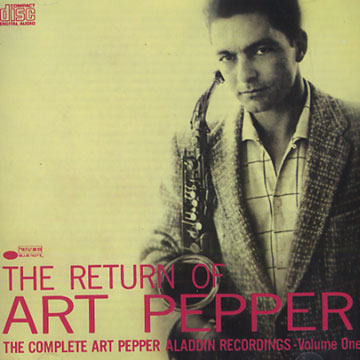
There are two groups here, recorded 1956 and 1957. The first group features Pepper straight out of prison and recording again. It's a somewhat unbalanced group and Pepper's style is intact but languishing. This makes instructive listening, considering how hot he could be on a good recording, I find it fascinating to see between the lines for a few moments while his fingering isn't as nimble and the ideas are developing more slowly. There's some good balladry ("You Go to My Head") and some flashy piano and trumpet from left coasters Russ Freeman and Jack Sheldon. The gems, for me, come in the pickup band on tracks 11-15 with Joe Morello and Red Norvo. This group was put together on the fly, presumably with little or no rehearsal, and the miracle is that it's a really tight date with a really positive chemistry. Morello was leader. "Tenor Blooz," "Yardbird Suite" and "You're Driving Me Crazy" show Pepper's style in full flight. Also, Norvo and Carl Perkins, and Pepper's interplay with Perkins, are not to be missed. If I had the choice to keep one disc out of this Aladdin set, The Return of Art Pepper might not be my first choice, but the Morello/Norvo recordings redeem it.
Labels:
1956,
1957,
1988,
aladdin,
alto,
alto saxophone,
art pepper,
bebop,
blue note,
bop,
cool,
joe morello,
quintet,
red norvo,
sheldon,
the complete aladdin recordings volume 1,
the return of art pepper,
west coast
Thursday, April 18, 2013
85. Lester Young / The Jazz Giants (1956)
The Green-Ramey-Jones factor is in effect here, as Lester blows for the first time alongside the exquisite Roy Eldridge and Vic Dickenson. Teddy Wilson provides piano, his first date with Prez in a decade, and the whole thing really swings. The chemistry is great and it's a good listen. Knowing who is on the session, I love hearing one chorus while waiting for the next guy. Lester does some fireworks (try "Gigantic Blues," also note Eldridge, Wilson and Jones) but he sounds profoundly blue throughout the others. I never bought the description of Prez as lean or
altoesque, or however that's said. He's got a big, sonorous tone
that portrays (and occasionally betrays) every nuance of the piece. These are mostly ballads so it suits this album especially well. In the arrangements, Lester usually goes first followed by Dickenson or Eldridge. When they get to the end, the whole band takes it out. It reminds me of a big band arrangement, and harnesses the septet's additional weight to good effect.
Monday, March 18, 2013
55. Martin Denny / Exotica! The Best of Martin Denny (1990)
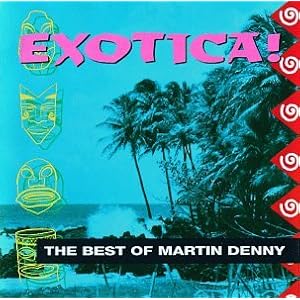
Is it jazz? Well, it might as well be, if we accept that Louie Armstrong and John Zorn occupy the same section at the record store. Martin Denny purveyed a style of lounge music that re-imagined common melodies with elaborate orchestration to create atmosphere with an "exotic" flavor. It was ideal background music for transporting you to another place. So Tiki culture, African drumming, cha-cha, tribal chanting, bird calls, etc., are all fair game. Exotica albums were made by hundreds of composers and orchestras, but Denny's work was always a few cuts above the rest, maintaining a unique sensibility that was frequently imitated by others. Exotica! The Best of Martin Denny was compiled from several LPs released in the 1950s. It begins with the quintessential "Quiet Village" and Denny's signature bird calls, howling, and other aural oddities sure to raise eyebrows at your next cocktail party. They do a lot of Lex Baxter compositions, but typical of Denny's style, there are other chestnuts, too. For instance, Duke's "Caravan," the town bicycle, is treated here with sufficient aplomb (which means a grab bag of interesting percussion and a wry grin). I was initially concerned that without the thematic context of each album, this compilation would sound disjointed. But surprisingly, I found that not just the pieces themselves, but their themes, dovetail nicely. And Denny keeps listeners awake during each song by scoring for a bewildering array of world percussion instruments. More academically inclined listeners might notice the mischievous melodies, ever present vibraphone, and humorous character all point toward Danny Elfman and Frank Zappa. If you made the mistake of thinking grown men who call like monkeys, birds, and tropical insects can't influence musical history, perhaps think again.
Sunday, February 10, 2013
30. Zoot Sims / Whooeee! (1956)
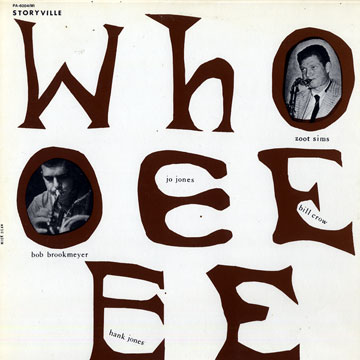
Zoot Sims always got it right. The albums were consistently excellent and already on the early ones he was confident and mature. His phrasing was economical and concise, driven by the melody and carried by a sweet, full tone. Did this guy ever play a clam? It's almost frustrating. Whooeee! is rare in the US but you can find it on Four Classic Albums by AVID Jazz (originally on Storyville), cheap for an import. If you listen closely, it's obviously a needle drop, especially the drums. But it's a goodie and after 20 years of bootleg collecting, a clean needle drop sounds like blue sky to me. The band is great: Bob Brookmeyer, Jo Jones, Hank Jones, and Bill Crow. Everyone is bent on melodic improvising, and they take their time, creating a spacious and friendly vibe. Hank Jones does these great, tinkling single-note solos, like on "Lullaby of the Leaves" where everyone lays out so Hank and Crow can trade licks to the gentle whoosh of Jones' hi-hat. Brookmeyer sounds great playing in unison with Sims, and the creamy vocal perfectly ensconced in the middle of "I Can't Get Started" is a rare treat, too. Four stars.
Sunday, February 3, 2013
24. Teddy Charles / The Teddy Charles Tentet (1956)
The credits on this impressive cool jazz album include J.R. Monterose, Gigi Gryce, Jimmy Raney, and arrangements by Gil Evans, Mal Waldron, and Jimmy Giuffre, as well as Teddy Charles. Those arrangements predominate: they are tight, fluid, and very cool. I love the orchestration, which uses both brass and reeds to cover the baritone, tenor, and alto ranges. In George Russell's "Lydian M-1," there are alternately brasses or reeds pinning down the top and bottom, while Monterose and Gryce take turns filling in the middle, and Peter Urban's brassy cornet soars above the continuo by Charles and Waldron. The instrumental textures mesh nicely, and each player has a strong sense of ensemble playing as well as a creatively swinging solo voice. Raney's solo in "Nature Boy" is sensitive and the perfect compliment to Charles soft work on the vibes. If you rule out the Miles Davis projects with Gil Evans from the next year, this album is quite different than anything going on in 1956.
Friday, February 1, 2013
22. Sonny Rollins / Tenor Madness (1956)
It's great to hear Coltrane and Sonny Rollins working alongside one another. At the time of this recording, both players were up and coming, on the brink of changing jazz as we hear it today. On the title track "Tenor Madness," everyone is eager and gregarious. Coltrane goes first, offering a bright, slippery tone with more focused objectives. Sonny is next, spreading it around more with a deeper, wetter tone. The playing from both men is anything but a cutting contest. In fact, they sound relaxed and patient, as if casually trying out new ideas without worrying about the overhead. It's a quality session with some historic import, and an interesting footnote to fans of Miles or Monk, for obvious reasons. Tenor Madness is also interesting in that it contains Miles Davis' working group, but proceeds without his direction. In that regard, the product comes off as far less focused and lacking the inertia of Workin', Steamin' or Relaxin'.
Wednesday, January 30, 2013
20. Miles Davis / The New Miles Davis Quintet (1956)
The maiden voyage on wax by the famous first quintet is short, sweet, and relaxed. It's still a young group as far as studio work was concerned so the set is fairly vanilla but hides a few gems, like Benny Golson's "Stablemates" and "The Theme," which is probably the hottest take on the disc. The performances hardly hint at what the band was capable of in a live setting, but Miles solos frequently and I really enjoy his thoughtful way with phrasing the ballads. Coltrane was still fishing for his voice and sounds a mite green compared to a few years later, but you can hear the pieces he's setting up. Another highlight is the opener, Ellington's "Just Squeeze Me." It has Chambers walking some coy figures on the bass while Philly Joe is keen to join the fun with the kick and snare, also playing some cool syncopated figures on the hi-hat. Overall, it's a smooth but enjoyable cruise and is sometimes so restrained that the rhythm section stands out more than the front line.
Thursday, January 17, 2013
07. Johnny Griffin / Johnny Griffin (1958)
This very early Johnny Griffin disc has me under its spell. Griffin imparts the music with a distinctive, bluesy swing that stands out among other luminary reedmen, a serious, down-to-earth style that speaks equally to the heart and gut. His roots in Chicago R&B are prominently displayed in the bouncing "Lollypop" and tough swing of "Satin Wrap," but a gentle finesse with the ballad is displayed in "These Foolish Things," a modly oldie that, surprisingly, does not sound one bit worse for the wear. Throughout the proceedings, Little Giant articulates his affection for musical fireworks by executing blazing runs with superhuman acuity, and fleshes out his phrasing with vibrant splashes of harmonic color. Junior Mance supports on the piano with blocks of chords and twinkling right hand forays, while Wilbur Ware (who gets a spot in "Riff-Raff") and Buddy Smith keep the whole thing afloat, rhythmically. Dear Verve, please put this CD back in print.
Subscribe to:
Posts (Atom)


