Recent listening, current

Showing posts with label 2000. Show all posts

Sunday, August 17, 2014

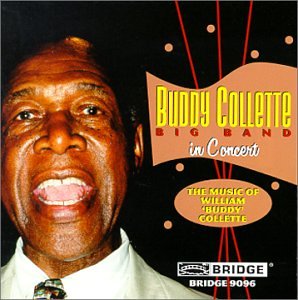
196. Buddy Collette / Live from the Nation's Capital (2000)

Buddy Collette was an originator on the West Coast jazz scene. He cofounded the Chico Hamilton Quintet and devoted his time to education, as well as composing and performing. This live disc from 2000 captures a Collette program for the ages, and its disparate contents cover the arc of his career. Performance and audio production are slick, typical of groups billed on the national stage. There is a lot to enjoy. Professionalism aptly describes the soloists, who play snappy, expressive lines that don't disrupt the cascading harmonies. Arrangements are by several including Collette. No matter the arranger, though, the playlist is unified by breaking the group into combos, building tension, and using the whole ensemble for bursts of energized dramatics. Nothing new under sun as far as big band goes (Gerald Wilson or Sam Rivers orchs are more my style) but the infectious bounce on tracks like "Mr. and Mrs. Goodbye" hold a warm sentimentality for a bygone era while others, like the Afro-Cuban rhythm of "Andre" or improvs on "Blues #4" keep the pace and make good use of variety. Live from the Nation's Capital isn't the most essential big band record in my collection, but it offers a lot of good stuff and demonstrates (in a very straight way) the wide array of styles that Collette worked in throughout his career.

Tuesday, February 25, 2014

188. John Lewis / Evolution II (2000)

When he recorded Evolution II, Lewis had long since achieved the accomplishments that would define his impact on jazz. But saying as much is unfair for this man. I scratch my head and marvel, open my ears and let the piano fill them with knowledge. His technique is still surprising, oscillating from arranged structures to improvised heavy swing. Here he reinterprets his own pieces in three separate continua: a gleaning from the past, the import of the present, and the dictates of his present moment. It shrugs at commercial boxes like "pop," "classical," or "jazz" by exposing commonalities in the ineffable and truly nameless thing that we call "music." As always, it points in a new direction. Maybe a little like Paul Desmond, his understated touch can miss you the first time, then devastate the second. Like Ahmad Jamal, he understands the penetrating effects of silence and balance. Or like Mingus, depth allows for endless reimagining. The meandering stroll down memory lane seeks unexplored areas of familiar paths. Whether the march from "Trieste," for instance, "Winter Tale" or the unmistakable strains of "Django," this effort proves that without Milt, another MJQ was impossible, but Lewis' mission would continue. Kudos to Lewis Nash, whose complex, articulate and just brilliant drumming puts all the pieces in place.

Saturday, May 11, 2013

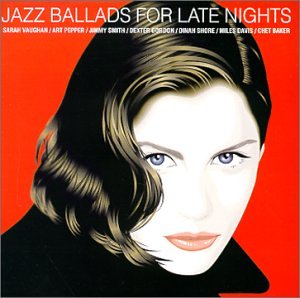
100. Various Artists / Jazz Ballads for Late Nights (2000)

In spite of similar thematic content, ballad comps are not often interchangeable. Each one has a different character depending on who's on it and what tunes they do. You could almost divide them into subcategories of microthemes. Take Sinatra's No One Cares or Chet Baker's Chet, and it's easy to see. Would you play the Sinatra record for a date? Never. Yet Chet could be perfect for a romantic occasion, and in another way, its stormy introspection also suits a party of one. Jazz Ballads for Late Nights has a mood that's suitable for two and seems made that way. It begins with the profound and majestic occasion of Sarah Vaughan singing her blues in "Round Midnight," but the rest of the disc has a warm atmosphere that leans the way of love shared, rather than love lost or unrequited. There is a sly, almost playful "Willow Weep for Me" by the Three Sounds, and also a swank "Lover Man" by Jimmy Smith, with beautiful and rhythmically provocative alto work by Lou Donaldson. Several vocals even the pace, reminding you and that special someone why you're listening (Baker's quaint and pining "My Ideal," or Dinah Shore's "My Melancholy Baby"). I think the mood on the Baker tune should have closed it out, preceded by Ike Quebec, and not the other way around. Baker veritably whispers the closing statements and makes it the perfect song to end on, and it doesn't leave you keyed up the way Ike's impassioned soloing does. But these are mere quibbles. What more do you need? Short answer: a babysitter.
Tuesday, April 2, 2013

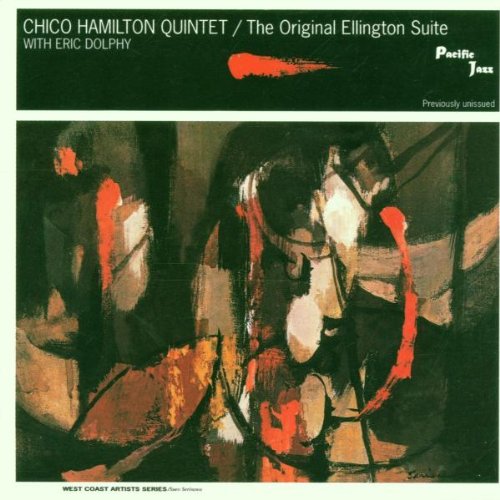
69. Chico Hamilton Quintet with Eric Dolphy / The Original Ellington Suite (1958)

I'm a fan of pianoless jazz groups in general, and no offense to the piano. The dynamics of such a group change without a baby grand to rally around, and a skilled leader like Hamilton can take proceedings into interesting territory. Comping duties fall to guitarist John Pisano (who also has sweet leads) and cellist Nate Gershman. None of this stopped Pacific from losing the tapes and test pressing, rediscovered inside another Chico sleeve in Brighton, England. I'm happy it found its way to Michael Cuscuna who issued the CD, and kudos to the collector who found the test pressing. The music's just great, some of the most refreshing and easygoing jazz I've heard in a while. Dolphy's alto, flute, or clarinet anchor an intimately swinging mood on staples like "In a Sentimental Mood," "I'm Beginning to See the Light," or the talkative "It Don't Mean a Thing." But all the cuts are good. If you're not sold on the cello, listen to that last track, or maybe its warm and reedy tone on "Day Dream" which retains all the emotional import the melody should have, but lacks the sometimes corny sentimentality of a violin.