Recent listening, current
Archived listening, 2013-2016
Tuesday, May 28, 2013
109. Julie London / Julie is Her Name (1955)
Julie London's range and the timbre of her voice is one that sits very well with me. Ensconced within her silky mezzo soprano is a space filled with sumptuous partials and overtones that make a single note sound like a chord. Her voice and my wife's are quite similar so when I listen, I sense something familiar. In the classic debut Julie is Her Name, London's young voice is the main attraction and backed often by only a guitar. Her phrasing and timing leave you on the edge of your seat, wondering where the next phrase will fall ("It Never Entered My Mind"). She's always playing this way with the lyrics and her timing, while Barney Kessel anxiously holds back comping. Later in her career, she fronted a big band whose eloquence and power gave her smoldering vocals and lovelorn ballads some extra emotional impact. But here it's all Julie. The album opens with the quintessential "Cry Me a River," and moves through 12 other standards and ballads including aforementioned, quirky "It Never Entered My Mind," and the beautiful "Laura." There's also a second volume, which is just as bit as this first volume, two records that should be on every jazz lovers shelf.
Monday, May 27, 2013
108. Duke Ellington / On the Road with Duke Ellington (1967)
On the Road is a documentary film from 1967 by Robert Drew. For an artist so prolific, Duke left behind precious few film documentaries. There is music performed in the film that'll give you goosebumps but the subject isn't the music itself, it's Duke and how he lives and works. The picture is grainy and saturated like an old Super 8, the audio is muddy, and you'll instantly disregard that because from the outset, you're aware that this is the best film on Duke Ellington that there is. It's delicious, for a Duke fan like me. The camera follows him in his daily routine as he opens his mail, lingers too long backstage on the piano, composes a new tune, or has his breakfast -- hot water, steak and potato, the same breakfast he's had for 40 years. Duke is a funny, funny guy. He's an autocratic employer, an eloquent speaker, and madly devoted to his craft. You see him flirting with fans at the airport, or backstage having a natter with Louis Armstrong, just talking like two old friends, which is extremely interesting. The bottom line is that Duke Ellington runs the show whether it's on the road, at home, or accepting an honorary doctorate. He works all nighters while he's not performing and performs when he's not working. At one point, he tells the crew that he can't imagine what retirement means because stagnation will not look good on him. And it's true, he worked until his death six years later. I think I learned that if I truly want what I think I want, then I know I'm not working hard enough. Like a thunderstorm, the power, sophistication, and beauty of Duke's orchestras always excited and impressed me. Watching it happen in the making reinforced that notion.
Sunday, May 26, 2013
107. Desmond, Brubeck, Van Kriedt / Reunion (1957)
This meeting of the minds that have met before on many occasions is as relaxed as it is concise. David Van Kriedt was the tenor and collaborator in the Octet alongside Brubeck and Desmond. He continued into academia, also playing with Stan Kenton, while Brubeck and Desmond became performers. On Reunion, there are some tastes of the fugue style writing for which the Octet was famous (Bach's "Chorale," the only tune without a Van K. credit), although in the mood is, as I mentioned, quite a bit more relaxed than it was in the Octet. Back then, as the record shows, everyone seemed scrambling to out-do his last chorus. This time, while it sometimes sounds as if there's no clear leader, each man gets a fair share of time during improvisations and the music has the feel of care and balance. The group idea of musicality is very strong. Brubeck often picks up where Van Kriedt leaves off, or Desmond does, with occasional episodes that quote slyly from whatever is near at hand. It's soft, sophisticated music with occasional fireworks ("Shouts," listen for the Brubeck boulder that spins Desmond into a tizzy) and superb arrangements by Van Kriedt, like the sumptuous "Prelude." Van Kriedt's tone is smooth and full like Lester Young, and the timbre is the ideal mixer for Desmond's alto.
Saturday, May 25, 2013
106. Frank Zappa / Hot Rats (1969)
Fusion, like the avant-garde, is a thing that everyone approaches from a different angle. Hot Rats is way off the typical fusion track, if you follow the example set by those who left Miles Davis' electric groups. But Frank wasn't moving in those circles. When he made Hot Rats, as ever, he was following his own muse. On the surface, Hot Rats takes the path of a hard rock band, emphasizing the "rock" half of the jazz-rock equation. It is filled out with intricate arrangements played on various reeds, electric guitar, electric violin, percussion, and keyboards. Most of the solos are blues-based guitar workouts or feedback-laden electric violin riffing by Sugarcane Harris (see "Willie the Pimp," "Gumbo Variations"). On the other hand, it also features quirky, composed pieces whose tight arrangements are closer to a synthesis of jazz and classical elements than they are to any mainstream American rock and roll from 1970. Listeners of European experimental music from the same time period, or Rock in Opposition groups like Henry Cow should have no trouble appreciating such pieces. "It Must Be a Camel" and "Peaches En Regalia" are notable in this regard, likewise the horn charts for "Son of Mr. Green Genes," which remained a live staple for years to come. Zappa was also a DIY innovator in the studio. If he didn't have the equipment he wanted, then he invented it, and he was endlessly creative at the mixing desk. So the aurally warm texture of Hot Rats was created with a forest of meticulous overdubs and tape manipulation techniques that Zappa pioneered on his own. Are you new to Frank Zappa? Hot Rats is a good entry point due to its presentation of several characteristics common to many pieces in the FZ oeuvre. It's also very good for rock audiences and toe dippers because it is listenable, contains none of Zappa's lyrics (which range from funny, to off-putting, to complete bullshit, depending on how they strike you), and is also widely available on CD format.
Labels:
1969,
frank zappa,
fusion,
guitar,
hot rats,
ian underwood,
jazz rock fusion,
jean-luc ponty,
john guerin,
max bennett,
paul humphrey,
reprise,
ron selico,
shuggie otis,
sugarcane harris,
violin
Friday, May 24, 2013
105. Benny Golson / Groovin' with Golson (1959)
Golson only has a single composing credit on this album ("My Blues House"), which is too bad considering how much I enjoy his style of jazz. But that tune, a slow blues, is the very first one on Groovin'. It is adequately seasoned with Curtis Fuller's flashy statements on trombone, perhaps more than Golson himself. Things move to a mid tempo piece "Drum Boogie" that swings hard with Art Blakey at the helm, before cooling down with the Rodgers and Hart standard "I Didn't Know what Time it was." Golson's sax blends sweetly with Fuller's trombone, and both are accomplished soloists. It's nice to hear their tones in opposition, too, as in "The Stroller" where a caustic Golson veritably peels the paint off the walls before we hear Fuller's punchy but softer sounding approach with short, staccato phrases. There's some brilliant piano work by Ray Bryant, possibly overshadowed by Golson or Fuller but easily underrated. Chambers and Blakey get a turn before everyone does fours and the thing wraps up. The quiet "Yesterdays" finishes the album with a whisper. Groovin' was recorded immediately before the formation of the Jazztet, but it's easy to see where things were going. I think here, Blakey gives a hard edge that was missing from even the Jazztet's most brilliant moments.
Thursday, May 23, 2013
104. Clifford Brown & Max Roach / Study in Brown (1955)
Study in Brown is a really enjoyable record. What's memorable, to me, in this Brown-Roach date from 1955, isn't just Brown's exceptional talent on the trumpet, but his talent as composer ("Sandu" is here) and contributions of tenor Harold Land on the front line. Between their instrumental abilities and composed works, the band is a really good combination. A bit like the Cookbook series by Eddie Davis, Brown and Roach went in the studio a few times and each time, the chemistry cooked something special. This set runs from blues to bop to standards, and through a variety of tempos. In the opening "Cherokee," Land can match Brown phrase for phrase at breakneck speed, and the wailing fragility of his reed provides additional texture and urgency. In each tune, Roach gets a lot of room, naturally, carving out his niche in jazz percussion with driving, melodically inspired solos on snares and toms. "Take the 'A' Train" has a really cool introduction and arrangement, and the jaunty "Gerkin for Perkin" keeps it interesting with a cool stop/start rhythm that causes Roach to kick up some dust. Such freshness, vibrancy and joy flows from this recording. It's almost hard to listen and not be overwhelmed by the sad feeling of knowing that Brown would be gone in less than a year.
Wednesday, May 22, 2013
103. Art Farmer / Meet the Jazztet (1960)
I love this album. Art Farmer's Jazztet was a lot like the Jazz Messengers. Their music had a different flavor than the Messengers but each group was stacked with the fine and innovative musicians and each played the picture of hard bop. Benny Golson does the arrangements and the band plays two of his tunes: "I Remember Clifford," the beautiful tribute for which words are woefully inadequate, and "Blues March," an attention-grabbing blues with a startling cadence and spunky arrangement. There are some obligatory standards ("It's Alright with Me," and swanky "It Ain't Necessarily So") during which the band displays its chops like fine silver. Golson and Farmer make ideal foils by themselves, Golson with superheated explosions of verbosity and Farmer with his carefully crafted and natural lyricism. But you can't forget or ignore the contributions of Curtis Fuller, either. He has some really hip parts, with big, brassy punctuation marks or deftly fingered runs that will make you think he's got a cornet. There's mucho variety, the arrangements keep it fresh, and Lex Humphries swings it hard. If you're getting into this type of music, Meet the Jazztet is essential listening.
Tuesday, May 21, 2013
102. Anthology of Big Band Swing, 1930-1955 (1993)
The scope of this Decca Records compilation encompasses the whole swing era from the stomping greats of 1930 to the final holdouts of the mid '50s. The restored sound quality is excellent but the strength, or allure, of this two-disc set is the variety of material that was chosen. The editors did a great job selecting the tracks, a sure success. Their work provides a detailed and meaningful cross section of the many diverse bands playing swing music in the United States. They could have flubbed it. Decca's roster was about as deep as the Yankees bullpen, but it also had some of the biggest guys in it. So in other words, while Basie, Duke, and Benny are represented here, they're not disproportionately represented to the exclusion of the label's other, smaller acts. Instead, the spotlight spreads a little
wider. The resulting collection is presented chronologically and allows listeners to follow swing as it matured and developed over a cool quarter-century. Across 40 tracks, there are 37 different bands that will jump, jive and wail you into a frenzy. There are so many great bands here in one collection, not to mention their soloists -- Fletcher Henderson, Don Redman, Chick Webb, Jimmy Lunceford, Mills Blue Rhythm Band, Tiny Bradshaw, Jack Teagarden, Noble Sissle, Glenn Miller. And the list goes on, and on, and on! I listen to the whole thing and I get excited thinking about the era, the big dance halls and the excitement this type of music provided to people like my grandparents in such a trying time of depression, war, and uncertainty. It's difficult and expensive for a listener to take in all the swing groups one-by-one and try to put them in context. These 40 songs make it much easier to understand foundational jazz music of the '30s, '40s, and '50s. This should be on every jazz collector's shelf.
Saturday, May 18, 2013
101. Buddy Tate / The Texas Twister (1975)
Tate was with Basie in the early days but has many dates to his own name and was a leader whose career lasted well into the '90s. His sound on The Texas Twister is large and assured, with occasional wailing outbursts, but it's less assertive than some other horns associated with the Count, like Eddie Davis or Illinois Jacquet. And I like that, too. But the music on Twister swings close to the Basie band in more ways than
one. To start with, there's the addition of Paul Quinchette on tenor. The first number "The Texas Twister" is an uptempo 32-bar intro
to the proceedings that showcases both horns (Tate on the left,
Quinchette on the right), and has game piano work by Cliff Smalls. I thought it could easily go a few more rounds but the leaders opted to be concise and it's off to the next tune once the front line gets back to the head. Further in the Basie vein of blues-based small group swing, we also get Tate singing a la Jimmy Rushing in several cuts, including two installments of "Take Me Back Baby" that showcase Tate's sweet vocal and the impact of opposed horns. The arrangements feature some expected dueling, a mature and more relaxed but no less exciting form of the stylistic counterpoint from the old days. It happens between Tate and Cliff Smalls, too, as in "Talk of the Town." Tate opens the tune in a whispering voice that is soon hammered by Smalls' angular piano statements directly on top of the beat. Tate returns to state his piece every bit as eloquently and reserved as before, endowing the ballad with some very poignant sensibilities. Tate also plays clarinet, on "Chicago" and the closer "Gee Baby," adding further depth to the quintet. It's a good session and thoroughly enjoyable listen with a few hidden surprises.
Labels:
1975,
blues,
buddy tate,
cliff smalls,
jackie williams,
jazz,
major holley,
new world,
paul quinchette,
quintet,
review,
rhythm and blues,
swing,
the texas twister,
vocal,
vocalist
Saturday, May 11, 2013
100. Various Artists / Jazz Ballads for Late Nights (2000)
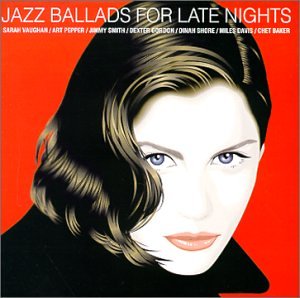
In spite of similar thematic content, ballad comps are not often interchangeable. Each one has a different character depending on who's on it and what tunes they do. You could almost divide them into subcategories of microthemes. Take Sinatra's No One Cares or Chet Baker's Chet, and it's easy to see. Would you play the Sinatra record for a date? Never. Yet Chet could be perfect for a romantic occasion, and in another way, its stormy introspection also suits a party of one. Jazz Ballads for Late Nights has a mood that's suitable for two and seems made that way. It begins with the profound and majestic occasion of Sarah Vaughan singing her blues in "Round Midnight," but the rest of the disc has a warm atmosphere that leans the way of love shared, rather than love lost or unrequited. There is a sly, almost playful "Willow Weep for Me" by the Three Sounds, and also a swank "Lover Man" by Jimmy Smith, with beautiful and rhythmically provocative alto work by Lou Donaldson. Several vocals even the pace, reminding you and that special someone why you're listening (Baker's quaint and pining "My Ideal," or Dinah Shore's "My Melancholy Baby"). I think the mood on the Baker tune should have closed it out, preceded by Ike Quebec, and not the other way around. Baker veritably whispers the closing statements and makes it the perfect song to end on, and it doesn't leave you keyed up the way Ike's impassioned soloing does. But these are mere quibbles. What more do you need? Short answer: a babysitter.
Friday, May 10, 2013
99. John Zorn / Spy vs. Spy (1989)
I remember it clearly. It was December of the year I turned 17, incidentally just a few weeks after I bought The Shape of Jazz to Come, my first Ornette Coleman album. I was in the parking lot of a concert, standing atop my cooler. I had been up there for about 30 minutes or so watching people walk by when one of the guys camping next to us started playing Spy vs. Spy on his car stereo. I had already made myself intimately familiar with the strains on Shape, so Zorn's mysterious and new (to me) spin on "Chronology" was a revelation. It literally fell out of the sky. Once the initial confusion subsided, there was bliss. I stayed on top of the cooler and talked to the guy who put on the album (Nate, from Columbus, who was standing on the ground). We chatted about other Ornette Coleman albums I should buy as we listened to Zorn's elite posse of contemporary jazzists sail through 15 more tunes. Although "Chronology" was the only one I knew, and it was over pretty fast, the rest of the disc already seemed like an old friend. Over the years, Shape and Spy became like mutual codexes to each other, which is funny, considering the lack of material that is common to both. In 1999 I lacked the listening background to bring a truly appreciative context to either record, but I'm astonished that either record filled the hole that it did, and I still enjoy them both greatly and they continually offer me new ideas to invest in.
That is, I think, a testament to the enduring vision of each. That's a mouthful but I can't think of any other way to put it. When I hear Zorn, Joey Baron, Tim Berne, Mark Dresser and Michael Vatcher painting the walls with a group improv like those found on Spy, I can hear their interpretations peeling back the layers of the onion, while simultaneously putting more back on the top. There's so much going on -- the clashing tonalities and meters, the timbres and partials of altos' upper register, the fury of it all. The language of each improvisation is so unique. It's like lightning in a bottle. And yet in all its abrasive, assertive, uncompromising glory, it exudes an inescapable beauty. I like "C & D," "Broadway Blues," "Feet Music," or "Zig Zag" the best, but this is one album I must always start from the beginning.
![]() |
| Somewhere above, I listen to John Zorn |
Labels:
1989,
avant-garde,
elektra musician,
free jazz,
group improvisation,
joey baron,
john zorn,
mark dresser,
michael vatcher,
ornette coleman,
punk jazz,
quartet,
spy vs spy,
thrash jazz,
tim berne
Sunday, May 5, 2013
Current interests and other things.
Being pinched for time hasn't killed my jazz habit, it's just changed the way I do it. It's certainly changed the way I write about it. If you're paying attention, you know I'm currently four days behind the 8-ball. I'd like to think I'm about to come up to speed in this and a few other projects, but who knows. The last four weeks have been very busy for me and the next four promise to be even busier. Hard work is a good thing.
I've been stretching out a little bit, exploring dusty corners for new things I haven't listened to. I look forward to blogging more about Rez Abbasi, Nathan Davis, Esperanza Spaulding, Stanley Turrentine, Ted Nash, and Rabih Abou Khalil.
Dig that camel.
I've been stretching out a little bit, exploring dusty corners for new things I haven't listened to. I look forward to blogging more about Rez Abbasi, Nathan Davis, Esperanza Spaulding, Stanley Turrentine, Ted Nash, and Rabih Abou Khalil.
Dig that camel.
Wednesday, May 1, 2013
98. John Coltrane / Interstellar Space (1974)
This was actually recorded in 1967, but not released by Impulse! until '74, almost a decade after Coltrane's death. It's famously dense, but not impenetrable. Throughout the album, Coltrane demonstrates a litany of technical ideas by running through scales, stacking chords, and changing meters in snatches of modal improvisation. It is very experimental and obviously one of the more inaccessible works in the Coltrane canon. Interstellar Space was recorded shortly after the session that produced Stellar Regions, so many of these pieces share themes. "Saturn" is the longest piece, also the only one to lack bells in the intro. Some people latch onto "Venus" which is the closest thing to a conventional melody on the record. Rashied Ali plays like a mystic, and I often find myself listening to him more than Coltrane, whose explorations are searching but also noisy and make the ear weary. Ali's rhythms seem to accommodate any of Coltrane's fancies, or rather Coltrane is free to step in and out of them when it suits he is doing. This is huge music for 1967 that has been hotly debated, put down, or academically dissected ad nausea ever since. I'm happy that the package was expanded on CD to include the similarly minded "Leo" and "Jupiter Variation." 2013 has a lot more context for this type of musical activity than there was in 1967, and it's found a happy home with hundreds of people. That's the crime of being ahead of your time, that it takes everyone else that much lonegr to catch up. Gregg Bendian chose this album to recreate with Nels Cline (Interstellar Space Revisited), describing it in the liner as his love letter to free jazz drumming. In that regard, I can't think of a finer template. Listen to both, see where it takes you.
Tuesday, April 30, 2013
97. Wayne Shorter / Wayning Moments (1962)
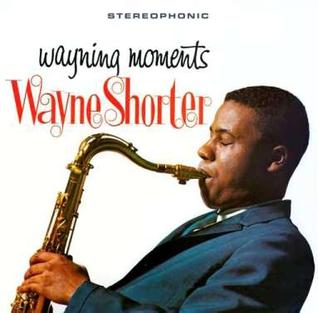
This album, his last LP on the Vee-Jay label and only his third as a leader, has aged very well. That's quite typical of other titles in the Shorter catalog. But in addition to providing really good listening for 2013, I think Wayning Moments should
be important to listeners for another reason. It demonstrates his
skills as soloist, leader, and composer at an early stage. It's the
prelude to his Blue Note years, a simple portrait of blues and bop
that was perhaps more appropriate to the market Vee-Jay was reaching
than the music Shorter would record for Blue Note. I turn it on and marvel at the growth of the artist from tenor in the Jazz Messengers, to this year's Without a Net. Say anything you like about Wayne Shorter, you cannot ignore the arc, the sweep, of his career in music. Recorded 1961, the sounds contained here are very much in the same vein as Blakey's Jazz Messengers. It's hard bop with both feet in the blues, straight-ahead jazz that is very slick and rendered with virtuosic skill. The band stays tight, the arrangements are concise, and no one takes too many chances. But no one needs to, because they're clearly not trying to do anything of the sort. In the opener, Freddie Hubbard plays alongside Shorter, adding strident Latin overtones to Bonfa and Jobim's "Black Orpheus." Eddie Higgins also gets in some nice choruses on piano, like the one in Shorter's "Dead End," "Callaway Went That-A-Way," or his comping and interplay with Shorter's solo voice in "All of Nothing at All" that is simply magical. Shorter has every other composition credit on the album for a total of four. Sandwiching Shorter's music between piecess by other composers (or maybe it's the other way around?), the album does not feel a single bit uneven, a testament to both the group and the compositions.
Labels:
1961,
1962,
eddie higgins,
freddie hubbard,
hard bop,
jazz,
jymie merritt,
marshall thompson,
quintet,
review,
tenor sax,
tenor saxophone,
trumpet,
vee jay,
wayne shorter,
wayning moments
Monday, April 29, 2013
96. Eric Dolphy / Conversations (1963)
The first side of this LP contains loosely swinging and glittering interpretations of two tunes ("Jitterbug Waltz" and "Musical Matador") that are, upon first impression, standard enough. But in Dolphy's hands they are things transmuted: multiform, elastic musical caricatures, elating and jubiliant. They are filled with evocative solos by Dolphy and feature tantalizing interplay with his group. Bobby Hutcherson paints the walls with thick chords and his two independently minded mallets seem to dance in circles while Dolphy ambulates on whichever instrument in the foreground. While the second side contains a shade of what colors the first, it is largely a different, darker and more serious, affair. Still rooted deeply in traditional material and reverently anchored to its origins, the music of Side Two seeks progress in the opposite direction. Like Dolphy's solo extemporizing of "Love Me," where his phrases adopt the cadence and tonality of the human voice and the alto literally speaks. In an impassioned conversation between two lovers (I think, but who knows?), he blows figures that invoke the ballad's humanity: blind, animalistic and primal sounds of raw feelings. It is beautiful but also adeptly cerebral, setting the stage for the centerpiece to come, "Alone Together." This is a reaching, expressionistic and inherently modern synthesis of traditional jazz and contemporary art music. Together with The Iron Man (recorded during the same sessions and itself another under-appreciated slab of Dolphy alchemy) the two records play like notecards to Dolphy's thesis presented on Out to Lunch. The final 13-minute piece creeps along just Davis and Dolphy, capriciously turning corners and building up others in its wake, as if trying to lose an unseen pursuer. With the preponderance of university and public radio jazz programs, this octet needs more attention. Airplay, airplay! It's like a Dolphy codex, a smaller, more manageable prototype of the brilliance that was to come.
Labels:
1963,
alto saxophone,
bass clarinet,
bobby hutcherson,
clifford jordan,
conversations,
eddie khan,
eric dolphy,
flute,
fuel,
huey sonny simmons,
jc moses,
octet,
richard davis,
varese sarabande,
william prince lasha
Sunday, April 28, 2013
95. The Jazz Five featuring Vic Ash and Harry Klein / The Five of Us (1960)
Vic Ash played a sweet clarinet but also came to double on tenor sax, and the latter is what he mostly does here. Harry Klein, the great British barisax, is the other reed, along with a rock solid Malcolm Cecil on bass and the piano of Brian Dee. Their set is slick and refreshing jazz in the deep rhythm and blues vein that should immediately resonate with Blue Note listeners. The twin-sax front line is similar to that of another great, and perhaps more well known, British hard bop super group: The Jazz Couriers featuring Tubby Hayes and Ronnie Scott. Such a comparison is easy to make, but the texture and dynamics of the Jazz Five are quite different than that of the Couriers, without mentioning stylistic differences between the members of the two groups. On "The Five of Us," the group works with an uptempo tune of its own composition, the latter section demonstrating its willingness to exploit the baritone in the arrangement, likewise with "'Pon My Soul." The group swings in a tight arrangement but maintains a freewheeling, loose and savvy spirit that I associate with Charles Mingus. Four of the five members were noted composers, and this EP features mostly their music instead of American-penned standards. That wins points in my book, and I think the quality of the compositions alone should warrant more serious interest from the American jazz community. Certainly someone took note: Riverside renamed the record The Hooter and released in stateside. There is one American tune, the ubiquitous "Autumn Leaves." It's a rather charming arrangement done in sections like vignettes, featuring a contribution from each member. I especially like Malcolm Cecil's pensive and melancholic chorus on the bass, right before it wraps up, and the opposition of the saxes is fantastic. If you're going to listen, and I recommend that you do, then stop! Don't read too much about it beforehand. It's better to just listen cold and let it take you where it will. You can swing by the BritJazz blog for a free download of the EP. If you do, be sure to leave a comment and say hey to the managers.
Labels:
1960,
baritone sax,
bill eyden,
Brian Dee,
brit jazz,
EP,
hard bop,
harry klein,
jazz,
malcom cecil,
quintet,
review,
tempo,
tenor sax,
tenor saxophone,
the five of us,
the jazz five,
tonny mann,
vic ash
Saturday, April 27, 2013
94. Thelonious Monk Quartet with John Coltrane at Carnegie Hall (2005)
Considering the complexity of Monk's style and the assertive individuality of Coltrane's style on the tenor, this music isn't just blazingly good, it's also surprisingly cohesive, at least to me. Rediscovered 2005 at the Library of Congress, it sheds invaluable light on the fabled partnership between Monk and Coltrane. Monk is so energetic, he's jumping all over the keyboard like popcorn, supported by a really intuitive drummer in Shadow Wilson. Sometimes Coltrane lays out for long section while Monk sketches the melody or takes a chorus. But when Coltrane steps back in, Monk comes alive in give-and-take interplay that surges the whole group ahead. Coltrane isn't giving us a smattering of scalar flights of fancy. He's carefully picking and choosing his spots as an ensemble player and featured soloist. It' so much more mature than the music previously available from this union, and kudos to all involved for bringing it out in the open. It makes me wonder what else is hidden in the Library of Congress?
Friday, April 26, 2013
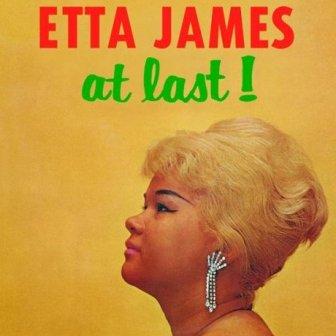
93. Etta James / At Last! (1961)
Labels:
1961,
argo,
blues,
chess,
chicago,
etta james,
mca,
pop,
rhythm and blues,
riley hampton,
soul,
vocal,
vocalist,
willie dixon
Thursday, April 25, 2013
92. Hank Mobley / A Slice of the Top (1966)
I just picked up this 1966 session by Hank Mobley and it's an odd one. Mobley is featured in the midst of several other interesting young players: McCoy Tyner does piano, Reggie Workman on bass and Billy Higgins on drums -- a good rhythm section of highly individualistic voices, plus Lee Morgan, Kiane Zawadi, Howard Johnson, and James Spaulding. The record is odd for choice of instrumentation, containing euphonium and tuba in addition to tenor, flute, and alto sax. Arrangements by Duke Pearson try to give order to this motley bunch but I can't help feeling that that the whole thing is a little awkward. It's a quartet (or quintet), that looks to be struggling to accommodate the extra pieces in a way that is relevant. At times the octet plods along like two people walking in the same pair of pants, instead of swinging in a tight but dangerously crowded arrangement, as demonstrated by similarly orchestrated groups of Charles Mingus or Thelonious Monk. I'll have to keep listening and I get the keen feeling that this one will grow on me. Look out!
Labels:
1966,
a slice of the top,
alto saxophone,
billy higgins,
blue note,
duke pearson,
euphonium,
hank mobley,
howard johnson,
james spaulding,
kiane zawadi,
lee morgan,
mccoy tyner,
octet,
reggie workman,
tenor sax,
tuba
Wednesday, April 24, 2013
91. Duke Ellington & His Orchestra / Never No Lament: The Blanton-Webster Band (2003)
This superb 3-disc set from Bluebird compiles all the master takes from 1940-42, plus a handful of juicy alternate takes. These sides are for the Duke catalog what the Complete Decca Recordings are for Basie. The comparisons should generally end there, but I just want to convey how important they are not only to the group, but to the notion of jazz itself. And finally, justice was done to this historic music in terms of packaging and audio quality (I say finally, but we've had this set for 10 years now), a clear improvement over previous digital offerings. If you already own RCA's Complete Duke Ellington set and you're only a casual listener, then there isn't much to entice you into repurchasing. But if you lean the way of the completist, or you're more serious about your collection, then you really need to have this on your shelf. It's many people's favorite Duke orchestra, and in hindsight the stand looks like a murderer's row of jazz legends. Of course you get Ben Webster and Jimmy Blanton, but there's also Cootie and Cat Anderson, Sonny Greer, Juan Tizol, Ray Nance, Rex Stewart.... the list goes on and on, without even getting into the vocalists. I'm not going to bother talking about individual tracks because we all have our favorites, and there isn't a lemon in the bunch. Above all, this music proves that eloquence is truly timeless.
Tuesday, April 23, 2013
90. Frank Morgan and George Cables / Double image (1986)
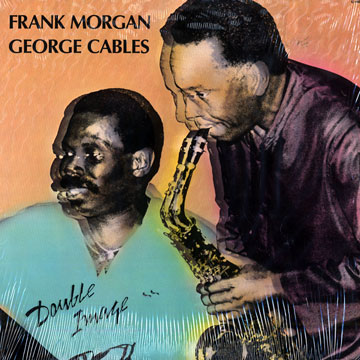
Another nice disc in Frank Morgan's comeback, and definitely something for the shelf. These two musicians are quite a pair. If a trio is less complicated and gives the leader greater clarity and flexibility than a quartet, then a duo takes that rationale to the next level. This album is aptly titled and features Morgan and Cables almost as sympathetic col-leaders. I'd love to hear Morgan's memories of the session. His alto is characteristically expressive. Together with Cables at the piano, they work through an interesting set list. I say it's interesting because there's only two chestnuts: "All the Things You Are" and "After You've Gone," which are quite good. The rest of the record is mixed of more recent stuff and a few originals. On the first side they do a really nice interpretation of Wayne Shorter's "Virgo" (sound the bias alarm, that's one of my favorite tunes) and "Blues for Rosalinda," which is a blues written by Morgan. Bop-inflected blues are his forte, complete with lightning-fast flurries of Birdlike chromaticity. In this regard, I am struck by how similar Morgan and Cables can be. Their choruses are saturated with the mood and use dynamics wisely, before flying up the registers in deftly fingered runs of dazzling acuity. The record closes with a meditative version of Miles' "Blue in Green," but not before Cables has a serious workout in his tune, "I Told You So," which you have to hear to appreciate. Seriously! It might be out of print, but if you can find a copy, buy it now.
Monday, April 22, 2013
89. Charles Mingus / East Coasting (1957)
Happy Birthday, Charles Mingus! He'd would have been 91 today. I like East Coasting a lot, and always have. Maybe it's the title, but the longer I remain in exile west of the Mississippi, the more I am drawn to this record. The lineup is one of my very favorite Mingus groups, probably because of Shafi Hadi on alto and tenor, but it's complemented by Bill Evans. Proceedings start with a beautifully longing take of "Memories of You," which crackles through some unexpected turns as the soloists lend their voices. That's a good rule for the whole record, which is always surprising me. No matter how many times I hear it, I hear something new. Tonight, for instance, I'm really into that bass solo in "West Coast Ghost," and the brief but alarming resurgence of the ensemble when Mingus finishes, before they take it out on a lamb. Mingus was always concerned with harnessing group chemistry and giving his musicians plenty of freedom to interpret changes, and this album is an outstanding exemplar of that magic. It might lack the gravitas of other dates, but who cares. I need to hear "Celia" one more time....
Sunday, April 21, 2013
88. Various Artists / Ultra Lounge Sampler (1996)
Without buying every disc in the Ultra Lounge series, you can have a nice cross-section of what the series offers in the slick Ultra Lounge Sampler. The CD came clad in gaudy leopard print fuzzy fabric that will inspire the animal in you at the next cocktail party or late night rendezvous. Each disc in the series focuses on a specific sub-genre of exotica, like Space Age, Tiki, Mambo, etc., and this collection dips its toes into each. I can dig the variety, and good sequencing makes a nice ride. It starts off with a real bang, or rather a real hoot and a chirp, with the archetypal "Mondo Exotica" by Martin Denny. Following are the wild vocal contortions of Yma Sumac, and then it's straight to Cape Canaveral with "Glow Worm Cha-Cha-Cha." The Rhapsodesia section is a nice touch, putting Julie London's syrupy "Go Slow" (don't miss "Teach Me Tiger" either!) right after two swingin' tunes by Louis Prima and Bobby Darin. There's a lot of pop nostalgia here, and it's all handled by the best studio orchestras in the business.
Labels:
1996,
april stevens,
bobby darin,
compilation,
directsource,
exotica,
jackie davis,
jazz,
julie london,
louis prima,
lounge,
martin denny,
review,
ultra lounge sampler,
vocal,
vocalist,
yma sumac
Saturday, April 20, 2013
87. Bobby Hutcherson / Dialogue (1965)
On Hutcherson's debut as leader, the members of his sextet make as much of an impact as he does. It's a lineup packed with powerful young players of the new jazz, many of whom are noted as leaders in their own right. But they create consistency that rejects the lie that too many cooks will spoil the soup. All compositions are by Andrew Hill, except "Idle While" and "Dialogue," by Joe Chambers. It's a good set, and the material is quite diverse. Like the mambo of "Catta" or free spirit displayed in "Le Noirs Marchant," all are enhanced by the group's diverse musical personalities. Hutcherson and Rivers, for example, play licks that are rhythmically jarring and colored by dissonance. But they're remarkably lyrical soloists, and the places they find musicality can be revelatory. Rivers also brings bass clarinet, flute, and soprano sax along with his tenor, so textures are always changing. The young Freddie Hubbard is also on the record, and his clarion trumpet is heard plainly above the ensemble, an ascendant talent whose first date as leader was just a few months off.
Friday, April 19, 2013
86. The Oscar Peterson Trio / Night Train (1962)
Probably the most well known of all Oscar Peterson dates, thanks to the archetypal deep swing of the title track. I read that Peterson's father was a railroad porter, and the composition and album are a tribute to him. The leader invests a lot of emotion in these quiet but swinging selections. There's a lot of good material on this record -- "C-Jam Blues," "Georgia on my Mind," "Moten Swing," "Honey Dripper," and "Night Train" are all bona fide classics. Peterson is comparatively quiet behind the keys, humming less and seemingly content while employing bouts of delicious slides and twinkling arpeggios to get his point across. He uses the dynamics of the keyboard very effectively to underscore the emotional impact of each piece. And remember those other two -- Ray Brown and Ed Thigpen -- ain't no slouches, either. I think Ray's about as bluesy as Oscar. Four stars, and a good album for a date.
Thursday, April 18, 2013
85. Lester Young / The Jazz Giants (1956)
The Green-Ramey-Jones factor is in effect here, as Lester blows for the first time alongside the exquisite Roy Eldridge and Vic Dickenson. Teddy Wilson provides piano, his first date with Prez in a decade, and the whole thing really swings. The chemistry is great and it's a good listen. Knowing who is on the session, I love hearing one chorus while waiting for the next guy. Lester does some fireworks (try "Gigantic Blues," also note Eldridge, Wilson and Jones) but he sounds profoundly blue throughout the others. I never bought the description of Prez as lean or
altoesque, or however that's said. He's got a big, sonorous tone
that portrays (and occasionally betrays) every nuance of the piece. These are mostly ballads so it suits this album especially well. In the arrangements, Lester usually goes first followed by Dickenson or Eldridge. When they get to the end, the whole band takes it out. It reminds me of a big band arrangement, and harnesses the septet's additional weight to good effect.
Wednesday, April 17, 2013
84. Modern Jazz Quartet / Concorde (1955)
I vividly remember the day I bought this LP. It was among the first jazz records I ever purchased, and I found it sitting at a yard sale in the next neighborhood. I must have been about 15 years old. In a box filled mostly with movie soundtracks, I found Concorde along with MJQ's Fontessa and Black Sabbath's Live at Last. I bought all three for fifty cents apiece, and went home happy. I didn't know much about jazz back then, but after studying the back cover intently, I made the right choice. This album is classic MJQ and also features the debut of Connie Kay. The Gershwin medley is the centerpiece, paired with an innovative take of "Softly as in a Morning Sunrise" on the second side. But there are surprises everywhere, as with the quiet beauty of "All of You" or lively conversation between Jackson and Lewis on "I'll Remember April." Milt Jackson is a hero pretty much everywhere (can you tell I like him?), at once bluesy and virtuosic. There's strong musicality in each of the tracks blowing sections, and it's hard to tell that Kay hasn't been playing with the other three members all along.
Labels:
1955,
bass,
concorde,
connie kay,
drums,
jazz,
john lewis,
milt jackson,
mjq,
modern jazz quartet,
percy heath,
piano,
prestige,
quartet,
review,
vibes,
vibraphone
Tuesday, April 16, 2013
83. Benny Golson / Gone with Golson (1959)
Rooted in Don Byas, et al., Golson takes at least one conservatively melodic chorus before stepping out a little farther. He's a very melodic player overall, but by the end of his turn, he's rushing ahead like a steam locomotive of emotional force. His arrangements and compositions are superb. In those furious bursts of energy it's easy to see his influence on Coltrane, but the leader's skills as composer also attracted Trane. Like the peculiar resolutions in "Soul Me" which work within, rather than toward, the gospel mode to ply such an intriguing charm. As for sidemen, Curtis Fuller is indispensable, transcending the slide and keenly harnessing the dynamic capabilities of his horn to make sympatico statements after Golson (try "Autumn Leaves). Brothers Ray and Tommy Bryant are an important unit whether it's comping, impeccable timekeeping, or taking their own choruses. So is Al Harewood felt, together about as solid a rhythm section as you could ask for. There's no Art Farmer in sight, but this isn't a Jazztet date and it's nice to watch Golson fly on his own, as it usually is.
Subscribe to:
Posts (Atom)


